

How to Reduce Test Anxiety Practical Strategies That Work
Tackling test anxiety is all about a smart combination of solid preparation, a healthier mindset, and a few key techniques to calm your body down when the pressure hits. The goal is to address both the physical and mental symptoms before, during, and after a test. By building real confidence through good study habits and learning to manage your nervous system, you can turn that frantic, overwhelming feeling into focused energy.
Understanding Why Test Anxiety Happens and What It Feels Like

You know the feeling. Your heart starts pounding, your palms get sweaty, and your mind goes completely blank right as the exam is handed out. This is more than just "pre-test jitters." It's test anxiety, a form of performance anxiety where the intense pressure to do well becomes so overwhelming that it sabotages weeks of hard work.
At its core, test anxiety is your body's natural "fight or flight" response kicking into overdrive. When your brain flags an exam as a threat—maybe due to a fear of failure, pressure from parents, or a bad experience in the past—it floods your system with stress hormones.
The problem is, this response was designed to help you escape physical danger, not solve calculus problems.
The Real Impact of the Fight or Flight Response
When this stress response takes over, your body gets its priorities mixed up. Blood is rerouted from the parts of your brain in charge of complex thinking (like memory and problem-solving) and sent to your large muscle groups. Your body is literally getting ready to fight a predator or run for your life.
This is why simply telling yourself to "calm down" almost never works. You can't out-think a physiological reaction. To truly get a handle on test anxiety, you have to learn how to calm your nervous system first. Only then can your brain get back online and access all the information you've studied.
Often, this feeling of dread builds up for days or even weeks before the exam. This is known as anticipatory anxiety, and it's a huge part of the test-taking struggle.
Our core philosophy at Bright Heart Learning is Connection Before Content. We know that a student's nervous system has to be calm and regulated before they can truly engage with academic material and perform their best.
To help you recognize the signs in yourself or your student, we've put together a quick-reference table. Pinpointing these symptoms is the first step toward managing them.
Common Signs of Test Anxiety
| Symptom Category | Common Examples | How It Impacts Performance |
|---|---|---|
| Physical | Rapid heartbeat, sweating, shaking, nausea, shortness of breath, headache, tense muscles. | These physical distractions make it nearly impossible to sit still and focus on the test questions. |
| Cognitive | Mind going blank, racing thoughts, difficulty concentrating, negative self-talk, trouble recalling information. | This directly interferes with the ability to think clearly, organize thoughts, and retrieve stored knowledge. |
| Emotional | Feelings of dread, fear, helplessness, disappointment, frustration, or irritability. | These powerful emotions can create a cycle of panic, making cognitive symptoms even worse. |
Seeing these symptoms laid out makes it clear how deeply test anxiety can affect a student's ability to show what they know.
You Are Not Alone in This Struggle
If this all sounds painfully familiar, you're in the majority. Test anxiety impacts an incredible number of students. Some studies show that it affects anywhere from 52% to 85% of health sciences undergraduates.
For example, data shows that in the United States, 55% of nursing students experience test anxiety, while 53.04% of medical students in Saudi Arabia and 52% in Malaysia face the same challenges. This isn't a personal failing; it's a widespread issue.
Understanding that test anxiety is a common physiological and psychological response is the first step. Once you can recognize its triggers and symptoms, you can start using targeted strategies—from smarter study routines to in-the-moment calming exercises—to regain control and finally perform your best.
Build Confidence with Smarter Study Habits
The old advice to "just study more" doesn't just fall flat—it can actually make test anxiety worse. It suggests that sheer hours logged at a desk are the answer. But from my experience, real, lasting confidence doesn't come from the *quantity* of study time. It's all about the **quality of your preparation**.
When we shift the focus to smarter, more strategic study habits, we build a solid foundation of knowledge. This genuine mastery is what silences that nagging voice in your head whispering, "What if I don't know the answer?"
Deconstruct Overwhelming Subjects
The first move is to stop seeing a huge task like a "History Midterm" as a single, terrifying monster. This is where executive function skills become your superpower. You have to break it down into small, concrete, and manageable pieces.
So, instead of a vague to-do list item like "Study for History," a plan that actually builds confidence looks more like this:
-
Monday: Review and summarize notes from Chapters 1-2.
-
Tuesday: Create flashcards for key dates and figures from Chapters 1-2.
-
Wednesday: Take a practice quiz on Chapters 1-2 and figure out why you missed any questions.
-
Thursday: Repeat the process for Chapters 3-4.
This method, known as task decomposition, transforms a scary goal into a series of small, achievable wins. Every time you check something off the list, you build momentum and prove to yourself that you're making real progress.
Embrace Active Recall Over Passive Review
So many students spend hours just rereading their textbooks or notes. This is a passive approach that creates a false sense of familiarity but doesn't lead to true understanding. To really master the material and build unshakable confidence, you have to practice active recall.
Active recall means forcing your brain to retrieve information without peeking at the answer. Think of it like lifting weights for your brain—it builds stronger neural pathways and makes the information much easier to access when you're under pressure.
The goal isn't just to recognize the information when you see it; it's to be able to pull it from your memory on command. This is the skill you actually use during a test, and practicing it is the best preparation there is.
Create a Realistic Study Schedule
Cramming is the number one fuel for test anxiety. Spreading out your learning over time—a technique called spaced repetition—is far more effective and way less stressful.
Start by putting the exam date on a calendar and working backward. Plan short, focused study sessions of 30-50 minutes, followed by a quick break to recharge. This works with your brain's natural attention span, not against it. For a deeper look at creating these plans, check out our expert advice on essential study skills for middle school students—the strategies work for learners of all ages.
Let's walk through how a student could plan their week for a big biology exam, completely avoiding that last-minute panic.
Scenario: A Student's Anxiety-Reducing Study Plan
-
Sunday Evening: Plan the week. Break down the 5 chapters into 10 smaller topics. Assign two topics to each day, Monday through Friday.
-
Monday-Friday (45 min/day): Study one topic for 20 minutes using active recall (like flashcards or explaining it out loud). Take a 5-minute break. Study the second topic for 20 minutes.
-
Saturday Morning (1 hour): Take a full practice test covering all 10 topics. This mimics the real exam and shines a spotlight on any weak spots.
-
Sunday Afternoon: Review only the questions you missed on the practice test. Don't introduce any new material. The rest of the day is for resting and relaxing before the exam.
This structured approach eliminates the need for frantic, late-night cram sessions. The student walks into the exam not just hoping they remember the material, but knowing they can recall it because they've been practicing that exact skill all week long.
Sadly, the need for these proven techniques is more urgent than ever. The COVID-19 pandemic made test anxiety significantly worse, with average scores on one anxiety scale jumping from 6.3 to 8.0 in 2023. Before the pandemic, only 15% of students in one study showed significant test anxiety; that number skyrocketed to 34% post-pandemic. That’s nearly one in three students dealing with both physical and mental distress. By building strong executive function and study skills, you can push back against these trends and reclaim your confidence.
Practical Techniques to Calm Your Nerves in Minutes

Your heart is pounding. Your thoughts are racing. The exam is sitting right in front of you. This is when you need tools that work now. Smart study habits are great for building long-term confidence, but in a moment of pure panic, you have to deal with your body's physical response first.
What you're feeling is your nervous system's "fight or flight" mode kicking into high gear. Your brain has flagged the test as a threat, pulling resources away from the calm, logical thinking you need to access what you've learned. The trick is to send a signal back to your brain that says, "We're safe. You can stand down."
These science-backed techniques do exactly that. They help you regulate your nervous system on the spot and bring your focus back to the here and now.
Slow Your Heart Rate with Box Breathing
One of the most powerful—and discreet—ways to dial down anxiety is by controlling your breath. Anxious breathing is shallow and fast. By intentionally slowing it down, you directly tell your heart rate to chill out and activate the part of your nervous system responsible for relaxation.
Box Breathing is a simple, four-step cycle you can do anywhere, even sitting at your desk mid-exam. No one will even notice.
-
Inhale Slowly: Silently breathe in through your nose for a count of four.
-
Hold Your Breath: Gently hold that breath for another count of four.
-
Exhale Slowly: Breathe out completely through your mouth for a count of four.
-
Hold Again: Hold your breath with empty lungs for a final count of four.
Repeat this cycle three to five times. The steady, predictable rhythm gives your racing brain a simple, calming task to focus on instead of the anxiety.
Anchor Yourself with the 5-4-3-2-1 Grounding Technique
When your thoughts start to spiral, grounding techniques are your lifeline. They pull you out of the chaotic "what ifs" in your head and plant you firmly back in your physical surroundings. The 5-4-3-2-1 method uses your senses to interrupt the panic cycle.
This is a fantastic tool for test anxiety because it forces you to stop worrying about the future and connect with the reality of the present moment.
The Goal of Grounding: Acknowledge your anxious thoughts without judgment, and then gently shift your focus to the tangible world around you. This simple act can stop a panic spiral in its tracks.
Here’s how to do it quietly at your desk:
-
5 Things You See: Look around and mentally name five objects. The clock on the wall, the texture of the desk, a scuff on your shoe, the pencil in your hand, the shape of the window.
-
4 Things You Feel: Bring your awareness to physical sensations. Your feet flat on the floor, the pressure of the chair against your back, the fabric of your shirt, the cool metal of your watch.
-
3 Things You Hear: Listen for three distinct sounds. The hum of the lights, a cough from across the room, the sound of your own quiet breathing.
-
2 Things You Smell: This one can be subtle, but give it a try. Maybe the smell of the paper, your soap, or the eraser on your pencil.
-
1 Thing You Taste: Focus on one taste. The lingering taste of your morning coffee, or even just the neutral taste inside your mouth.
This exercise works by giving the anxious part of your brain too much sensory information to process, leaving less room for worry. It's a powerful mental reset button.
For some students, the sense of touch is especially grounding. Tactile tools like the squeezable stress balls in our favorite tools collection can offer a quiet, physical outlet for all that nervous energy, helping you focus without disturbing anyone. Beyond these immediate fixes, it's worth exploring other effective relaxation and mindfulness techniques to find what works best for you.
The key is to practice these techniques when you're calm so they become second nature. That way, when anxiety hits during an exam, you’ll have a reliable toolkit ready to go, helping you get back in control and show what you really know.
Reframe Your Thoughts About Testing
The sweaty palms, the racing heart, the blank mind—we often think of test anxiety as a physical problem. But it doesn't start in your body. It starts in your mind.
Anxiety is fueled by the stories we tell ourselves. A negative, spiraling narrative about an upcoming exam can trigger our fight-or-flight response just as effectively as a real-world threat. The good news? You have the power to change that story.
Learning to manage your thoughts is one of the most durable skills you can build to beat test anxiety. It isn't about forced, unrealistic positivity. It's about catching the unhelpful thoughts, questioning them, and shifting your internal dialogue to a more balanced and realistic place.
Catching and Challenging Negative Thoughts
The first step is simply to notice your automatic negative thoughts (ANTs). These are the reflexive, pessimistic thoughts that pop into your head when you think about a test, often without you even realizing it.
They sound like:
-
"I'm definitely going to fail."
-
"I'm just terrible at math."
-
"If I do poorly, my parents will be so disappointed."
Once you start hearing that voice, you can start questioning it. Don't just accept these thoughts as facts; treat them like hypotheses to be tested.
Ask yourself:
-
What's the evidence? Do I have real proof this thought is 100% true? What evidence do I have that it's not true?
-
Is there another way to look at this? Could there be a more balanced, less catastrophic perspective?
-
What would I tell a friend? If my best friend came to me with this exact same worry, what would I say to them?
This process disrupts the anxiety cycle. Instead of letting a negative thought spiral out of control, you're hitting the brakes and examining it with logic. That simple act robs it of its power.
A test score is a snapshot of your performance on one particular day. It is not, and never will be, a measurement of your intelligence or your worth as a person. Reminding yourself of this is a powerful way to take the pressure off.
The link between emotional regulation and academic success is incredibly strong. Research shows that these strategies can buffer the negative impact of test anxiety on grades, an issue that affects over 50% of medical students worldwide. Studies highlight that unchecked test anxiety often goes hand-in-hand with mood instability and low self-esteem, making these mental tools essential for success. You can explore further research on why these strategies are so important.
From Negative to Neutral Thinking
Let's be realistic: jumping from "I'm going to fail" to "I'm going to ace this!" often feels fake and can even backfire. The goal isn't toxic positivity. It's a shift from negative to neutral or realistic thinking.
This table gives you a simple framework to practice that shift. The next time you catch a negative thought, walk it through this process.
| From Negative to Neutral Thinking |
|---|
| A simple framework to help you identify, challenge, and replace the automatic negative thoughts that drive test anxiety. |
| Automatic Negative Thought | Evidence Against the Thought | Balanced Alternative Thought |
|---|---|---|
| "I'm going to forget everything as soon as I see the test." | I've studied for two weeks, completed practice problems, and was able to recall the information yesterday. | "I've prepared for this. I may feel nervous at first, but I have the knowledge and tools to handle the questions." |
| "If I don't get an A, I've failed." | An A is the goal, but a B would still be a good grade and reflect my effort. My overall grade isn't solely dependent on this one test. | "My goal is to do my best and show what I know. A good grade would be great, but my effort is what truly matters." |
| "Everyone else understands this better than I do." | I don't actually know what's in other people's heads. I've asked questions in class and have a solid grasp on most of the topics. | "I'll focus on my own preparation and my own test. Comparing myself to others isn't productive and just adds stress." |
Over time, this practice becomes more natural. You start to automatically short-circuit the negative spirals before they even get started.
Visualize a Successful Experience
Finally, you can use the power of visualization to create a mental blueprint for success. This is more than just wishful thinking; it's a focused mental rehearsal of the entire test-taking process going smoothly.
Find a quiet place, close your eyes, and walk yourself through the whole experience:
-
Imagine waking up feeling calm and prepared.
-
Picture yourself arriving at the test location early, feeling confident and settled.
-
Visualize receiving the test, taking a slow, deep breath, and reading the first question with clarity.
-
See yourself working through the exam, easily recalling what you studied and calmly tackling challenging problems.
-
Finally, imagine turning in your test with a sense of accomplishment, proud of the effort you put in.
By mentally rehearsing a positive outcome, you're training your brain to associate the test with competence and calm, not panic. This helps reframe that nervous energy from a threat into something manageable you can use to your advantage.
Design Your Own Exam Day Routine
The 24 hours before an exam are a big deal. This window of time can either build you up, making you feel confident and calm, or it can send your anxiety into a complete tailspin. By creating a predictable and powerful exam day routine, you can sidestep decision fatigue, save your mental energy for the test, and walk in feeling prepared and in control.
Think of it like an athlete's pre-game ritual. They don't leave things to chance on game day, and neither should you. A solid routine gets rid of that last-minute panic and sets the stage for you to do your best work.
Prepare Everything the Night Before
Your pre-exam routine really kicks off the evening before the test. The main goal here is to get everything organized so that your morning is as smooth and stress-free as it can possibly be. This simple act of preparation sends a powerful signal to your brain: you've got this.
Here’s a quick checklist to run through:
-
Gather Your Supplies: Pack your bag with everything you'll need. This means pens, pencils, erasers, a calculator (with fresh batteries!), your student ID, a watch, and anything else that's permitted.
-
Plan Your Outfit: Choose something comfortable and wear layers. Test rooms are notoriously unpredictable—they can be freezing or boiling—and being physically uncomfortable is a distraction you just don't need.
-
Confirm Logistics: Double-check the test location, the start time, and how you're getting there. Knowing exactly where to go and how you'll get there prevents a frantic, stressful morning rush. While our tutors are based in Poulsbo, WA, we help students everywhere get ready for these make-or-break moments.
The Myth of Last-Minute Cramming
That powerful urge to cram new information the night before an exam is a classic anxiety response. It might feel productive, but the research is clear: it’s one of the worst things you can do. At that point, your brain isn't really storing new long-term memories effectively; you're mostly just creating more mental clutter.
Instead of cramming, use that evening for a light review of key concepts you already feel good about. This reinforces your confidence without adding any new stress. Your number one goal the night before is to rest and relax, not to learn.
After a short review, close the books. Do something that calms your nervous system down. Maybe that's a warm bath, listening to some chill music, or just hanging out with family. Prioritizing rest over cramming ensures your brain is refreshed and ready to recall information—which is way more valuable than a few extra facts you frantically tried to memorize.
Fuel Your Brain for Success
What you eat on exam morning really, really matters. Your brain needs stable, sustained energy to perform at its peak. Steer clear of sugary cereals or pastries that give you a quick energy spike followed by a crash right when you need to be focused.
Instead, go for a balanced breakfast that includes:
-
Complex Carbohydrates: Think oatmeal, whole-wheat toast, or a bran muffin.
-
Lean Protein: Eggs, Greek yogurt, or a protein smoothie are great options.
-
Healthy Fats: Add some avocado, nuts, or seeds.
This combination provides a slow, steady release of energy, keeping your concentration levels stable all the way through the exam. And don't forget to drink water! Even mild dehydration can mess with your focus and make you feel more anxious.
The timeline below is a great visual for how to reframe those anxious thoughts, which is a key skill to practice as part of your exam day routine.
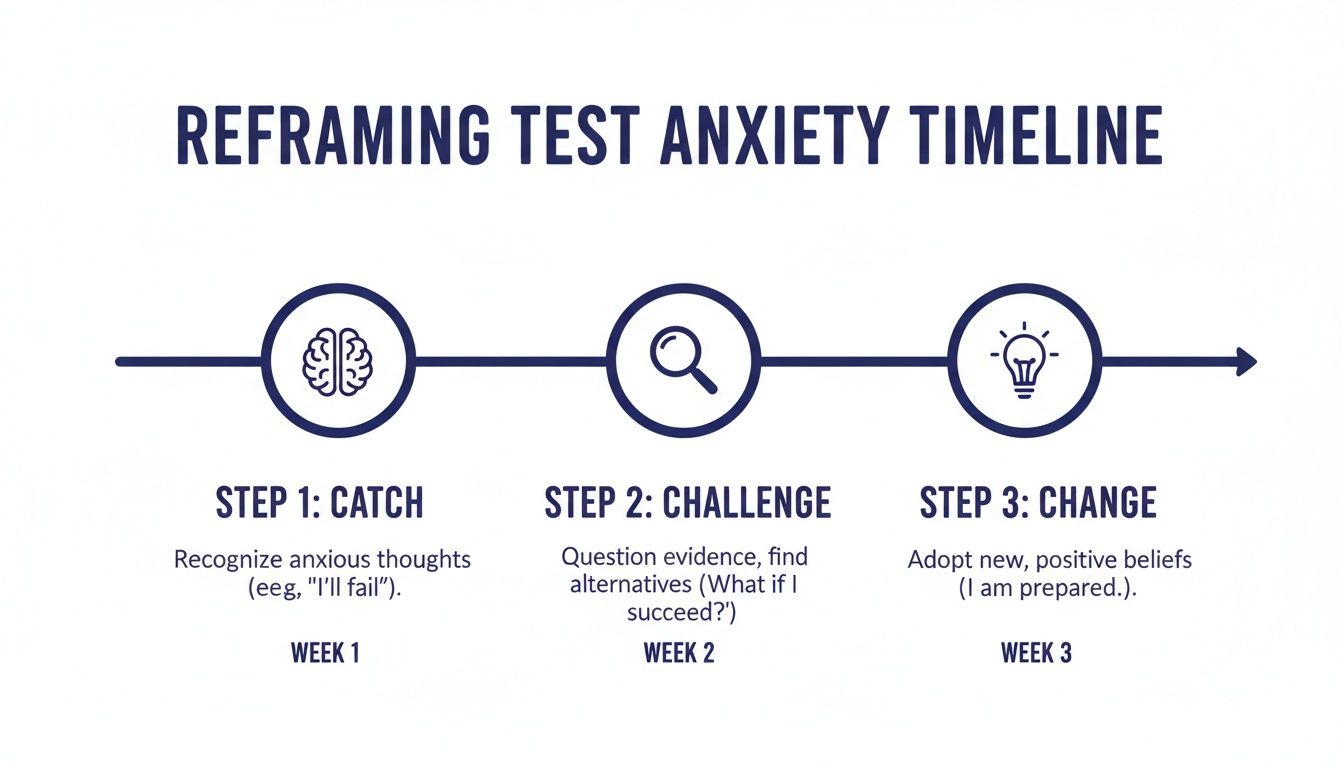
This shows that reframing anxiety is a process. It starts with just noticing the thought and then moves toward actively changing it—which is exactly what a good routine helps you do.
Arrive Early and Center Yourself
Plan to get to the testing location at least 15-20 minutes early. This buffer eliminates the stress of hitting traffic or getting lost and gives you a moment to get used to the environment. Use this extra time to find the restroom, grab a drink of water, and find your seat without feeling rushed.
Once you’re settled, take a few moments for yourself. This is not the time to flip through your notes or talk to other students who are also stressed out. Instead, close your eyes and practice that Box Breathing technique we talked about. A few minutes of slow, controlled breathing can do wonders for a racing heart and help you focus your mind right before the test begins. It's a simple, final step in your routine that makes sure you start from a place of calm.
When You Need More Than Self-Help Strategies
Sometimes, even the best strategies aren't quite enough to quiet significant test anxiety. And that's completely okay. Recognizing when to bring in more support isn't a sign of failure—it’s a smart, courageous step toward finding what truly works.
If you or your student has diligently tried the techniques in this guide but still feel stuck in a cycle of overwhelm, it might be time to add a new layer to the support system. The goal is to build a team that can help from all angles—academically, emotionally, and strategically.
Recognizing the Signs for Professional Help
So, how do you know when it’s time to reach out? While some pre-test jitters are normal, certain signs indicate the anxiety has become severe enough to disrupt daily life. It’s important to be honest with yourself and watch for these patterns.
Look for these specific indicators:
-
Persistent Avoidance: The student consistently dodges studying, skips class on test days, or shuts down any conversation about exams.
-
Severe Physical Symptoms: The anxiety shows up as frequent panic attacks, debilitating headaches, or ongoing digestive issues.
-
Significant Grade Drops: Test scores are consistently and dramatically lower than homework grades, even when they know the material.
-
Changes in Mood or Behavior: The anxiety spills over, causing persistent irritability, social withdrawal, or feelings of hopelessness.
If these signs feel familiar, it’s a strong signal that professional support from a school counselor or a licensed therapist is the next logical step. These professionals are trained to provide evidence-based strategies, like cognitive behavioral therapy (CBT), which can be incredibly effective.
Seeking Academic Accommodations
For many students with diagnosed test anxiety, academic accommodations can be a total game-changer. These aren't a "crutch." They're a way to level the playing field, allowing a student to show what they know without being unfairly penalized by their anxiety.
Accommodations are about creating access. They remove the barriers that anxiety puts in place, giving a student a fair shot to show what they have truly learned.
The most common and helpful accommodation for test anxiety is extended time. Just knowing that extra buffer exists can dramatically reduce the frantic, time-based pressure that fuels the fight-or-flight response.
Getting accommodations in place usually starts with a conversation. Here’s where to begin:
-
Start with the School Counselor: They can explain the school's specific process and what kind of documentation you might need.
-
Gather Documentation: This often involves a formal diagnosis from a doctor or therapist. Clear documentation is the key to getting the right support.
-
Formalize the Request: You will likely need to submit a formal request to the school's support services team to create a 504 Plan or an IEP.
The Power of Personalized Academic Coaching
While therapy addresses the clinical side of anxiety and accommodations provide logistical support, there’s often a crucial piece missing: the need for personalized, in-the-moment strategies that blend academic skills with emotional regulation.
This is exactly where specialized academic coaching comes in.
Our entire approach at Bright Heart Learning is built on a "Connection Before Content" philosophy. We know that a stressed-out brain can't learn. Our one-on-one coaches don't just reteach chemistry formulas; they help students build the executive function and nervous-system-aware skills needed to walk into a test with confidence.
For parents wondering how to best create this environment at home, our guide on how to support stressed-out students offers practical, actionable advice.
A great coach provides what a classroom teacher or even a therapist often cannot: a highly personalized game plan that weaves study skills, calming techniques, and mindset shifts right into the learning process. By combining these different avenues of support, you create a powerful strategy that empowers a student to turn their anxiety into genuine, lasting confidence.
At Bright Heart Learning, we specialize in helping students overcome the exact challenges discussed in this guide. Our tutors and academic coaches provide personalized, one-on-one support that goes beyond academics to build confidence, reduce anxiety, and foster a true love of learning. If you’re ready to see your student thrive, schedule a free consultation with us today.