

How to Focus Better When Studying: A Neuro-Smart Guide
If you’ve ever sat down to study, only to find yourself rereading the same sentence ten times, you’re not alone. The feeling is beyond frustrating. But that struggle to concentrate isn’t a personal failing—it’s a signal that your brain and body need support.
Learning how to focus better when studying starts with understanding why your attention wanders in the first place. The real reasons usually have deep roots in your nervous system, your environment, and your brain's core operating system: your executive functions.
The Science Behind Why You Can't Focus

Think of your brain as a high-performance computer. If too many apps are running in the background—anxiety about a test, the constant buzz of your phone, or just plain exhaustion—the main program you want to run (studying!) will lag or even crash.
This is exactly why our core philosophy at Bright Heart Learning is Connection Before Content. A calm, regulated mind isn't a "nice-to-have"; it's the essential foundation for any real, deep learning to happen.
Identifying Your Biggest Focus Blockers
Before you can build better study habits, you need to know what’s standing in your way. Focus challenges almost always stem from three core areas. As you read through these, see which ones feel most familiar to you.
Physiological Blockers: These are all about your body. Think poor sleep, not drinking enough water, an unbalanced diet, or sitting still for too long. A tired or under-fueled brain simply cannot sustain attention. It doesn't have the resources.
Environmental Blockers: Your study space has a massive impact on your ability to concentrate. The usual suspects? A cluttered desk, bad lighting, an uncomfortable chair, and the most powerful blocker of all: digital distractions from your phone and computer.
Emotional Blockers: This is your internal world. Stress, anxiety, or just feeling completely overwhelmed can hijack your ability to focus. When your nervous system is stuck in a "fight-or-flight" response, your brain prioritizes scanning for threats, not memorizing historical dates.
Your brain cannot learn effectively when it's stressed. The very first step to better focus is creating a sense of safety and calm, both inside and out. This principle is fundamental for managing attention, especially for students navigating ADHD or anxiety.
The Role of Executive Functions
Underpinning all of this are your executive functions—a set of mental skills that include working memory, flexible thinking, and self-control. Managed by your brain's frontal lobe, these skills are what allow you to plan, organize, and actually get things done.
When you struggle to focus, it’s often a sign that these cognitive resources are stretched thin. You can learn more about how these skills develop over time in our guide on executive function skills by age.
Building better focus, then, isn't about brute force or "trying harder." It's about creating the right conditions to support these crucial brain functions. This idea is gaining traction everywhere. For instance, the 2025 Gallup Voices of Gen Z survey found that 78% of high schoolers feel a teacher excites them about the future. That’s a significant jump from 70%. This surge in engagement—driven by relational trust—is directly linked to better focus and learning.
Once you understand these brain-based reasons, you can finally move from frustration to action.
If you're feeling overwhelmed and just need a place to start, this table breaks down some of the most common focus challenges and gives you a concrete action you can take right now.
Quick-Start Focus Strategies You Can Use Today
| Challenge | Immediate Action | Why It Works |
|---|---|---|
| Feeling restless and fidgety | Do 10 wall push-ups or 20 jumping jacks. | It provides sensory input (proprioception) that helps regulate a scattered nervous system, making it easier to settle down. |
| Mind keeps wandering to your phone | Put your phone in another room, completely out of sight. | It removes the visual cue and the temptation, reducing the cognitive load of constantly resisting the urge to check it. |
| Overwhelmed by a large project | Write down the very first, smallest possible step. (e.g., "Open the document" or "Read the first paragraph.") | This breaks the cycle of avoidance and creates momentum. Accomplishing a tiny task releases a bit of dopamine, making the next step feel easier. |
| Rereading the same page over and over | Set a timer for 15 minutes and commit to focusing only for that short block. | A short, defined period feels manageable and less intimidating than an open-ended study session, making it easier to start. |
Sometimes the smallest, most immediate actions can make the biggest difference in getting your brain back online and ready to learn. By understanding what's blocking you, you can choose the right strategy to get back on track.
How to Design Your Ideal Study Sanctuary
Your ability to focus is tangled up in your surroundings. When your study space is a mess, your brain has to work overtime just to tune out the chaos. That leaves a lot less mental energy for actually learning. Designing a study sanctuary is about intentionally creating a physical and digital environment that sends a clear signal to your brain: "It's time to concentrate."
Think of it like setting the stage for a performance. You can't expect an actor to deliver a powerful monologue with stagehands running around in the background. In the same way, you can’t expect top-tier mental performance when your brain is constantly being pulled in different directions by clutter, noise, and digital pings.
This is about more than just tidying up your desk. It’s about reducing cognitive load. Every single item in your line of sight and every notification on your screen is a tiny decision your brain has to process—either engage with it or ignore it. By cutting down on these micro-decisions, you free up a massive amount of mental bandwidth.
Taming Your Digital Distractions
Let's be honest: your digital world is probably the biggest focus-killer. Even having a smartphone nearby can splinter your attention, a fact that’s been proven time and again.
A 2023 Global Education Monitoring Report from UNESCO, drawing data from 14 countries, showed that simply having a mobile device nearby significantly tanks learning. Yet, fewer than 25% of schools have policies banning them. This data just confirms what we see with our students every day; getting your digital world in order is non-negotiable for better focus. You can learn more about these findings on tech's impact on education from UNESCO's report.
To get back in the driver's seat, you have to build some intentional walls between you and your devices.
The Out of Sight Rule: The simplest trick is usually the most powerful. Put your phone in another room. Not just on silent or flipped over, but physically gone. This removes both the visual temptation and the "I'll just check one thing" impulse.
Use App Blockers Strategically: Install an app blocker like Freedom or Cold Turkey Blocker on your computer and phone. Don’t just turn it on randomly; schedule recurring block sessions that line up with your study blocks. Automate it so willpower isn't part of the equation.
Curate Your Digital Workspace: Before you start, close every single unrelated tab and program. A clean desktop with only the necessary documents open creates a clear, focused digital field, just like a clean physical desk.
Optimizing Your Physical Space for Deep Work
Once your digital world is quiet, it’s time to look at your physical surroundings. The goal is to create a space that feels both calming and energizing for your brain.
Start by decluttering. Clear everything off your desk that isn’t absolutely essential for the task at hand. That pile of old papers, the collection of random pens, and other junk are subtle visual distractions that constantly chip away at your focus.
Next, check your lighting. Dim, harsh, or flickering lights are a recipe for eye strain and fatigue, making it nearly impossible to study for long stretches. Natural daylight is king, so if you can, set up your desk near a window. If that’s not an option, get a good desk lamp with a neutral or cool-toned bulb to mimic daylight and keep your brain alert.
Harnessing Sound to Enhance Concentration
Total silence isn't always the answer. For a lot of learners, especially those in noisy dorms or busy households, the right kind of background sound can be a game-changer for blocking out distractions and sharpening focus.
Your auditory environment can either be a major distraction or one of your greatest focus aids. The key is to choose sounds that are consistent and non-engaging, allowing them to fade into the background while masking disruptive noises.
Here are a few options to play around with:
White, Pink, or Brown Noise: These sounds use a steady frequency to cover up jarring noises like a slamming door or a barking dog. Brown noise, in particular, has a lower, deeper rumble that many people find incredibly calming.
Instrumental Music: Playlists with classical music, lo-fi beats, or ambient electronic tracks can set a productive mood. The key is no lyrics. Words will compete for your brain's language-processing power, which is the last thing you want.
Nature Sounds: The gentle rhythm of rain, a flowing stream, or forest sounds can have a deeply calming effect on the nervous system, which helps prime your brain for learning.
Building your study sanctuary is an act of self-advocacy. By taking charge of your physical and digital environments, you're building a powerful foundation that makes focusing easier and learning feel less like a battle. We see this firsthand with the students we work with from our home base in Poulsbo, WA, and it's a skill that serves them long after the exams are over.
Mastering Time with Brain-Friendly Study Techniques
The real secret to focusing better when you study isn’t about forcing yourself to sit at a desk for hours on end. It’s about working with your brain's natural rhythms of attention and energy, not fighting against them.
Think about it: your brain wasn’t designed for an eight-hour marathon of deep concentration. It thrives on focused sprints followed by genuine rest. By using smart time management techniques, you can structure your effort into manageable, brain-friendly blocks, which helps you avoid the burnout that leads to rereading the same paragraph ten times.
The Pomodoro Technique: A Classic for a Reason
The most famous method for this is the Pomodoro Technique. Its beauty is in its simplicity. You work for a focused 25-minute interval, then take a strict 5-minute break. After four of these cycles, you take a longer break of 15-30 minutes.
This technique is incredibly effective for a few key reasons:
It beats procrastination. A 25-minute block feels small and totally doable, making it much easier to start a task you’ve been putting off.
It builds your focus muscle. Like lifting weights, you train your attention in short, intense bursts, gradually strengthening it over time.
It protects your energy. Those built-in breaks are non-negotiable. They give your brain a chance to reset and prevent the mental fatigue that kills productivity.
Adapting Study Cycles for Your Unique Brain
While the classic 25/5 Pomodoro cycle is a fantastic starting point, it's not a one-size-fits-all solution. The ideal study rhythm really depends on your unique nervous system and the task at hand.
For instance, a student prone to hyperfocus, which is common with ADHD, might find a 25-minute timer jarring and disruptive. For them, a longer cycle—say, 50 minutes of work followed by a 10-minute break—might be way more effective. It lets them ride that wave of deep concentration without being pulled out of it too soon.
On the flip side, a student dealing with high distractibility or anxiety may find even 25 minutes feels like an eternity. In this case, shorter "micro-bursts" of 15 minutes of focus followed by a 3-5 minute break can feel much more achievable and help build momentum without feeling so overwhelming.
The goal isn't to follow a rigid formula but to discover what rhythm allows you to achieve a state of relaxed alertness. Experiment with different work-to-rest ratios until you find the cadence that works for you. This is a core part of developing the self-awareness that great learners possess.
Sample Study Schedules in Action
So what does this look like in the real world? Here are a couple of sample schedules that put these principles into practice.
High Schooler SAT Prep (2-Hour Block)
Minutes 0-25: Focus on math problems.
Minutes 25-30: Break (walk around, get water, stretch).
Minutes 30-55: Review challenging vocabulary flashcards.
Minutes 55-60: Break (look out the window, close your eyes).
Minutes 60-85: Complete a reading comprehension section.
Minutes 85-90: Break (quick snack, listen to one song).
Minutes 90-115: Review incorrect math problems from the first block.
Minutes 115-130: Longer break! You've earned it.
College Student Juggling Two Classes (3-Hour Block)
Minutes 0-50: Deep work on a research paper for History 101.
Minutes 50-60: Break (step outside for some fresh air).
Minutes 60-110: Work through a problem set for Chemistry 205.
Minutes 110-120: Break (tidy up the desk, refill water).
Minutes 120-170: Return to the History paper to outline the next section.
Minutes 170-180: Final break before wrapping up.
Notice how both schedules group similar tasks together (task-batching) and alternate between different subjects to keep the brain engaged. Learning how to manage your own learning process is a critical skill. For a deeper dive, explore our guide on powerful metacognitive strategies for learning.
For those looking to truly master intense concentration, check out a complete guide to Deep Work, a methodology designed to maximize your focused output.
This flowchart can help you quickly figure out what's pulling your focus and how to handle it.
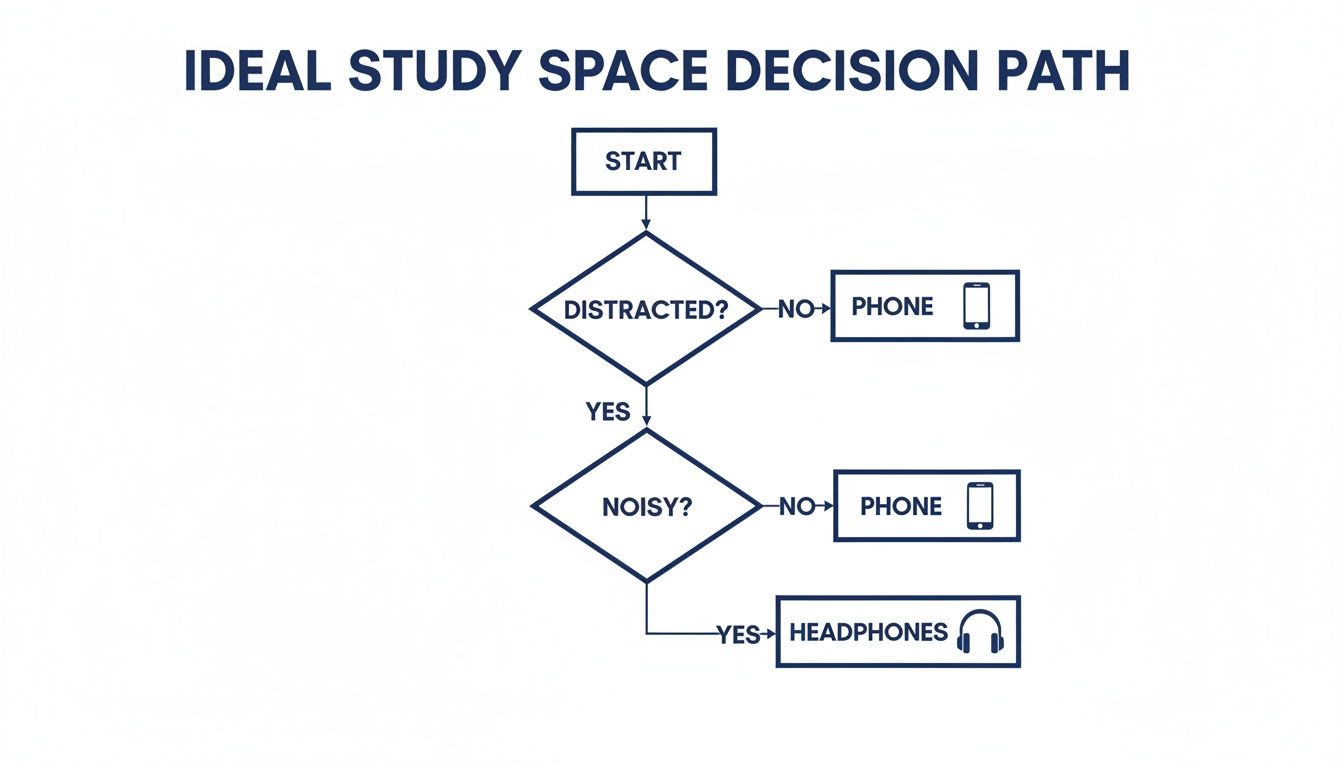
As the decision tree shows, whether your room is noisy or quiet, your phone is often the biggest distraction to manage. Structuring your time with these techniques is the best way to stay on task and build sustainable study habits that actually stick.
Tune Into Your Body to Sharpen Your Brain

Here's something most study guides miss: your ability to focus isn't just about willpower. It’s deeply, fundamentally connected to your physical state.
When your body is stressed out, exhausted, or running on empty, your brain flips into survival mode. Deep concentration becomes almost impossible because your system is busy handling perceived threats. So, learning how to focus better when studying often starts not with your textbooks, but with your body.
With a few simple, powerful routines, you can calm your nervous system and send a clear signal to your brain that it's safe to settle in and learn. Think of these pre-study rituals as a bridge, gently transitioning you from a state of distraction or anxiety into one of relaxed, ready alertness.
Calm Your Nervous System Before You Even Open a Book
Before diving into a marathon study session, just take five minutes to ground yourself. This small investment pays off with huge dividends in sustained attention later. It’s all about consciously downshifting your mental and physical gears.
One of the most effective techniques I've seen is box breathing. It’s incredibly simple: inhale for a count of four, hold for four, exhale for four, and hold again for four. Doing this just five times can significantly lower your heart rate and quiet a mind that’s racing with a million other thoughts.
Gentle movement is another game-changer. Sitting for hours makes you feel sluggish and dulls your focus. Try these quick stretches right at your desk:
Neck Rolls: Gently tilt your head from side to side, then in slow circles. You'll be amazed at how much tension you're holding in your neck and shoulders.
Seated Cat-Cow: Put your hands on your knees. As you inhale, arch your back and look up toward the ceiling. When you exhale, round your spine and drop your chin to your chest.
Torso Twists: Sit up tall and gently twist your upper body from one side to the other. You can use the back of your chair to get a slightly deeper stretch.
These tiny movements get blood flowing back to your brain and release the physical tension that almost always comes with mental stress. Creating a calm internal state is a non-negotiable, especially if you’re prone to feeling overwhelmed by academic pressure. For more on this, check out our guide on how to reduce test anxiety.
Fuel Your Brain for Peak Performance
Just like a car needs the right gas, your brain needs high-quality fuel and hydration to perform at its best. Dehydration is a notorious focus-killer. Even being slightly dehydrated can trigger fatigue, headaches, and a major drop in cognitive function.
Make it a habit to start every study session with a full glass of water. Keep a bottle on your desk as a visual reminder to keep sipping. And when it comes to snacks, please, skip the sugary junk that guarantees an energy crash. Instead, choose brain-boosting foods that provide steady, sustained energy.
Your brain is an energy hog, consuming about 20% of your body's total calories. Feeding it high-quality fuel—think nuts, berries, or dark chocolate—provides the steady glucose supply it needs for memory and concentration. Processed sugars just create disruptive energy spikes and slumps that kill your focus.
Here’s a quick look at what works and what doesn't:
| Brain-Boosting Choices | Focus-Draining Choices |
|---|---|
| Handful of almonds or walnuts | Bag of chips |
| Apple slices with peanut butter | Candy bar |
| Greek yogurt with berries | Sugary soda or energy drink |
| Hard-boiled egg | Cookies or pastries |
The Two Pillars You Can't Ignore: Sleep and Movement
Finally, let's talk about the two most critical (and most often neglected) foundations for sustained focus: sleep and regular movement. So many students wear sleep deprivation like a badge of honor, but it's really a serious cognitive handicap.
Your brain does its housekeeping while you sleep—consolidating memories and clearing out metabolic junk. Consistently getting 7-9 hours of quality sleep is probably the single most effective thing you can do to improve your ability to learn and remember information.
Likewise, regular physical activity is like hitting the reset button for your brain. You don't need to live at the gym; even a brisk 20-minute walk can boost blood flow, release feel-good endorphins, and sharpen your executive functions.
When you weave these body-mind routines into your life, you're not just fighting for focus in the moment. You're building a resilient foundation that makes focusing feel less like a struggle and more like your natural state.
Seeing What Works and Navigating the Rough Patches
Let’s be real: improving your focus isn't a one-and-done fix. It's a journey. What feels like a magic bullet one week might fall flat the next, especially when life—exams, stress, you name it—gets in the way. That’s why the final piece of this puzzle is learning how to see what’s working, spot the hurdles, and adjust your game plan.
This isn’t about chasing some mythical state of perfect concentration. It’s about becoming a detective of your own mind. You're gathering clues about what helps you lock in and what pulls you away. When you start noticing these patterns, you can make tiny, smart adjustments that add up to massive gains in focus and confidence.
Simple Ways to See Your Progress
You don't need fancy apps or complicated spreadsheets to track your focus. The whole point is to create a simple feedback loop that tells you what’s actually helping. A plain notebook or a notes app on your phone is perfect.
Try keeping a Focus Log for just one week. After each study block, take 60 seconds to jot down a few things:
The Session: How long did you aim for? (e.g., 25 minutes)
The Distractions: How many times did your mind wander? What was the culprit? (e.g., phone buzz, worrying about dinner, the dog barking)
The Vibe: On a scale of 1-5, how locked-in did you feel?
The Strategy: What did you try? (e.g., Pomodoro, phone in another room, lo-fi music)
After just a few days, patterns will jump out at you. You might discover you’re laser-focused in the morning but a mess after lunch. Or maybe that lo-fi playlist everyone raves about actually makes you less focused. This data isn't for grading yourself; it's for getting smarter about how you study.
The most effective learners aren't the ones with perfect focus—they're the ones who are most self-aware. Tracking isn't about judgment. It's about getting the intel you need to use your energy wisely.
This rhythm of tracking and adjusting is a cornerstone of effective learning. It actually mirrors the sophisticated methods used in huge educational studies. For instance, the TIMSS 2023 study, which involved over 650,000 students globally, used adaptive testing that changed question difficulty based on student answers to get a more accurate picture of their skills. Just as the test adapted to the student, we can adapt our strategies based on our own feedback. You can actually read the full TIMSS 2023 international results and see how this principle works on a massive scale.
A Practical Guide to Troubleshooting Your Focus
Even with the best plans, some days are just a slog. Focusing will feel like pushing a boulder uphill. That’s totally normal. The trick is to have a few go-to moves for when you get stuck, so you don't just throw in the towel.
Here are some of the most common focus hurdles I see and the strategies that actually work to get past them.
| Common Hurdle | What It Might Feel Like | A Strategy to Try |
|---|---|---|
| The "I'll Do It Later" Trap (Procrastination) | "I know I have to start. I just… can't. My brain feels stuck in mud." | The 5-Minute Rule. Tell yourself you only have to work on it for five minutes. Seriously. Set a timer. The hardest part is almost always just starting. More often than not, once the five minutes are up, you'll have enough momentum to keep going. |
| The "Brain Fried" Feeling (Burnout) | "I'm exhausted. I've been staring at this for hours, and nothing is sticking anymore." | Schedule a Real Break. This isn't a quick scroll on your phone. This is a scheduled, totally non-academic block of time. Go for a walk without your phone, call a friend, sketch something. True recovery is an active reset, not just a pause. |
| The "Where Do I Even Start?" Panic (Overwhelm) | "This project is a monster. I have no idea how to even begin. It's just too much." | Brain Dump & Smallest Step. Grab a piece of paper and write down every single task and thought related to the project. Don't organize it, just get it out. Then, find the absolute smallest, easiest first step. Your only goal is to do that one tiny thing. |
When you treat these roadblocks as problems to solve instead of personal failings, you build resilience. This cycle of trying, observing, and tweaking is how you develop the kind of durable, lifelong attention skills that serve you far beyond your next exam. It's exactly what we help students build every day in our specialized academic coaching programs.
Putting It All Together: Your Next Steps
You've just walked through a whole toolkit of strategies—everything from designing your study space to managing your time with brain-friendly routines. The real magic, though, happens when you move from reading about focus to actually putting these small, powerful habits into practice.
Lasting change isn’t about a massive, one-time effort. It's built from the small wins. It’s choosing to slide your phone into another room before you start. It’s taking a real, screen-free break when you feel your brain starting to fry. It's simply noticing what’s pulling your attention away, without judging yourself for it. Each one of those choices strengthens your focus muscle.
Your Actionable Focus Checklist
To get you started right now, here’s a quick recap of the most effective strategies we’ve covered. Don't try to tackle them all at once. That's a recipe for overwhelm. Just pick one or two that feel doable this week and build from there.
Design Your Sanctuary: Clear your desk of everything except the absolute essentials for the task at hand. The biggest move? Put your phone in another room or use a dedicated app blocker.
Work in Sprints: Grab a timer. Work in focused bursts—25-50 minutes is a great starting point—followed by a non-negotiable 5-10 minute break. This isn't wasted time; it's how your brain resets.
Prime Your Brain: Before you even open a book, take five deep, slow breaths. Do a couple of simple stretches. And always start with a full glass of water on your desk.
Track Your Progress: For just a few days, keep a simple log. Note when you felt most "in the zone" and what the biggest distractions were. This isn't for judgment; this data is your personal roadmap.
The most powerful thing you can do is shift from passively reading about focus to actively experimenting. True progress comes from doing, observing, and tweaking your approach to find what truly works for you.
When You Need More Support
If you’ve given these tips a real shot and still feel like you're spinning your wheels, that's not a sign of failure. It's a signal that you might benefit from a more personalized approach.
Sometimes, the biggest hurdles—like deep-seated procrastination patterns or overwhelming test anxiety—require a guide to help you build the specific skills needed to move past them.
To take your first steps towards a more focused academic life, you can explore more strategies to improve focus. And if you're ready for dedicated support, our specialized academic coaching programs are designed to do just that. We help students build durable executive function skills and create a plan that works with their brain, not against it.
Your Study Focus Questions, Answered
Over years of executive function coaching, we've heard just about every question in the book about focus. Here are a few of the most common ones, with answers straight from our experience.
How Long Should I Study At a Time?
Honestly, there’s no single magic number. But for most people, the sweet spot is somewhere between 25-50 minutes of focused work followed by a 5-10 minute break. The real goal here is to figure out what works for your brain.
If you have a neurodivergent brain, especially with ADHD, you might find that shorter, more intense bursts of 15-20 minutes are way more effective. The key is to stop before you feel fried. That way, you have enough mental energy left to dive back into the next session feeling refreshed, not drained.
What Apps Actually Work to Block Distractions?
The most effective apps are the ones that create a real, hard-to-ignore barrier between you and your biggest time-wasters. In a moment of weakness, you want something that won't let you give in easily.
We've seen a few stand out with our students:
Freedom: This is a powerhouse. It blocks distracting websites and apps across all your devices at once, so you can't just switch from your laptop to your phone.
Cold Turkey Blocker: True to its name, this one is famous for being incredibly difficult to bypass once you set a block.
Forest: This one takes a different approach by gamifying your focus. You grow a virtual tree while you stay off your phone—leave the app, and the tree dies. It's surprisingly motivating.
But don't overlook the simple tools you already have. Your phone's built-in ‘Focus’ or ‘Do Not Disturb’ modes can be powerful first steps in silencing the noise.
Can I Really Improve Focus If I Have ADHD Or Anxiety?
Yes, absolutely. But it’s not about "trying harder." For learners with ADHD or anxiety, improving focus is about working smarter with your brain, not against it. It's about using compassionate, brain-aware strategies that externalize motivation, manage your energy, and keep your nervous system calm.
Brute force doesn’t build focus—compassionate structure does. Real progress comes from using tools like body doubling (studying with a friend), taking strategic breaks to prevent burnout, and practicing mindfulness to regulate stress before it hijacks your attention.
This is where personalized academic coaching can make all the difference. Having someone in your corner provides tailored support, accountability, and the right strategies for your unique brain.
At Bright Heart Learning, this is exactly what we do. We specialize in creating personalized plans that help students build these skills from the ground up. If you're ready to turn that feeling of frustration into one of focus and confidence, check out our specialized academic coaching programs.
Related from Bright Heart Learning: Trouble focusing is frequently an executive function pattern. Read more on ADHD paralysis, executive dysfunction.