

Elementary Homeschool Programs: Find the Best Fit for Your Child
So, you’re thinking about homeschooling.
Welcome. Taking charge of your child’s education is a big decision, and it’s completely normal to feel a mix of excitement and “where do I even start?” You’re not alone. More and more families are choosing this path, looking for a better fit for their kids.
This guide is your roadmap. We’ll break down what elementary homeschool programs actually are, help you figure out what your child really needs to thrive, and walk you through the practical side of things. Our goal is to cut through the noise and give you the confidence to choose a program that feels right for your whole family.
It’s More Than a Trend—It’s a Movement
Homeschooling has grown like wildfire in the last few years. What used to be a tiny niche is now a mainstream choice for millions of families. At its heart, this shift is about parents wanting a more direct say in what their kids are learning, how they’re learning it, and what their daily life looks like.
The numbers are pretty staggering. By the 2024-2025 school year, homeschooling families made up between 5.2% and 5.4% of all K-12 students in the U.S. That’s somewhere between 3 and 4 million kids—nearly double what it was just five years ago. It’s a clear sign that something big is happening in education. You can dig deeper into these numbers with these recent homeschooling statistics.
Homeschooling isn’t just about doing school at the kitchen table. It’s a chance to build an education from the ground up that fits your child’s unique wiring—their strengths, their quirks, and their passions. It’s about making learning a truly personal experience.
Here’s what we’ll walk through together in this guide:
- Different Homeschooling Models: We’ll look at the core philosophies, from structured “school-in-a-box” options to more flexible, interest-led approaches.
- How to Actually Choose: You’ll get practical criteria for matching a program to your child, your family’s lifestyle, and your state’s rules.
- Creating a Real-Life Schedule: We’ll talk about building a daily rhythm that works for learning, play, and everything in between.
- Support for All Kinds of Learners: We’ll cover strategies for kids who need a little extra support to succeed.
Ready? Let’s start by demystifying the different types of programs out there.
Comparing Different Homeschooling Models and Philosophies
Choosing an elementary homeschool program can feel like walking into a massive library—so many options, where do you even start? The key is understanding that each “book,” or model, tells a different story about how children learn best. These aren’t just curriculum packages; they’re complete educational philosophies.
Instead of getting lost in jargon, think of these models as different styles of coaching. Some coaches have a strict playbook everyone follows, while others adapt their strategy to the players on the field. Your goal is to find the coaching style that best fits your child’s personality and your family’s goals.
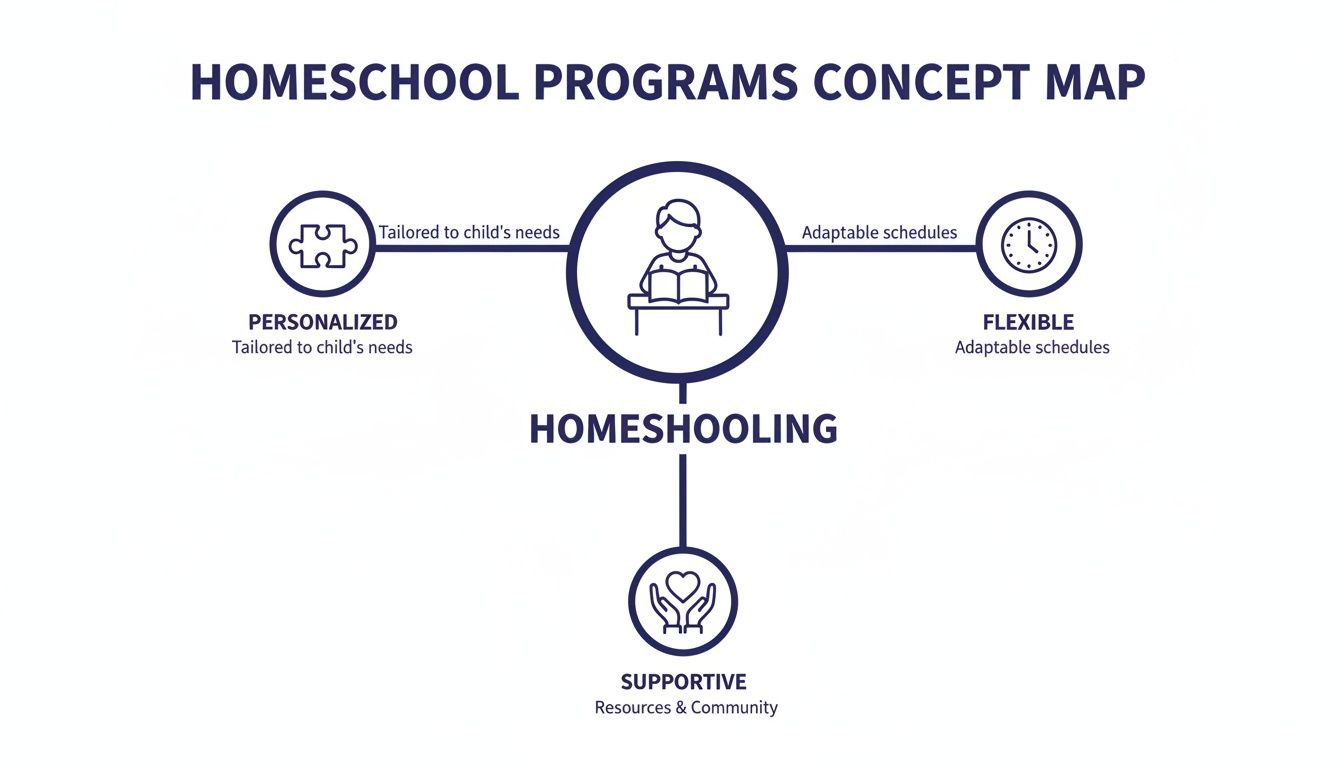
To help you get started, let’s break down some of the most common approaches you’ll encounter. Each has its own unique rhythm and focus.
Comparing Elementary Homeschooling Models
This table offers a quick snapshot of the most popular models. Think of it as a starting point to see which philosophies might resonate most with your family.
| Homeschool Model | Core Philosophy | Best For Learners Who… |
|---|---|---|
| Traditional (School-at-Home) | Replicates a conventional classroom with structured schedules, textbooks, and clear expectations. | Thrive on routine, benefit from clear structure, and are transitioning from public school. |
| Charlotte Mason | Education is an “atmosphere, a discipline, a life.” Uses living books, nature study, and short lessons. | Are curious, love stories, enjoy hands-on activities, and benefit from a gentler pace. |
| Montessori | Child-led, hands-on learning within a prepared environment. The parent acts as a guide, not a lecturer. | Are independent, self-motivated, and learn best by doing, touching, and exploring. |
| Classical | A rigorous, language-focused method that follows the three stages of the Trivium (Grammar, Logic, Rhetoric). | Are analytical, enjoy deep dives into history and language, and benefit from structured memorization. |
| Eclectic | A “mix and match” approach, pulling the best elements from various models to create a custom fit. | Have unique learning profiles or where parents want maximum flexibility and personalization. |
While this table gives you the headlines, let’s dive a little deeper into what each of these actually looks like in a real home.
The Traditional School-at-Home Approach
This is often the first model new homeschooling families consider because it’s the most familiar. The Traditional or School-at-Home model mirrors a typical classroom structure, using textbooks, workbooks, and a set schedule. It’s like bringing the public school experience right to your kitchen table.
This approach is highly structured, often coming as an all-in-one “boxed curriculum.” It provides a clear path with pre-planned lessons, which can be a huge relief for parents who want to make sure they’re covering all the required subjects. This model works beautifully for children who thrive with routine and clear expectations.
The Charlotte Mason Philosophy
Developed by British educator Charlotte Mason, this model is built on the beautiful idea that children are whole people who learn best from real-world experiences and high-quality literature. It’s a gentler, more soulful approach to education.
A Charlotte Mason day often includes:
- Living Books: Using narrative-driven books written by passionate authors instead of dry, fact-based textbooks.
- Nature Study: Spending significant time outdoors observing, sketching, and connecting with the natural world.
- Short Lessons: Keeping formal lessons brief (15-20 minutes for young children) to maintain focus and protect their natural curiosity.
This philosophy is an incredible fit for kids who are curious, love stories, and blossom with a less rigid academic schedule.
Montessori and Child-Led Learning
The Montessori method centers on child-led, hands-on learning. The parent acts as a guide, preparing an environment full of purposeful materials that invite the child to explore concepts independently. It’s far less about direct instruction and much more about fostering discovery.
The greatest sign of success for a teacher… is to be able to say, ‘The children are now working as if I did not exist.’ – Maria Montessori
This approach is ideal for independent, self-motivated learners who enjoy tactile activities and moving at their own pace. Freedom within limits is the core principle here.
The Classical and Eclectic Models
The Classical model is a rigorous, language-focused approach that follows a three-stage pattern called the Trivium (Grammar, Logic, and Rhetoric). In the elementary years, the focus is on the Grammar stage, emphasizing memorization of facts, rules, and stories as the building blocks for later learning. It’s a great fit for analytical kids who enjoy history, language, and structure.
Finally, we have the Eclectic model—the ultimate mix-and-match approach. Parents who follow this path don’t stick to a single philosophy. Instead, they pull the best resources from various models to create a truly customized education. A family might use a structured math curriculum but embrace a Charlotte Mason approach for literature and science. This has become the most popular style, as it offers maximum flexibility to build unique elementary homeschool programs that truly honor the individual child.
How to Choose a Program That Fits Your Family
Okay, you’ve explored the different philosophies and seen what’s out there. Now it’s time to move from theory to action. How do you actually pick one?
Let’s be clear: choosing the right program isn’t about finding a single “perfect” curriculum. It’s about finding the best fit for your unique family ecosystem. Think of it like choosing a plant for your garden—you have to consider your specific soil, sunlight, and climate to help it thrive.
This desire for a better fit is a huge reason families are leaving traditional schools. Research shows that parental dissatisfaction with the school environment and academic quality is a major driver. In Massachusetts, for example, public school enrollment dropped 4.2% while homeschooling surged 56% since 2019. Families aren’t just leaving something; they’re actively seeking something better. That search starts with an honest look at your own home. You can read more about the research behind this homeschooling growth right here.
Start With Your Child’s Learning Profile
Before you even glance at a curriculum catalog, stop and observe your child. How do they naturally take in information? What makes them light up and what makes them shut down? Understanding their learning profile is the single most important piece of this puzzle.
- Visual Learners: Do they remember what they see? These are the kids who love charts, colorful books, diagrams, and video lessons.
- Auditory Learners: Do they learn best by listening? They thrive with read-alouds, discussions, audiobooks, and catchy songs or rhymes to help things stick.
- Kinesthetic Learners: Do they need to move to learn? These hands-on kids need experiments, building blocks, active games, and plenty of movement breaks to stay engaged.
Most kids are a blend, but there’s usually one style that stands out. When you match a program to that dominant style, you prevent a world of frustration and make learning feel like a natural extension of who they are.
Evaluate Your Family’s Practical Realities
A beautifully designed curriculum is completely useless if it doesn’t work with the realities of your daily life. It’s time for a realistic check-in on your family’s resources—your time, your energy, and your budget.
Choosing a homeschool program is a three-way partnership between the curriculum, the child, and the parent. If any one of those elements is consistently strained or unsupported, the entire system struggles. The goal is sustainability, not perfection.
Ask yourself these honest questions:
- Parental Involvement: How much time can you realistically dedicate to direct, one-on-one teaching each day? Some programs are incredibly parent-intensive, requiring a lot of prep and active instruction. Others are designed for more independent work or have online components.
- Family Schedule: Do you have a predictable 9-to-3-style routine, or is your schedule more fluid? A rigid, traditional program might be a disaster for a family that travels often or has parents with unconventional work hours.
- Budget: Homeschooling costs can range from almost nothing to thousands of dollars a year. Setting a clear budget beforehand helps you narrow the options to what’s financially sustainable for the long haul.
- State Requirements: Finally, get crystal clear on your state’s homeschooling laws. Some states have specific subject requirements or mandate standardized testing, which will absolutely influence your curriculum choice.
By thinking through your child’s needs and your family’s capacity, you can find a program that sets everyone up for a successful and genuinely joyful year. And if you find you need to fill a few gaps, exploring options like tutoring for elementary subjects can provide that extra layer of support right where you need it.
Supporting Learners with ADHD and Executive Function Challenges
For so many families, the real magic of homeschooling is the freedom it offers to support a child with ADHD, anxiety, or executive function difficulties. Let’s be honest: a traditional classroom can feel like an impossible fit, a constant battle against how a child’s brain is naturally wired. At home, you get to change the rules.
You can design a day that builds your child up instead of wearing them down. This shifts your role from taskmaster to coach. The goal is no longer just to muscle through a lesson plan; it’s to create a space that feels safe for their nervous system. A place where they feel understood, capable, and ready to learn. In elementary homeschool, this often means focusing less on the curriculum and more on the conditions for learning.

Practical Strategies for a Supportive Environment
Creating this kind of supportive structure isn’t about throwing out your curriculum. It’s about weaving in small, powerful adjustments that make a world of difference for a child’s focus and emotional regulation.
Here are a few simple strategies that really work:
- Embrace Movement Breaks: Don’t fight the wiggles—use them! Weaving in short, frequent movement breaks is a game-changer. Think five minutes of jumping jacks, a quick race to the mailbox, or some big stretches. Movement hits the reset button on the brain, making it easier to focus on the next thing.
- Use Visual Schedules: So much anxiety comes from not knowing what’s next. A simple visual schedule, with either pictures or words, brings predictability to the day. It helps prevent meltdowns over transitions and gives kids a sense of control because they can see their day laid out.
- Break Down Big Tasks: An instruction like “finish your math worksheet” can feel completely overwhelming. Try breaking it down into tiny, achievable steps. “Let’s do the first three problems together,” and then, “Okay, now you try the next three.” This is a core piece of executive function support—it builds momentum and makes huge assignments feel doable.
The big idea here is to adapt the environment to the child, not force the child to adapt to a rigid environment. It’s about honoring their need for movement, predictability, and manageable steps. When you do that, you’re directly building their capacity for independent learning.
For kids facing specific hurdles like reading, there are so many thoughtful approaches. You might find some helpful strategies for supporting children with ADHD and reading difficulties to add to your toolbox.
Honoring Your Child’s Unique Wiring
Ultimately, supporting a child with ADHD or executive function challenges is about honoring their unique brain. It’s about seeing them for who they are and recognizing that their nervous system just works differently. They require different kinds of support to feel settled enough to learn.
This means prioritizing connection over content, always. When a child feels seen and supported, their brain is in a much better place to handle academic demands. You can get a clearer picture of what executive function support looks like in action to see how this comes to life.
By putting these nervous-system-aware strategies into practice, you can transform your homeschool from a place of struggle into a place where your child can truly shine.
Building a Balanced Homeschool Schedule You Can Actually Use
So, what does an elementary homeschool program actually look like on a Tuesday morning? Moving from big ideas about educational philosophies to a practical daily rhythm is where homeschooling becomes real.
The beauty of this path is that your schedule doesn’t have to mirror a traditional school’s bell system. Not even close.
Instead, you can design a flow that honors your child’s natural energy levels and your family’s unique needs. Many families find that short, focused bursts of academic work followed by ample time for play, creativity, and real-world learning is far more effective. A rigid, hour-by-hour plan often leads to burnout, while a flexible routine provides structure without the stress.
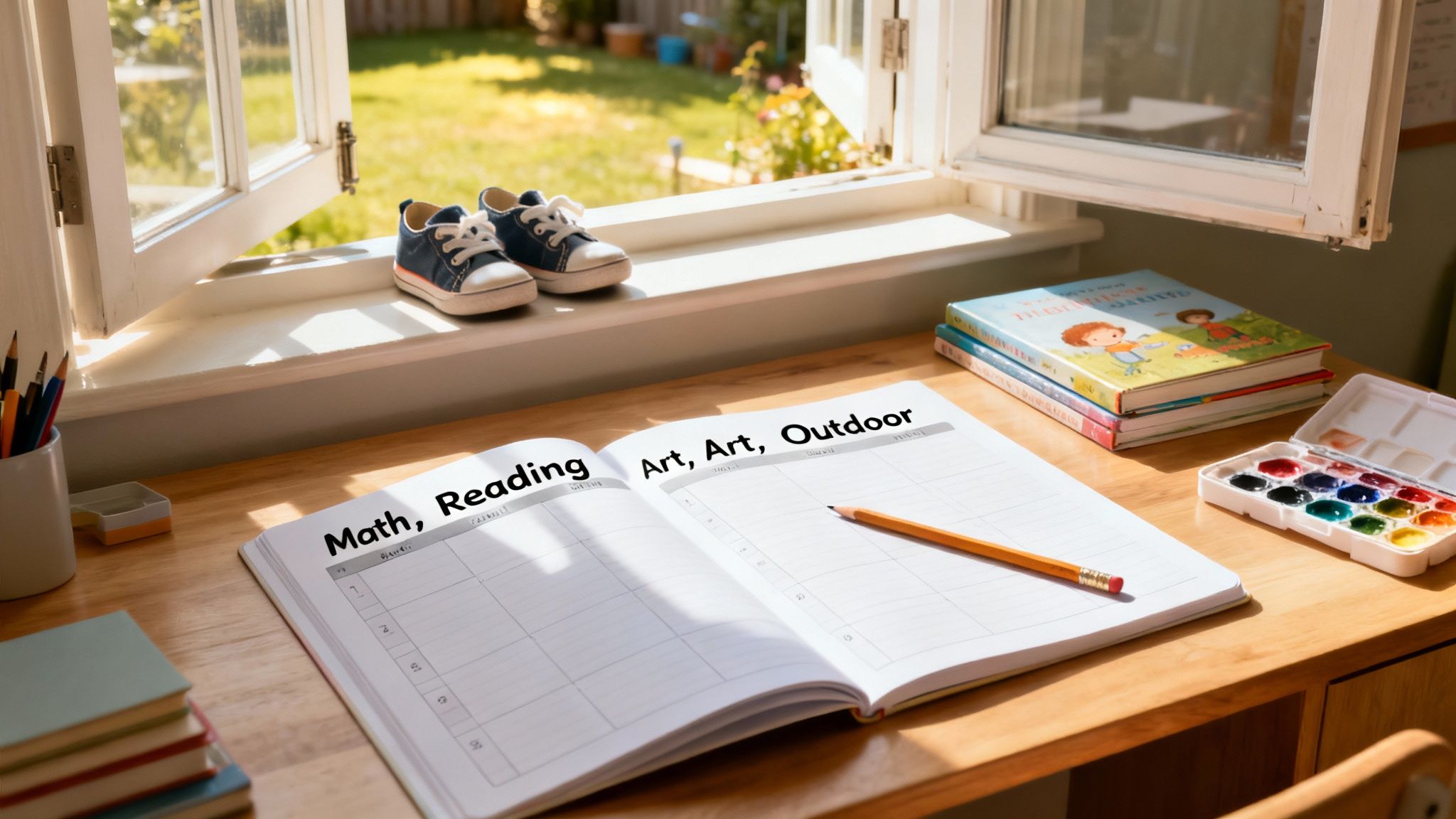
A Sample Weekly Homeschool Schedule
Think of this as a flexible blueprint, not a strict mandate. This sample for a second-grader balances core subjects with other essential activities, showing how you can fit everything in without spending all day at the table.
| Time Slot | Monday | Tuesday | Wednesday | Thursday | Friday |
|---|---|---|---|---|---|
| 9-9:30 AM | Morning Walk & Reading | Nature Journaling | Math Games | Morning Walk & Reading | Art Project |
| 9:30-10:15 AM | Math Lesson | Language Arts | Math Lesson | Language Arts | Catch-Up & Review |
| 10:15-11 AM | Free Play | Free Play | Library Trip | Free Play | Free Play |
| 11 AM-12 PM | History/Social Studies | Science Experiment | Music/Choir | History/Social Studies | Nature Co-op |
| Afternoon | Independent Reading | Chores & Life Skills | Field Trip | Art & Handicrafts | Outdoor Play |
Notice how this structure dedicates the morning to more intensive academic work? That leaves afternoons wide open for exploration, community activities, and practical life skills.
What Is a Scope and Sequence?
Another tool that demystifies planning is the scope and sequence. It sounds technical, but it’s simply a roadmap of what your child will learn (the scope) and in what order (the sequence) over the school year.
A scope and sequence provides peace of mind. It ensures you’re covering the necessary learning milestones for your child’s grade level without having to invent the entire educational path from scratch. It gives you structure, and structure provides freedom.
For example, a second-grade math scope might include:
- Quarter 1: Mastering addition and subtraction facts up to 20.
- Quarter 2: Introduction to two- and three-digit addition with carrying.
- Quarter 3: Introduction to basic multiplication and division concepts.
- Quarter 4: Telling time, counting money, and basic fractions.
Seeing the year laid out this way helps you track progress and adjust your pace as needed, ensuring a solid foundation is built step-by-step. For detailed guidance on structuring your homeschooling day, explore this ultimate homeschool daily schedule template guide.
We’re Here to Help You Build a Homeschool You Love
Figuring out the right elementary homeschool program can feel like a monumental task. I get it. The options are endless, the stakes feel high, and it’s easy to feel like you’re doing it all alone. But you don’t have to. At Bright Heart Learning, we partner with families to turn that overwhelm into confidence, moving beyond theory to offer real, practical support that actually works.
It all starts with getting to know your child—truly. We go way beyond just looking at academic gaps. Our first step is a deep dive into their unique learning profile to understand their strengths, their struggles, and what makes them light up. This isn’t just a formality; it’s the foundation for building a learning plan that’s as unique as they are.
From a Plan on Paper to Real Progress
Once we have that clear picture, we connect you with the right support, whether it’s one-on-one tutoring or specialized executive function coaching. Our entire approach is built on a simple but powerful philosophy: Connection Before Content. We take the time to build a genuine relationship with your child first, creating a safe space where they feel seen, heard, and understood.
This trust is what makes everything else possible. It allows our nervous-system-aware strategies to land, reducing the friction and anxiety that so often come with learning. We help students build durable skills that last a lifetime, long after the worksheet is done or the test is over.
We believe every child can thrive when they have the right tools and the right support. Think of us as your dedicated partner—the one who brings the structure, expertise, and encouragement your family needs to build a homeschool environment that is not just successful, but joyful.
This need for a more personalized path is growing. Around the world, homeschooling is on the rise at a rate of 2-8% annually, with big surges in countries like Japan, Mexico, and France. These numbers just confirm what so many families are feeling: a one-size-fits-all education isn’t working for everyone. You can read more about this global shift in education on eduww.net.
So whether you need targeted help in a single subject or comprehensive homeschooling support and advising, we’re here. Let’s work together to create an education where your child doesn’t just get by, but truly comes alive.
Let’s Talk About the Big Questions
Even when you’re excited about homeschooling, a few big questions can keep you up at night. That’s completely normal. Let’s tackle some of the most common worries parents have head-on.
But What About Socialization?
This is the number one question every homeschooling parent gets, usually from a well-meaning relative. The old myth of the lonely, isolated homeschooler is powerful, but it’s just not what we see in real life.
Think about it: true socialization isn’t about sitting quietly in a room with 25 kids who happen to be the same age. It’s about learning to connect with all kinds of people in real-world settings.
Homeschooling actually opens the door to more authentic social experiences, not fewer. Your child’s world can be full of:
- Homeschool Co-ops: These are fantastic hubs where families gather for group classes, shared projects, and fun field trips.
- Community Activities: Think sports teams, art classes, scouting troops, and library events where they’ll meet kids with shared interests.
- Park Days: Many homeschool communities have regular, informal meetups where kids play and parents connect. It’s the lifeline for so many families.
Often, the friendships formed in these environments are deeper and more diverse than what’s possible in a single-grade classroom.
Do I Need a Teaching Degree to Do This?
Nope. Absolutely not. Let’s get this one out of the way right now. You do not need a formal teaching background to be an incredible guide for your child.
Your real qualifications are far more important: you know your child better than anyone, and you are deeply invested in seeing them shine.
The best homeschool educators aren’t certified teachers; they’re dedicated parents willing to learn right alongside their kids. Your job is to spark curiosity, find great resources, and be their biggest cheerleader.
Modern elementary homeschool programs are designed for parents. They come with detailed teacher’s guides, online help, and even scripted lessons that tell you exactly what to say. Your connection and enthusiasm are worth so much more than a teaching certificate.
How Will I Know If They’re on Track?
Without a formal report card, how do you measure progress? The good news is, you’ll have a much more meaningful view of your child’s learning than a letter grade could ever provide.
You can see their progress every day. You’ll use tools like curriculum-based quizzes, create a portfolio of their best work (which is amazing to look back on!), or simply keep a running list of the new skills they’ve mastered.
Many states do have specific requirements, like an annual standardized test or a portfolio review with a certified teacher. These aren’t scary hurdles; they are helpful checkpoints that give you peace of mind and confirm that your child is learning and growing.
Feeling a bit more prepared? Having the right support changes everything. Bright Heart Learning offers personalized advising to help you navigate your homeschool journey, from choosing the perfect curriculum to figuring out a schedule that actually works. Visit us to see how we can help your family thrive.