

Mastering AP Statistics Tutoring: A Guide to Finding the Right Fit
AP Statistics tutoring is a partnership. It’s a dedicated, one-on-one academic relationship built to pull back the curtain on complex statistical concepts for high school students. This goes way beyond simple homework help. The real goal is to build a deep, intuitive understanding of topics like probability, inference, and data analysis—the heavy hitters of the AP exam.
This kind of personalized support is essential for students aiming for that top score, and it’s a game-changer for anyone feeling steamrolled by the fast pace of the class.
What AP Statistics Tutoring Actually Involves

Think of an AP Statistics tutor as a personal trainer for your analytical mind. The objective isn't just surviving the next quiz. It's about developing lasting critical thinking and data literacy skills that stick with you long after the exam is over. It’s no surprise that this kind of focused support is becoming more common as families see the power of truly personalized education.
The demand is growing globally. The private tutoring market was valued at a massive $124.5 billion in 2024 and is expected to soar to $238.5 billion by 2033. Right now, academic training for specific subjects like AP Stats makes up about 67.8% of that market. This shows a clear trend: families are actively seeking out expert help for tough courses and high-stakes exams.
Who Benefits Most from This Support
It’s a common myth that tutoring is just for students who are failing. In reality, a huge range of learners thrives with a dedicated academic partner. We build our tutoring around the official AP Statistics course curriculum, making sure every concept is covered in a way that makes sense.
This targeted guidance helps students connect abstract formulas to real-world problems, turning confusion into genuine confidence. The support is shaped to meet each student exactly where they are.
Who is tutoring really for? Let's break it down.
Who Benefits Most from AP Statistics Tutoring
| Student Profile | Primary Challenge | How Tutoring Helps |
|---|---|---|
| The High-Achiever Aiming for a 5 | Mastering the nuances of free-response questions and optimizing exam-day strategy. | A tutor hones their analytical writing, sharpens their interpretation of data, and runs through timed practice to ensure they can perform under pressure and secure that top score. |
| The Overwhelmed Learner | The class moves too fast, leaving foundational gaps in understanding. | Tutoring provides a safe, judgment-free space to slow down, ask unlimited questions, and rebuild those core concepts from the ground up until they feel solid. |
| The Capable but Unconfident Student | They understand the material but second-guess their abilities, leading to test anxiety. | A tutor acts as a coach, reinforcing their skills through practice, celebrating small victories, and building the self-assurance they need to trust their knowledge. |
As you can see, the "why" behind seeking tutoring is different for everyone, but the outcome is the same: building skills and confidence where they're needed most.
A Philosophy of Connection Before Content
Great tutoring is built on trust. We’ve seen time and again that a strong, supportive relationship is the key to unlocking a student's real potential. This is doubly true for kids navigating learning differences, anxiety, or challenges with executive function.
Our core philosophy is Connection Before Content. We take the time to build rapport and truly understand a student's unique learning style before we ever touch on chi-square tests or confidence intervals.
This approach creates an environment where students feel seen, heard, and safe enough to take academic risks. It shifts the dynamic from a stressful chore to an engaging exploration of ideas. By putting that connection first, our tutors can pinpoint the exact source of a struggle and adapt their methods to what actually works for that student. You can learn more about our philosophy for all tutoring for AP classes on our main services page.
Ultimately, our goal isn't just to prepare a student for one exam. It's to equip them with the confidence to analyze and interpret the data-rich world that awaits them.
Our Approach to Building Lasting Statistics Skills
Tutoring that actually works is never about cramming formulas or just getting through tonight’s homework. It’s about building a rock-solid foundation of understanding that sticks with a student long after the AP exam is over.
Our entire philosophy is built on one core idea: Connection Before Content. We focus on creating an environment where students feel safe, supported, and ready to learn. This nervous-system-aware approach helps students feel comfortable enough to ask the questions they’ve been holding back and take the small academic risks that lead to huge breakthroughs.
It all starts with our initial intake. We don't just ask what chapter they're on. We dig deeper to understand the specific struggle, their learning style, and any anxieties they have about stats. Is it the abstract nature of probability that’s tripping them up? The dense vocabulary of inference? Or is it the sheer pressure of the exam itself? Pinpointing these challenges from day one is how we build a truly adaptive learning plan.
Crafting a Personalized Learning Journey
Once we get a clear picture of a student’s unique needs, we map out a path forward using evidence-based strategies. The goal is simple: make statistics feel tangible and intuitive, not just a long list of formulas to memorize. Generic lesson plans just don’t cut it for a subject as nuanced as AP Statistics, so our tutoring is always shaped around the individual.
We lean heavily on a few key methods:
Using Real-World Data: We bring abstract concepts to life by connecting them to things students actually care about, like sports analytics or social media trends. This makes the material far more engaging and easier to grasp.
Visual Aids for Complex Topics: We use diagrams, graphs, and other visual tools to demystify tricky ideas like normal distributions or sampling distributions. It helps students truly "see" the concepts instead of just reading about them.
Targeted Exam Practice: Building stamina for the AP exam is a must. We strategically use official, past exam questions to get students comfortable with the unique format, pacing, and style of questioning they’ll face on test day.
This isn’t just about learning what to do; it’s about deeply understanding why you’re doing it.
More Than Just a Grade
Sure, better grades and a high score on the AP exam are important goals. But our vision for success goes much further. The real point of high-quality AP statistics tutoring is to develop durable skills that will serve students in college and whatever career they choose. We’re here to cultivate critical thinking, data literacy, and sharp analytical reasoning.
A student who learns how to critically evaluate a data set, question assumptions, and clearly communicate their findings has gained a skill for life, not just for a single test.
These abilities are becoming essential in almost every field. By focusing on the underlying logic of statistics, we help students build a mental framework they can apply to new and unfamiliar problems down the road. This approach transforms them from passive learners into active, confident problem-solvers. It’s the heart of everything we do.
Our process is designed to be structured and supportive, moving students from a place of uncertainty to one of genuine confidence. Each session methodically builds on the last, creating momentum and reinforcing key concepts. We believe in showing students how to think like a statistician, empowering them to tackle challenges on their own. This not only prepares them for the test but equips them for a future where making sense of data is everything.
You can explore our tutoring services to see how we put these principles into practice for every single student.
How to Find an AP Statistics Tutor That Clicks
Finding the right person for AP statistics tutoring feels less like hiring someone and more like finding a partner for your student's academic journey. Sure, credentials on a resume are a good starting point, but the real magic happens when a tutor’s teaching style and personality truly connect with your student.
That connection is everything. It's the foundation for building confidence and, more importantly, a deep, intuitive understanding of the material. The search can feel like a lot, but if you break it down into a clear process, it becomes totally manageable. Your goal is to find someone who isn't just a stats whiz but also a great communicator and a patient guide—a mentor who can make complex statistical ideas feel simple.
Key Qualities of an Exceptional Tutor
Before you dive into your search, it helps to know what you’re actually looking for. A great AP Statistics tutor has a specific blend of skills that go way beyond knowing the difference between a Type I and Type II error. In a way, it's insightful to consider the principles of marketing for coaches, because the best tutors naturally highlight these exact qualities to attract the students they can help most.
Here are the non-negotiables:
Deep AP Curriculum Knowledge: They need to know the College Board’s curriculum inside and out. This includes the exam format, the specific language used in free-response questions, and all the common places students get stuck.
Patience and Empathy: The tutor has to meet your student where they are. They should be able to offer encouragement and adapt their pace without judgment, especially when a concept just isn’t clicking.
Strong Communication Skills: This is huge. A good tutor can explain tricky topics like p-values or confidence intervals in multiple ways, using analogies and real-world examples until the lightbulb goes on.
Adaptability: A one-size-fits-all method is a recipe for failure. The best tutors have a whole toolbox of teaching strategies they can pull from to match your student's unique learning style.
Red Flags to Watch Out For
Just as important as knowing what to look for is knowing what to avoid. Certain promises and behaviors are major red flags that suggest a tutor might not be the right fit, or worse, could create more stress for your student.
Be wary of any tutor who:
Guarantees a Specific Score: No one can ethically guarantee a 5 on the AP exam. A tutor’s role is to guide and empower, but the student's own effort is a massive part of the equation. This kind of promise just creates unhealthy pressure.
Relies on a Single, Rigid Method: If a tutor insists that their way is the only way, it shows a serious lack of flexibility. Every student learns differently, and a good tutor adapts to the student—not the other way around.
Lacks Professionalism: This one is simple. It includes things like consistently being late, showing up to sessions unprepared, or communicating poorly with you or your student.
Focuses Only on Answers: A tutor who just hands out answers to homework problems is doing your student a huge disservice. The goal isn't just to complete an assignment; it's to teach the process of how to think through the problem.
The College Board's official AP Program site is the source of truth for the course. Any qualified tutor should be intimately familiar with it.
This is where you'll find the official course descriptions and exam details that a great tutor should know cold.
Questions to Ask a Potential Tutor
Once you've got a short list, a brief interview or consultation call is the best way to see if there's a real personality fit. The questions you ask should be designed to get past the resume and reveal their teaching philosophy.
The most important question isn't "How many students got a 5 with you?" but "How do you help a student who is completely lost and frustrated?" Their answer will tell you everything you need to know about their empathy and problem-solving skills.
Come to the call ready with a few pointed questions:
How would you simplify a complex topic, like the Central Limit Theorem, for a student seeing it for the very first time?
Can you give me an example of how you'd adapt your teaching for a student with test anxiety versus one who struggles with motivation?
What's your process for figuring out a new student's strengths and weaknesses in the first couple of sessions?
How do you use official AP exam questions and free-response questions (FRQs) in your tutoring?
Choosing a tutor is a big decision, and working with a true professional makes all the difference. To understand what sets them apart, learn more about the benefits of working with certified tutors and the high standards they are held to.
What Can I Expect From AP Statistics Tutoring?
Walking into your first AP Statistics tutoring session can feel like a bit of a mystery. We get it. But the whole process is built to be supportive, clear, and centered entirely around you. The goal is simple: move from feeling uncertain about stats to feeling clear and in control. It's about turning those tricky statistical concepts into skills you actually understand and can use.
It all kicks off with that first session, where we lay the groundwork for everything that follows.
The First Session: Your Collaborative Blueprint
That initial meeting is less about diving headfirst into hypothesis tests and more about building a real connection. A great tutor uses this time to establish rapport, making sure you feel comfortable and heard from the get-go.
They’ll ask good questions to get a clear picture of your strengths, pinpoint exactly where the confusion is setting in, and figure out how you learn best. This isn't a lecture; it's a conversation.
Here’s what that looks like in practice:
Getting to Know You: We'll start by chatting about your experience in AP Stats so far. What are your goals? What parts of the class are causing the most stress?
A No-Pressure Skill Check: Through a few carefully chosen practice problems, the tutor will gauge where you're at with the core concepts. This isn’t a test. It’s just a way to find a starting point.
Building the Game Plan, Together: You and your tutor will map out a plan for the next few sessions. You'll help prioritize the topics and set a pace that feels right. This way, you have ownership over your own learning journey.
From there, every session builds on the last. This creates a steady rhythm of learning that prevents that awful last-minute cramming and dials down the anxiety that comes with a high-stakes exam.
A Sample Study Plan That Leads to the Exam
A structured plan takes the mystery out of preparing for the AP exam. Instead of staring up at a massive mountain of material, you see a clear path with manageable steps. The timeline below shows how we break down the curriculum into focused, weekly chunks to ensure you cover everything without getting overwhelmed.
Finding the right tutor shouldn't be another source of stress. Our process is straightforward, and this timeline shows you how to go from searching to starting your first session in just a few days.
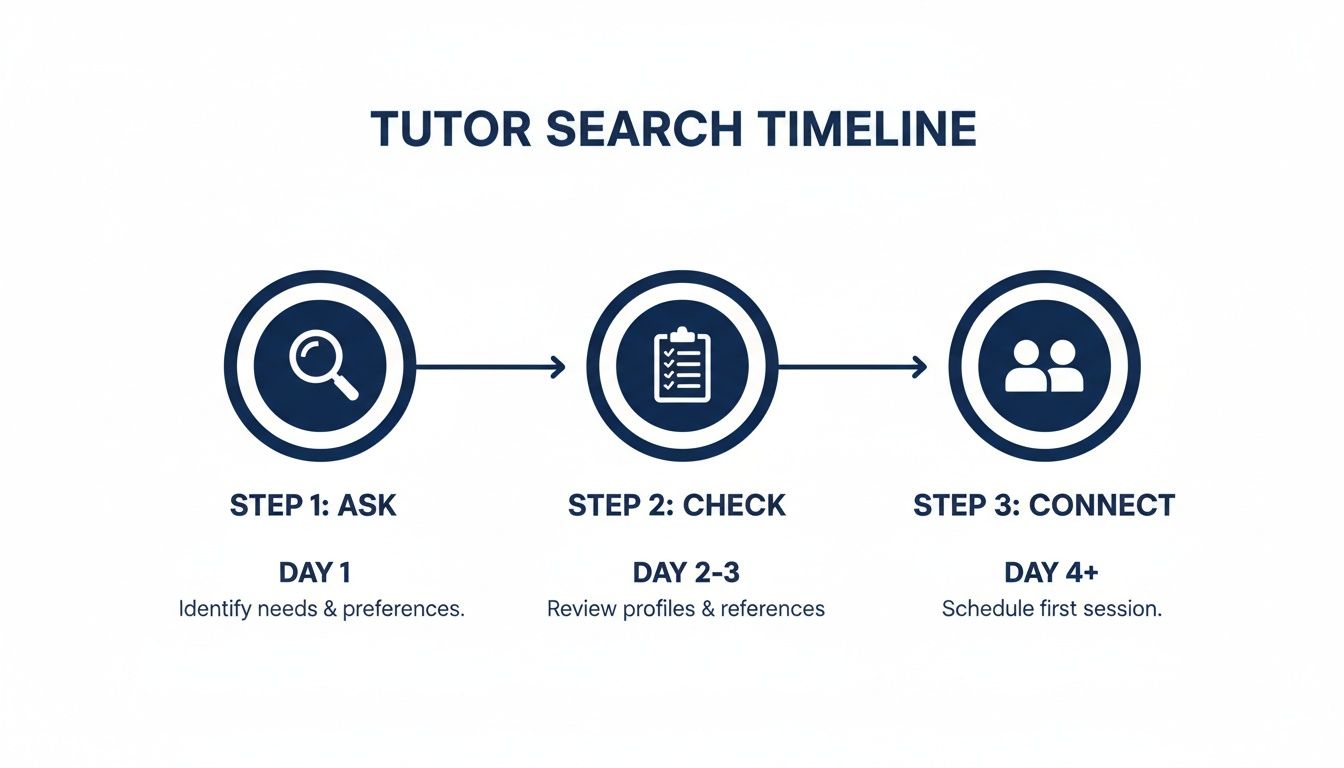
The key is a focused, methodical search. When you ask the right questions, check a tutor's background, and make sure there's a genuine personal connection, you find someone who truly clicks.
Once you've found that fit, a multi-week prep plan brings a sense of calm and order to the chaos of AP season. Here’s an example of what that structure looks like.
Sample 12-Week AP Statistics Exam Prep Timeline
| Weeks Out from Exam | Primary Focus Unit | Key Concepts and Skills |
|---|---|---|
| Weeks 12-10 | Unit 1 & 2 Exploring Data | Mastering graphical displays (histograms, boxplots), describing distributions (shape, center, spread), and understanding z-scores and the Normal model. |
| Weeks 9-7 | Unit 3 & 4 Relationships & Design | Focusing on correlation, regression lines (LSRL), interpreting slope and r-squared, and differentiating between observational studies and experiments. |
| Weeks 6-4 | Unit 5 & 6 Probability & Random Variables | Building a solid understanding of probability rules, discrete and continuous random variables, and binomial and geometric distributions. |
| Weeks 3-1 | Unit 7-9 Inference & Review | Deep dive into confidence intervals and significance tests for proportions and means, chi-square tests, and extensive practice with full-length AP exams. |
A great plan does so much more than just cover the material; it builds real confidence. Week by week, as you master a new unit, your self-assurance grows. This systematically reduces test anxiety and gets you ready to perform at your best on exam day.
This steady approach makes sure no topic gets left behind and gives you plenty of time to practice applying your knowledge to those tricky free-response questions. The final weeks are all about timed practice, simulating the real exam environment to build your stamina and sharpen your time-management skills.
If you'd like to discuss a plan tailored specifically for you, you can always contact us for a consultation.
Tailored Strategies for Neurodiverse Learners
Cracking AP Statistics isn't just about memorizing formulas. It's about organizing your thoughts, staying focused when a problem gets tricky, and managing the pressure of a high-stakes exam. For neurodiverse students—including those with anxiety, ADHD, and executive function challenges—this side of the course can feel like the real test.
We get it. That's why we believe in supporting the whole student. Our AP Statistics tutoring is grounded in the reality that every brain is wired differently. A killer strategy for one student might be a total flop for another. Our tutors don't just teach the curriculum; they build a toolkit of approaches and adapt to the student in front of them, creating a space where they can actually thrive.
This means we go way beyond the textbook. We’re teaching students how to learn in a way that’s built for them, developing skills that will carry them far beyond the AP exam.
Strategies for Students with Anxiety
Statistical anxiety is a very real thing. It often comes from the fear that one tiny mistake will derail an entire multi-step problem. The long, free-response questions can feel totally paralyzing. Our tutors are trained to gently break this cycle and build a student’s confidence back up.
Here’s how we help:
Deconstruct the Problem: We teach students to slice and dice those intimidating FRQs into small, bite-sized pieces. Suddenly, a monster question becomes a simple, step-by-step checklist.
Practice Mindfulness: It sounds simple, but introducing grounding techniques like box breathing can be a game-changer. Students learn how to calm their nervous system right in the middle of a test to get their focus back.
Focus on Process, Not Perfection: We celebrate the small wins. We show them how explaining their reasoning and showing their work can earn valuable partial credit, even if the final number isn't quite right.
The goal is to help a student's inner voice shift from, "I'm going to mess this up," to "I have a process I can trust." That change in perspective alone can slash test-day stress and boost scores.
Support for ADHD and Executive Function Challenges
Juggling formulas, keeping notes organized, and remembering deadlines for projects—AP Statistics is an executive function minefield. For students with ADHD or executive function weaknesses, it can feel like trying to build a house in an earthquake. Our tutors step in as academic coaches, helping them build the sturdy systems they need to stay on track.
Here's what that support looks like in action:
The Pomodoro Technique: We introduce them to timed work intervals—like 25 minutes of focused work followed by a 5-minute break. This simple trick helps manage energy and prevent burnout during long study blocks.
Visual Formula Sheets: Forget a boring, dense list of equations. We help students create their own color-coded, visual guides that make critical information much easier to find and remember during a test.
Organizational Systems: We work one-on-one to find a note-taking style that clicks and help them use a planner or digital tool to keep track of every deadline, from homework to final exam prep.
We believe this kind of structural support is just as important as the academic material itself. If you want to dive deeper into this, you can learn more about what executive function support looks like in our dedicated guide.
By bringing these strategies into our sessions, we help students build their statistical knowledge and the self-management skills they’ll need to succeed in college and whatever comes next.
Common Questions About AP Statistics Tutoring
Deciding to bring in an AP Statistics tutor is a big step, and it's completely normal to have a lot of questions. You want to know you're making the right call for your student and your family. Let’s walk through the practical side of things—from scheduling and cost to what success actually looks like.
There's a reason so many families are seeking out this kind of support. Subject-specific help, like AP Statistics tutoring, made up a huge 57.41% of the U.S. online private tutoring market in 2024. And it's not slowing down. The test prep part of that market is expected to grow by 12.5% every year between 2025 and 2030. It’s clear more parents are seeing the value in expert guidance for these tough, high-stakes exams. You can read more on these trends in the full report on the U.S. online private tutoring market.
Getting your questions answered is the first step toward making a decision you feel good about. Let's get into the details.
How Much Does AP Statistics Tutoring Cost?
Tutoring costs can vary quite a bit based on a tutor's experience, how often you meet, and the type of plan you choose. We believe in being upfront about pricing and offering a few different ways to work with us so you can find what fits your family’s budget and goals.
Here’s a simple look at how we structure our pricing:
Pay-As-You-Go: This is our most flexible option. You can book sessions whenever you need them, which is perfect for a student who just needs a quick review before a big test or is stuck on one particularly nasty chapter.
Monthly Packages: For students needing steady, weekly support, these packages are the way to go. They offer a better per-session rate and help build the consistency needed for real progress throughout the semester.
Exam Prep Bundles: We also offer focused, intensive packages designed specifically for the AP exam. These usually kick off in the 8-12 weeks before the May exam and include a set number of sessions dedicated to content review, test-taking strategies, and timed practice.
Our goal is simple: make truly great tutoring accessible. We're always happy to talk through these options to find the best path for your student.
How Long Until We See Results?
This is probably the most important question we get asked. Every student learns at their own pace, of course, but you should absolutely expect to see tangible progress within the first few sessions.
The very first result you'll see isn't always a grade—it's a change in confidence. When a student leaves a session saying, "Okay, I actually get it now," that's the first sign things are starting to click.
From that point, the more concrete results start to appear. Here’s what a realistic timeline often looks like:
First 2-3 Sessions: We start by building a connection and figuring out the real root of the struggle. The key "result" here is your student feeling less anxious and more comfortable with the material.
First Month: After a few weeks, students usually start seeing better scores on quizzes and homework. They also start asking sharper questions in class because their foundation is getting stronger.
After Two Months: With consistent weekly work, this is when we often see a real jump in test scores. The concepts are connecting, and they can tackle those tricky, multi-step problems without feeling overwhelmed.
True mastery is a marathon, not a sprint. The goal of good AP Statistics tutoring is to build a deep, lasting understanding that sticks. That steady effort is what turns into an A on the final and a great score on the AP exam.
How Much Time Should My Student Commit Outside of Sessions?
For tutoring to really work, the learning can’t stop when the session ends. It’s a partnership. The tutor is the guide, but the student has to be an active participant in their own success.
Think of it like having a personal trainer. The trainer can design the perfect workout and show you the right form, but you won’t see any changes unless you also put in the work between your sessions at the gym.
We typically recommend that students plan for about 1-2 hours of independent work for every hour of tutoring. This time is best spent on:
Reviewing Session Notes: Going over the concepts we just covered to make them stick.
Completing Practice Problems: Applying the new skills to homework or other practice questions.
Prepping for the Next Session: Coming in with specific questions or topics that gave them trouble during the week.
This is the work that turns the "aha!" moments from a tutoring session into knowledge they truly own. It empowers students to take control of their learning and build the independent skills they’ll need in college and beyond. You can visit us in Poulsbo by checking our location on this map.
Ready to help your student move from frustration to confidence in AP Statistics? At Bright Heart Learning, we build supportive, one-on-one partnerships that make complex concepts click. Learn more about our student-centered approach and schedule a consultation at https://brightheartlearning.com.