

How to Improve Reading Comprehension Skills: Tips & Tools
Improving your reading comprehension isn't just about learning a few new tricks.Improving your reading comprehension isn't just about learning a few new tricks. It’s about building a toolkit of active strategies—previewing what you’re about to read, asking questions as you go, summarizing the main ideas, and linking it all back to what you already know. This is a much deeper process than just gliding your eyes over words; it's about making meaning out of them.
Why Reading Comprehension Is More Than Just Reading Words

Does this sound familiar? Your child reads a page out loud beautifully, with perfect fluency. But when you ask what it was about, you get a blank stare. If you're nodding along, you are definitely not alone. It's one of the most common frustrations we see, and it highlights a critical truth: reading and comprehending are two totally different skills.
Reading is the mechanical part—decoding letters into words. Comprehension is the magic that happens next. It’s an active, surprisingly complex cognitive process that demands the brain to do a whole lot at once.
The Mental Juggling Act of Comprehension
Think about what your brain is actually doing when you understand a text. It’s decoding words, pulling up their meanings from your memory, holding the beginning of a sentence in mind while you read to the end, and weaving all that new information into your existing knowledge.
Now, imagine throwing ADHD, anxiety, or executive function deficits into that mix. That mental juggling act suddenly feels like an impossible feat.
A student with a weak working memory might forget the start of a paragraph by the time they get to the end. For another, anxiety can hijack the brain, triggering a fight-or-flight response that shuts down the very systems needed for complex thought. This is why a reader can stare at a page for ten minutes and absorb absolutely nothing.
The struggle isn't a lack of effort; it's often a sign of cognitive overload. The brain is working so hard to manage focus, decode text, and regulate emotions that there’s no mental bandwidth left for actual understanding.
This is exactly why our approach at Bright Heart Learning is built on a "Connection Before Content" philosophy. Before we can teach a single strategy, we have to create a safe, trusting environment that dials down the anxiety. Lowering that stress response is the non-negotiable first step to building the focus needed for real comprehension. To dive deeper into this foundation, you can explore the importance of reading in our detailed article.
Setting a Hopeful Path Forward
The first thing we do is validate the struggle. When a student feels truly understood, they become open to trying again. It’s powerful. Even the debate over things like AI Vs. Human Translators: Preserving Literary Style shows just how much meaning lives between the lines—it's never about a simple word-for-word translation.
Throughout this guide, we’ll lay out a clear roadmap of actionable, science-backed strategies. We'll move from getting to the core of the problem to putting effective solutions in place at home, helping you transform reading from a source of frustration into a real opportunity for connection and success.
Building a Strong Foundation for Reading Success
Imagine trying to build a house on shaky ground. No matter how beautiful the design, the structure will never hold. Improving reading comprehension works the same way. Before a reader can master complex ideas, they have to solidify the essential building blocks that make reading possible in the first place.
Many well-meaning parents and teachers jump straight to comprehension strategies, but this often skips over the real source of the struggle. If a child’s brain is using all its energy just to figure out what the words on the page are, there’s simply no mental bandwidth left to understand what those words mean.
This is why we always start with the foundational trio of reading success: phonological awareness, phonics, and fluency. Strengthening these areas first makes reading less of a battle, freeing up precious brainpower for understanding.
Hearing the Sounds in Words
Long before a child even knows the alphabet, they can learn to hear the architecture of language. This skill is called phonological awareness, and it's the ability to recognize and play with the sounds in spoken words. It’s a purely auditory skill—no letters required.
Think of it like playing with sound blocks. Can a child clap out the syllables in "caterpillar"? (Ca-ter-pil-lar). Can they tell you that "cat" and "hat" rhyme? Can they hear that the very first sound in the word "sun" is /s/?
These aren't just cute games; they are crucial pre-reading exercises. They train the brain to tune into the distinct sounds that letters will eventually represent. A child who struggles to hear the individual sounds in "dog" (/d/-/o/-/g/) is going to have a much harder time learning to spell or read it later on.
Simple, playful activities at home can make a huge difference here.
Rhyming Games: "I'm thinking of a word that rhymes with bug and you can find it on the floor." (rug)
Syllable Clapping: Clap out the parts of family members' names. (Ma-ri-a, 3 claps!)
First Sound Fun: "What's the first sound you hear in the word milk?" (/m/)
Connecting Sounds to Letters
Once a reader can hear the sounds, the next step is connecting them to the letters that write them down. This is phonics, and it's the bridge between spoken language and written text. It’s the set of rules that helps us decode unfamiliar words instead of just guessing.
If phonological awareness is hearing that "ship" is made of three sounds (/sh/-/i/-/p/), phonics is knowing that the letters "sh" make the /sh/ sound, "i" makes the /i/ sound, and "p" makes the /p/ sound. This explicit instruction is non-negotiable. Without it, reading is just a frustrating memory game.
The research on this is overwhelming. A World Bank review of 120 studies across 170 languages shows that systematic phonics instruction boosts comprehension by 20-30% in the early grades. Further research from EGRA assessments on over 500,000 students reveals that kids who master letter sounds early read 2-3 times faster by the third grade. You can explore the full data on global reading proficiency to see just how critical these skills are.
Strengthening these foundational skills is not about rote memorization. It’s about making the process of decoding so automatic that the brain is freed up to do the real work of reading—thinking and understanding.
Reading with Accuracy and Expression
The final piece of this foundational puzzle is fluency. Fluency is the ability to read with speed, accuracy, and proper expression. It’s the difference between a choppy, robotic recitation of words and a smooth, conversational flow that sounds like natural speech.
A fluent reader doesn't have to stop and painstakingly sound out every single word. Their decoding skills have become so automatic that they can read whole phrases at a time. This allows their brain to finally focus on the narrative, the characters, and the meaning behind the sentences.
A lack of fluency is often a major roadblock to comprehension. When reading is slow and laborious, the reader loses the thread of the story and forgets what they read just a few sentences ago. One of the best ways to build this skill is through repeated reading of the same short text.
Simple Fluency Practice at Home
Choose a short passage: Pick a paragraph from a book that is at or just below your child's independent reading level. The goal is success, not struggle.
You go first: Model what fluent reading sounds like—smooth, expressive, and paying attention to punctuation.
Practice together: Have your child read the same passage aloud a few times. Don't correct every single error. The goal here is to build rhythm and confidence.
Notice the improvement: Point out how their reading gets faster and more natural with each try. This builds momentum and motivation like nothing else.
By shoring up weaknesses in phonological awareness, phonics, and fluency, we reduce the cognitive load on a reader. We clear the path so they can move beyond just reading the words and start truly engaging with the ideas. This foundational work paves the way for all the advanced comprehension strategies to come.
Using Active Strategies to Unlock Meaning
Once a reader has a solid foundation, it's time to shift from passive reading—just letting eyes glide over words—to active reading. This is where the real magic happens.
Active reading means engaging with the text like a detective, constantly thinking, questioning, and connecting ideas. Strong readers do this so automatically they don't even notice, but here's the good news: these skills can be explicitly taught and practiced until they become second nature.
A simple way to organize these techniques is to think about what you do before, during, and after you read. This framework gives a sense of control, especially for readers who feel overwhelmed by a wall of text. It turns a single, intimidating task into a series of small, manageable steps.
First, though, that reading foundation has to be solid. The process below shows how mastering sounds, linking them to letters, and then building fluent, automatic reading are the essential first steps.
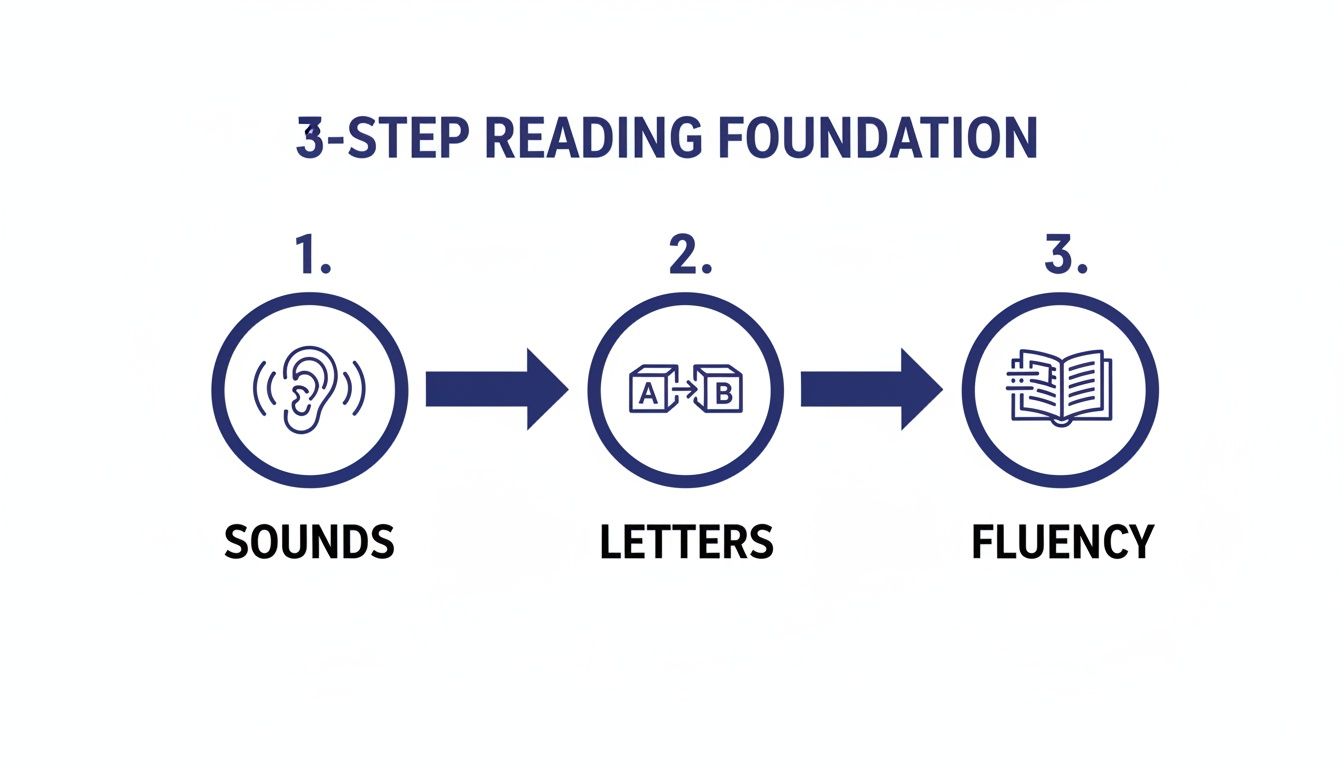
When those foundational skills are locked in, a reader's brain is freed up to apply the powerful active strategies we're about to explore.
Before You Start Reading
What you do before your eyes even hit the first sentence can completely change how much you get out of a text. Think of these pre-reading strategies as a warm-up for your brain. They fire up your executive functions, helping you get organized and focused.
First, preview the text. Don't just dive in. Take a minute to scan everything. Look at the title, headings, and subheadings. Glance at pictures, charts, or any words in bold. This quick survey gives you a mental map of where you're going.
Next, activate your prior knowledge. Ask yourself, "What do I already know about this?" Connecting new information to what's already in your brain is one of the most effective ways to make it stick. You might be surprised by the connections your brain can make, even if you think you know nothing about the topic.
During the Reading Process
This is where the real mental workout happens. Instead of letting the words just wash over you, active readers are constantly interacting with what they're reading. This internal conversation keeps the mind engaged and prevents that all-too-common feeling of, "I just read a whole page and have no idea what it said."
A core strategy here is to ask questions as you go. Get curious. Turn headings into questions. When the text introduces a new idea, ask who, what, where, when, why, and how. Even a simple thought like, "I wonder why that happened?" can flip your brain from passive to active mode.
Another incredibly powerful tool is visualization. As you read a description, try to create a mental movie of the scene. What does the character look like? What does the setting feel or smell like? This simple act makes the text far more memorable and engaging by turning abstract words into vivid, concrete images.
Key Takeaway: The goal isn't just to get through the text; it's to have a conversation with it. Question it, challenge it, and connect it to your own world. This active stance is the hallmark of a skilled reader.
Finally, make it a habit to summarize in your own words. At the end of a paragraph or a short section, just pause and ask, "What was the main point here?" Trying to explain it in a single sentence forces you to filter out the minor details and lock onto the core message. It's a critical skill for understanding the difference between a text's topic and its main idea.
After You Finish Reading
The work isn’t over when you hit that final period. The moments right after you finish reading are crucial for cementing your understanding and moving that information into long-term memory. This is where you pull all the threads together.
Start by synthesizing the entire text. Think back over everything you just read. How do all the smaller points and summaries fit together to create one big message? Can you explain the author's purpose in just a few sentences? This is a much bigger skill than just recalling facts; it's about seeing the whole picture.
Then, focus on drawing inferences. An inference is just an educated guess based on clues from the text plus your own background knowledge. Authors rarely state everything directly—they expect readers to read between the lines. If a character is described as having clenched fists and a red face, you can infer they are angry, even if the word "angry" never appears.
Globally, an estimated 70% of kids in low- and middle-income countries lack age-appropriate reading skills, but we know systematic instruction can reverse this. For example, phonological awareness training alone can boost comprehension by 22%. And explicitly teaching comprehension strategies has been shown to lift scores by 15-20%, a key factor in Sweden's academic rebound between 2012 and 2018.
By intentionally using these strategies before, during, and after reading, anyone can build the mental habits that lead to deep and lasting comprehension. If you're looking for more guidance, check out our guide on how to distinguish between a topic and a main idea. It’s a vital step toward becoming a more confident and effective reader.
Some students also find that hearing information spoken aloud helps them process it better. Modern audio to text tools for students can transform lectures and discussions into written notes, giving them another way to actively review and engage with the material.
To help put all this together, here is a quick toolkit of the key strategies.
Active Reading Strategy Toolkit
| Strategy | What It Means | Try This Prompt |
|---|---|---|
| Previewing | Skimming the text before you read to get an overview. | "What do the title and headings tell me this is about?" |
| Questioning | Asking questions while you read to stay engaged. | "I wonder why the author included that detail?" |
| Visualizing | Creating a mental picture of what the text describes. | "What does this scene look, sound, and feel like in my mind?" |
| Summarizing | Restating the main points in your own words. | "In one sentence, what was that section about?" |
| Inferencing | Reading between the lines to understand what's not stated. | "Based on these clues, what can I figure out?" |
| Synthesizing | Connecting all the parts to understand the big picture. | "What is the single most important message of this entire text?" |
Think of these not as a rigid checklist, but as a set of tools you can pull out whenever you need them. The more you practice, the more automatic they become.
Supporting Readers with Executive Function Challenges
For a lot of readers, the real roadblock to comprehension has nothing to do with the words on the page. It's about what’s happening inside their own head.
When executive function challenges are in the mix—especially those connected to ADHD and anxiety—reading can feel deeply frustrating. It’s like trying to build a complex puzzle while someone is constantly shaking the table.
If a reader's nervous system is stressed or their working memory is overloaded, it becomes almost impossible to hold onto information from one sentence to the next. Their brain is so busy wrestling with distractions, managing big feelings, or just trying to stay put that there’s no bandwidth left to actually make meaning.
This is exactly why a student can read a paragraph out loud perfectly, then look up with a blank stare, having no idea what they just read.
Recognizing this internal battle is the first step. The goal isn't to force them to focus, but to create the conditions where focus can happen more naturally. That means we have to support both the nervous system and the brain's executive functions directly.
Calming the Nervous System to Prime the Brain for Reading
A dysregulated nervous system sees everything as a potential threat—and a dense page of text is no exception. Before any real learning can happen, the brain needs to feel safe and calm.
Integrating a few nervous-system-aware strategies can make a world of difference. These aren't just fluffy add-ons; they are essential tools for getting the brain into a state where it's actually ready to learn.
Bring in Movement Breaks: Don't expect a kid to sit still for 30 straight minutes of reading. Short, intentional movement breaks—like doing five quick jumping jacks or a big stretch—can reset a restless mind and body. This helps release physical tension and gets blood flowing back to the brain.
Use Fidget Tools with Purpose: A fidget isn't a toy; it's a focusing aid. Squeezing a stress ball or using a wobble cushion provides just enough sensory input to quiet down a "busy" brain, freeing up attention for the page.
Try Pre-Reading Mindfulness: Even just a minute or two of quiet can be incredibly powerful. Before diving into a reading session, try a simple breathing exercise: breathe in for a count of four, hold for four, and breathe out for six. This simple act can lower the heart rate and signal to the nervous system that it's safe to relax and engage.
Scaffolding Executive Functions to Reduce Cognitive Load
Once the nervous system is in a better place, we can introduce practical supports that act as external scaffolding for those shaky executive functions. These tools reduce the amount of mental juggling a reader has to do, freeing up their cognitive resources for the actual job of comprehension.
Think of these scaffolds as a co-pilot for the brain, helping it plan, organize, and remember what it’s taking in.
For a student with executive function challenges, expecting them to organize complex information from a text without support is like asking them to build a bookshelf without instructions or tools. Graphic organizers and other scaffolds provide that missing structure.
Breaking a big task down into smaller, more visible parts is a core principle of good executive function support. Instead of handing over a whole chapter and expecting them to just "get it," try these techniques to make the task feel more manageable.
Map It Out with Graphic Organizers: A simple story map or a cause-and-effect chart can work wonders. These visual tools offload the heavy lifting of holding a story's entire structure in working memory. The reader can focus on understanding one piece at a time because they have a visual map to lean on.
Work in Timed Chunks: The Pomodoro Technique is fantastic for this. Set a timer for a short, focused work period (maybe 15-20 minutes) followed by a 5-minute break. This creates a clear start and finish line, which helps with getting started and fights that overwhelming "this is going to take forever" feeling.
Bring in Text-to-Speech Tools: For readers who also struggle with decoding, listening to the text while following along can be a game-changer. It dramatically reduces their cognitive load, allowing them to put their mental energy into understanding the meaning of the words, not just figuring out what the words are.
By combining these nervous-system-aware tips with concrete executive function supports, we create an environment where reading becomes less of a battle and more of an achievable skill. This compassionate, personalized approach is key to transforming a student's relationship with reading.
To learn more about how this looks in practice, check out our guide on what executive function support looks like. It’s all about meeting students where they are and giving them the specific tools they need to find success.
Making Reading a Consistent Practice
Knowing the strategies is one thing. Actually using them is where the magic happens. Turning abstract techniques into solid, automatic habits comes down to one thing: a consistent routine.
And the secret here is consistency over intensity.
Forget marathon reading sessions on Saturday mornings. They're far less effective than short, focused bursts of daily practice. Just 20-30 minutes of intentional reading each day builds momentum, strengthens neural pathways, and boosts confidence without causing burnout. This keeps it manageable for everyone.
Building a Weekly Reading Rhythm
A simple schedule can turn good intentions into real action. The goal is to weave different kinds of reading into the week, mixing skill-building with the pure joy of a good story.
Think of these as flexible starting points, not rigid rules.
For Early Readers (Grades K-2)
At this age, it's all about building a positive, playful relationship with books.
Daily (15-20 min): Read-aloud time. This is your chance to model what fluent reading sounds like. Point out rhymes, identify sounds, and ask fun questions like, "What do you think the dragon will do next?"
3x a week (5-10 min): Quick phonics or sight word games. Flashcards or a good app can make this feel like play, not work.
Weekend: "Free choice" reading. Let them pick any book they want. Even if they just look at the pictures and tell you the story in their own words, that's a huge win.
For Developing Readers (Grades 3-5)
Now, the focus shifts to using comprehension strategies and building up reading stamina.
Daily (20-25 min): Independent reading of a "just right" book (more on that below).
2x a week (10 min): "Talk about the text" time. This is a casual chat where you ask them to summarize a chapter they just read or describe the main character.
1x a week (15 min): Focused strategy practice. Pick one skill to work on together. Maybe it's visualizing a scene like a movie in their head or asking "I wonder…" questions about the plot.
For Middle School Readers (Grades 6-8)
Here, the aim is to deepen their analytical skills and keep them engaged with reading as schoolwork gets more demanding.
4-5x a week (30 min): Sustained reading time. Let them choose what they read—novels, articles, graphic novels, it all counts.
2x a week (15 min): Practice summarizing something a bit more complex, like a news article or a dense chapter. Have them write a three-sentence summary to lock it in.
Weekly Check-in: Chat about what they're reading. Ask about the themes, what motivates the characters, or if it connects to anything else they're learning or experiencing.
Finding Those "Just Right" Books
A routine only works if your child has the right materials. A "just right" book is one that's engaging but not so hard that it causes frustration.
An easy way to check is the five-finger rule.
Have your child read one full page from a book. If they get stuck on five or more words, that book is probably too challenging for solo practice right now. It can still be a fantastic book to read together, but for their independent time, an easier text will build their fluency and confidence much more effectively.
The best reading routines are built on small, consistent wins. Make sure to celebrate the effort of sticking to the schedule, not just the progress. This sends a powerful message: reading is a journey, not a performance.
This consistency has never been more critical. The COVID-19 pandemic had a major impact on learning, wiping out nearly two decades of progress in reading. But the good news from UNESCO models on post-pandemic literacy recovery is that targeted efforts work. Consistent, short sessions are proven to rebuild skills far better than long, infrequent ones. Plus, adding a little writing—like composing a summary—can boost retention by as much as 30%.
Creating a routine that fits your family's life is a powerful first step. If you need a hand developing a personalized plan that targets your child’s specific challenges, our team is here to help. To get started, schedule a consultation with us at Bright Heart Learning.
Still Have Questions? Let's Talk It Out.
Even with a solid game plan, you're bound to have questions about what this looks like in the real world, with your specific kid. Here are some of the most common concerns we hear from parents trying to navigate the messy, wonderful process of building stronger readers.
How Do I Know if It’s Dyslexia?
This is a big one. While some comprehension struggles are just part of the learning curve, you might be wondering if something deeper is going on. You're right to trust your gut.
Key signs that often point toward dyslexia include a serious struggle with decoding (sounding out words), reading that's painfully slow, persistent spelling issues long after peers have moved on, and a powerful, consistent avoidance of anything involving reading.
If those patterns sound familiar, it's a good idea to look into a formal assessment. Think of them as red flags that the foundational wiring for reading isn't quite secure yet. To build real comprehension, you have to get to the root of the problem first.
My Teen Hates Reading. How Can I Get Them to Practice?
Ah, the reluctant teenager. The key here is to sidestep the battle altogether. Forget what you think reading "should" look like and meet them where they are.
The most powerful thing you can do is connect reading to what they already love. This means moving way beyond traditional books. Think graphic novels, articles about their favorite athlete, deep dives into video game lore, or even the lyrics to their favorite songs.
Reframe it. It's not "reading practice;" it's "researching" their passion. You can also lower the effort by introducing audiobooks while they follow along with the text. The goal isn't to force them to love novels; it's to gently rebuild a positive, low-pressure connection with the written word.
Our "Connection Before Content" philosophy is huge here. The goal is to talk about what they're reading, not to quiz them on it. An open, curious conversation—"What's the coolest thing you've learned about that character?"—can reignite their interest and make reading feel less like a chore and more like a discovery.
How Long Will This Take to Actually Work?
Every reader's journey is different, but the one non-negotiable ingredient is consistency. With about 20-30 minutes of focused, daily practice, you can often see some really encouraging shifts in confidence and fluency in just a few weeks.
But let's be realistic. The deeper skills—the ones where a student starts independently using strategies like inferencing or summarizing without being prompted—usually take several months to become second nature.
And remember, progress is almost never a straight line. There will be good days and frustrating days. Celebrating the small wins is absolutely essential for keeping everyone's spirits up.
What's the Single Most Important Thing I Can Do at Home?
Read aloud together. Seriously. It doesn't matter how old your child is. This simple act is a powerhouse for reading development at every single stage.
For little ones, it's how they build a rich vocabulary and hear what fluent, expressive reading is supposed to sound like. It wires their brain for storytelling.
For older kids and even teens, taking turns reading chapters of a high-interest book keeps them engaged with complex stories and ideas without making them carry the full cognitive load. It's a shared experience, not a lonely task.
Best of all, it opens the door for natural, rich conversation. You can model how skilled readers think by simply wondering out loud: "Huh, I wonder why she did that…" or "I'm guessing this will happen next." You're showing them, not just telling them, how to be an active, engaged reader.
At Bright Heart Learning, we specialize in turning reading frustration into confidence. Our tutors use personalized, nervous-system-aware strategies to build foundational skills and foster a genuine love of learning. If you're ready to create a tailored plan that addresses your child's unique needs, visit us online to get started.