

How to Prepare for GED Test Your Proven Plan to Pass
Getting ready for the GED test starts with a smart, personal strategy. I’ve found that the students who succeed don’t just grab a book and start cramming. Instead, they follow a simple but powerful roadmap: they take a diagnostic test to see where they stand, build a study schedule around those results, and practice with the right materials.
This approach makes sure you’re spending your precious time exactly where it will have the biggest impact.
Build Your Personalized GED Study Plan
Jumping into GED prep without a plan is like trying to drive to a new city without a map. You might get there eventually, but you'll waste a lot of gas and probably take a few wrong turns. The most successful students I've worked with don't start with a textbook; they start with a quick assessment to get their bearings.
This first step is so important because it turns a vague goal—"pass the GED"—into a clear set of tasks you can actually tackle. At Bright Heart Learning, we’ve seen over and over again that a solid plan built on self-awareness is what builds real confidence. It’s not just about what you study, but how you organize your time and energy.
Start with a Diagnostic Snapshot
Before you can map out your route, you need to know your starting point. The single best tool for this is the official GED Ready® practice test. Think of it as a pre-test designed by the same people who make the real exam. It gives you a score report that’s incredibly accurate at predicting how you’ll do.
This report is your treasure map. It will show you:
- Which subjects are already strong points for you.
- Which subjects need the most work.
- The specific skills inside each subject that you need to focus on.
For example, you might discover you’re already a pro at the Reasoning Through Language Arts (RLA) section but that algebraic expressions in Math are tripping you up. That insight is gold. It lets you focus your study time where it counts instead of just guessing.
The infographic below shows how this simple, three-part process works.
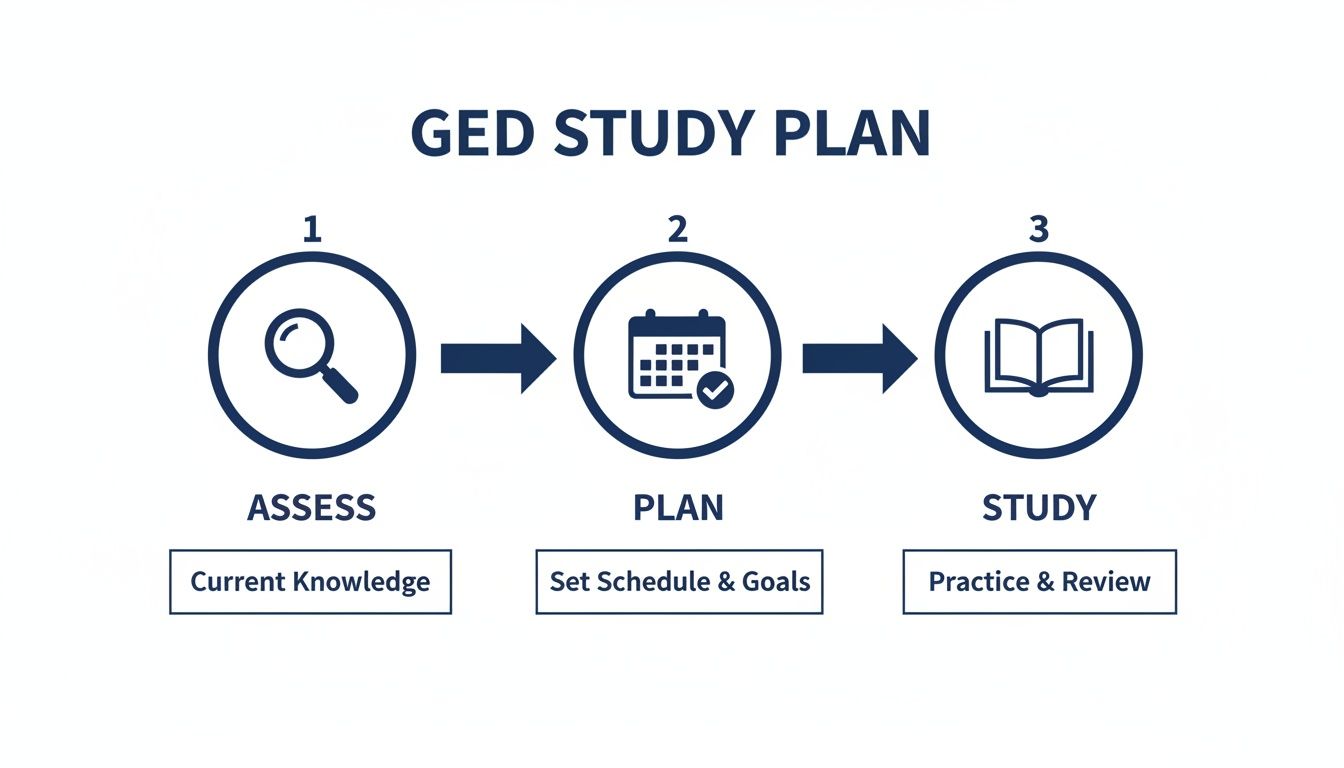
As you can see, a successful journey always moves from assessment to planning and then, finally, to focused studying.
Create a Realistic Study Schedule
Once you have your diagnostic results, it’s time to build a schedule that actually fits your life. A huge mistake I see people make is creating a super ambitious plan that’s impossible to stick with, leading to quick burnout. Remember, consistency beats intensity every time.
Your GED study plan should work for you, not the other way around. A sustainable schedule you can follow for a few hours a week is far more effective than an overwhelming one you give up on after three days.
Look at your week—work, family, appointments—and find small, dedicated pockets of time for studying. Even 30-45 minutes of focused work, four or five days a week, can make a massive difference.
Make sure you prioritize the subjects where your GED Ready® scores were lowest, but don't forget to review your stronger subjects, too. This keeps everything fresh and builds the kind of solid study skills for college students that will help you long after the GED is done.
Here’s a simple template to help you organize your week.
Sample Weekly GED Study Schedule
Use this flexible template to structure your study time based on your diagnostic test results and personal commitments.
| Day | Focus Subject | Activity (e.g., Concept Review, Practice Questions) | Duration |
|---|---|---|---|
| Monday | Math | Review algebra concepts + 10 practice problems | 45 minutes |
| Tuesday | RLA | Read a short passage & answer comprehension Qs | 30 minutes |
| Wednesday | Science | Watch a video on a key concept (e.g., life science) | 30 minutes |
| Thursday | Math | Work through a full practice worksheet | 45 minutes |
| Friday | Social Studies | Review U.S. government basics | 30 minutes |
| Saturday | Catch-up/Review | Review notes from the week or rest | 30-60 minutes |
| Sunday | Rest | Rest day | N/A |
This is just a starting point, of course. Adjust it to fit your needs, your energy levels, and your life. The goal is to create a rhythm you can maintain.
And here's some encouragement: the GED is more achievable than ever. Since 1942, the program has helped over 20 million people earn their high school equivalency. Today, the pass rate is a strong 80%, and it's accepted by nearly 100% of U.S. colleges and employers. You can do this.
Time to Tackle the GED Subjects: Your Game Plan for Each Section
With your study plan sketched out, it's time to dive into the real work. Here’s a secret I’ve learned from years of coaching students: knowing how to prep for the GED means recognizing that each of the four tests—Math, Language Arts, Science, and Social Studies—is its own beast. A one-size-fits-all strategy just won't work. You need a specific game plan for each.
The biggest shift you need to make is moving from a memorization mindset to an application mindset. This isn't about cramming facts. It's about learning how to think critically, analyze what you're given, and solve problems. These are the skills that tie every single section of the exam together. Over and over again, our tutors at Bright Heart Learning see students make huge breakthroughs the moment they start using these subject-specific techniques.

Tackling Mathematical Reasoning
Let's be honest: the math section is what keeps most people up at night. But it doesn't have to be your roadblock. The key is to stop treating it like a test of what you've memorized and start seeing it as a series of puzzles waiting to be solved. And the best part? You don’t have to memorize a single formula, because they give you a formula sheet on test day.
Your real job is to figure out how and when to use those formulas. This means you should spend your study time really understanding the concepts behind the numbers. For example, instead of just memorizing the formula for the area of a circle, work through practical problems that use it, like figuring out how much sod you'd need for a circular lawn.
Here are a few core strategies that actually work:
- Translate English into Math: So many GED problems are word problems. Get in the habit of breaking them down sentence by sentence to figure out what mathematical question is really being asked.
- Make the Formula Sheet Your Best Friend: Find a copy of the official GED formula sheet online and use it for every single practice problem. The more familiar it is, the more of a lifeline it will be on test day.
- Learn Your Calculator: You get an on-screen calculator (the TI-30XS MultiView™) for the test. Take the time to learn its functions, especially how to work with fractions and exponents. It will save you a ton of time.
Excelling in Reasoning Through Language Arts (RLA)
The RLA test is so much more than a grammar quiz. It’s designed to see how well you can read with a critical eye, analyze an argument, and write a clear, persuasive essay. Roughly 75% of the test is reading comprehension, with the other 25% split between your Extended Response essay and language conventions.
Your number one goal here is to become an active reader. That means you're engaging with the text, asking questions as you read, and zeroing in on the author's main point and the evidence they use to back it up. When you read a passage, don't just let your eyes skim the words; look for the hidden structure of the argument.
The RLA section isn't about having the "right" opinion. It's about your ability to find evidence within a text and use it logically to support your own analysis in the essay portion.
To build this skill, practice summarizing short news articles or identifying the main idea in a few paragraphs. For the essay, keep your structure simple: an introduction that clearly states your point, a few body paragraphs that pull specific evidence from the text, and a conclusion that wraps it all up. If you need a deeper dive, we have more targeted support for improving your GED Language Arts skills in our dedicated guide.
Decoding Science and Social Studies
At first glance, Science and Social Studies seem like they're all about memorizing an endless list of dates, names, and scientific laws. But the GED test flips that on its head. Both of these sections are really reading comprehension tests disguised with subject-specific content.
You don't need to know every article of the U.S. Constitution or have the periodic table memorized. Instead, you'll be given passages, charts, graphs, and maps and asked to interpret the information right in front of you. Your job is to think like a scientist or a historian would.
This means you’ll need to sharpen a few key reading skills:
- Reading for Data: When you see a graph, immediately ask yourself: What is this actually showing me? What are the trends? What conclusion can I draw only from this data?
- Identifying Cause and Effect: In a history passage, always be on the lookout for the relationship between events. What caused this to happen? What were the ripple effects?
- Understanding Scientific Reasoning: For a science passage, think about the scientific method. What was the hypothesis? How was the experiment designed to test it? What do the results tell us?
Bringing in social learning techniques can also be a game-changer here. Just talking through a complex historical event or a scientific concept with a study partner or tutor can unlock new insights and make it stick. There's no better proof that you understand something than being able to explain it to someone else. If you focus on these interpretation skills, you’ll be ready for whatever topics they throw at you on test day.
Develop Real Test-Taking Confidence and Stamina
Knowing the material is the first step, but being able to perform under the pressure of the clock is what really brings home a passing score on the GED. It’s one thing to know all the notes to a song; it's another thing entirely to perform it flawlessly on stage. This part of your prep is all about that stage performance—building the mental muscle and practical skills you need for the big day.
The goal here is to shift from just answering questions to actually simulating the real exam experience. This is how you build stamina, nail down your timing, and learn to manage the nervous energy that can trip up even the most prepared students.
Go Beyond Practice Questions with Full-Length Tests
Short quizzes are great for a quick check-in on a concept, but they won't prepare you for the marathon that is a full GED subject test. The entire GED exam runs over seven hours, and individual sections can last up to 150 minutes. Staying sharp for that long isn't automatic—it's a skill you have to practice.
This is where full-length, timed practice tests become your best friend. Taking a complete test under exam-like conditions does a few crucial things for you:
- It builds mental stamina. You’re training your brain to stay focused over a long haul, which is key to avoiding sloppy mistakes toward the end of a section.
- It reveals your timing issues. You might realize you're burning too much time on certain question types and then rushing through others. You just can't see these patterns with short drills.
- It makes the real thing feel familiar. The more you simulate the test environment, the less intimidating the actual exam will feel when you walk into the testing center.
Try to schedule at least one full-length practice test for each subject a couple of weeks before your official test date. Treat it like the real deal: find a quiet spot, set a timer, and turn off your phone.
Master Your Pacing and Question Strategy
Once you start taking timed tests, you can really start fine-tuning your strategy. It’s not just about getting the right answer; it’s about managing your time so you can give every single question your best shot.
One of the most effective strategies I've seen students use is the three-pass approach. Here’s how it works:
- First Pass (The Easy Wins): Go through the whole section and answer every question you know you can solve quickly. This builds momentum and gets easy points on the board right away.
- Second Pass (The Maybes): Now, circle back to the questions you skipped. These are the ones you're pretty sure you can figure out, but they’ll take a little more brainpower.
- Third Pass (The Toughest Nuts to Crack): With whatever time is left, tackle the hardest problems. By now, you've already banked points on everything else, so you can focus without the pressure of leaving easier questions unanswered.
The GED doesn't penalize for wrong answers, so you should never leave a question blank. Learning to make a smart, educated guess is a vital part of preparing for the GED test. Always try to eliminate answers you know are wrong to boost your odds.
This method stops you from getting stuck on a single tough question and running out of time for easier ones that come later.
Turn Test Anxiety into Focused Energy
Feeling nervous before a big test is completely normal. In fact, it shows you care. At Bright Heart Learning, our "Connection Before Content" philosophy is all about acknowledging how your emotional state impacts your ability to perform. The idea isn't to get rid of anxiety, but to learn how to manage it so it doesn't get in your way.
If you feel your heart pounding or your mind going blank during a practice test, simple grounding techniques can make a world of difference.
Try This Simple Breathing Exercise:
- Close your eyes for a second.
- Inhale slowly through your nose for a count of four.
- Hold that breath for a count of four.
- Exhale slowly through your mouth for a count of six.
- Repeat this three to five times.
This simple exercise helps calm your nervous system and pull your focus back to the present. If test anxiety is a major hurdle for you, we share more in-depth strategies in our guide on how to reduce test anxiety.
History is on your side here. Back in 2013, over 848,000 adults took at least one GED subject test. Of the nearly 743,000 who finished the whole battery, an amazing 75.3% passed. Those numbers tell a clear story: the vast majority of people who commit to the process succeed. You are walking a path that countless others have walked successfully before you.
Handling the GED Logistics and Accommodations
Beyond hitting the books and calming your nerves, there’s a whole practical side to taking the GED. This is the stuff that can trip you up if you don’t plan for it: creating your account, scheduling the actual exams, and getting any accommodations you might need.
Taking a few minutes to sort out these details now saves you a world of last-minute stress. Think of it as clearing the runway so you can focus on what really matters—showing what you know on test day.

Getting Set Up and On the Schedule
Your official starting point for all things GED is GED.com. The very first thing you’ll do is create a free account. This becomes your personal command center for registering, scheduling tests, checking scores, and finding official study materials.
Once your account is live, you’ll face your first big choice: Will you test at an official center or take the exam online from home? Neither is better than the other; it just depends on what works for you.
- In-Person Testing: This gives you a quiet, structured space without the distractions of home. It’s perfect if you thrive in a formal setting or if your home tech setup isn’t quite right for the online version.
- Online Testing: This option offers incredible flexibility and the comfort of your own space. To qualify, you’ll need a computer with a webcam, a solid internet connection, and a "Green" (likely to pass) score on the GED Ready® practice test for that subject.
A quick pro-tip: You don't have to tackle all four tests in one go. In fact, most people schedule them one by one. This lets you focus your study efforts and builds momentum as you pass each subject.
Securing Accommodations If You Need Them
The GED test is designed to measure what you’ve learned, not how you deal with a disability. If you have a documented condition like ADHD, dyslexia, anxiety, or a physical challenge, you may qualify for accommodations to ensure a fair testing experience.
These aren't special advantages; they are simply adjustments that level the playing field so your abilities can shine through.
Accommodations are about making sure your test score reflects your knowledge, not the barriers created by a disability. If you think you might qualify, it's absolutely worth looking into.
Common accommodations include things like extra time, a separate testing room, or more frequent breaks. The critical thing to know is that you must apply for and get approved for these supports before you schedule your exams. The process starts on your GED.com account and requires documentation from a professional.
The Accommodation Application Process
The application itself is pretty simple, but getting your documents in order can take some time. Definitely don’t leave this until the last minute.
Here's the general flow of what to expect:
- Collect Your Documentation: You'll need a current letter or report from a doctor, psychologist, or specialist. This document should diagnose your condition and specifically recommend accommodations.
- Fill Out the Request Form: Log in to your GED.com account, find the accommodations section, and complete the request form.
- Submit Everything: Upload your form and all the supporting paperwork for review.
- Wait for a Decision: The GED Testing Service usually reviews applications within 30 days. Once you're approved, the accommodations will be available for you to select whenever you schedule a test.
Taking the time to handle these logistics is a powerful act of setting yourself up for success. If you'd like a hand navigating these steps, our team at the tutoring center in Poulsbo is here to help. You can find us using this map to Bright Heart Learning.
Self-studying for the GED is a fantastic way to take control of your future, but it doesn't mean you have to go it alone. Sometimes, hitting a wall isn’t a sign that you should quit—it’s a signal that it's time to bring in some backup. Realizing when to ask for help can be the single smartest move you make.
I’ve seen it countless times: a student feels like they should be able to figure it all out with just a textbook and sheer willpower. But getting personalized support isn't a crutch. It’s a tool—one that can save you a ton of time, cut down on frustration, and give you strategies you just can't find in a book.
Recognizing the Signs You Need Help
So, how do you know when you’ve hit that point? It usually boils down to a few common hurdles that are incredibly tough to overcome on your own. If any of these feel familiar, it might be time to think about getting an expert in your corner.
Keep an eye out for these indicators:
- You've hit a plateau. You’re putting in the hours, but your practice test scores in a subject like Math or RLA are completely stuck.
- Motivation is a constant battle. The initial drive is gone, replaced by a nagging sense of being overwhelmed. You find yourself procrastinating more than studying.
- Test anxiety is taking over. Just the thought of the real exam makes your stomach turn, making it nearly impossible to focus during study sessions.
These aren't signs of weakness. They’re just signals that your current approach has taken you as far as it can.
Tutoring Versus Coaching: What’s the Difference?
When people think about getting help, the first word that comes to mind is usually "tutoring." But it’s really important to know the difference between tutoring and academic coaching, because they solve very different problems.
A tutor is your subject-matter expert. Their job is to help you master the content of the GED. A great math tutor, for example, can break down algebraic functions five different ways until one of them finally clicks for you.
An academic coach, on the other hand, is focused on the process of learning. They’re the ones who help you build skills like time management, organization, and emotional regulation. A coach helps you figure out why you’re procrastinating and then works with you to build a system to move past it.
At Bright Heart Learning, we believe in a combined approach. True success comes when you not only understand the material (tutoring) but also have the executive function skills and confidence to apply it effectively (coaching).
This integrated system is powerful because it addresses both the "what" and the "how" of preparing for the GED. To see what this looks like in action, you can Learn more about our GED prep services.
Finding the Right Expert for You
Once you’ve decided to look for support, the next step is finding the right person. This is a partnership, so finding a good fit is everything. When you're talking to a potential tutor or coach, don’t just ask about their qualifications—ask about their approach.
Here are a few questions to get you started:
- How do you personalize your sessions for each student?
- What specific strategies do you use for things like test anxiety or motivation issues?
- How do you measure progress beyond just practice test scores?
Their answers will tell you a lot about their philosophy. You’re looking for someone who gets your learning style and understands your specific challenges. Think of this as an investment in your future. And speaking of the future, for broader career guidance that might involve educational steps like the GED, you might also consider hiring a career coach.
Whether it’s for academics or career planning, getting expert help is a sign of strength, and it can seriously speed up your journey to success.
Common Questions About Preparing for the GED
As you start mapping out your path to passing the GED, it’s totally normal for questions to pop up. Getting clear, straightforward answers is one of the best ways to stay focused and confident.
Let's dive into some of the most common questions we hear from students getting started.
How Long Does It Take to Prepare for the GED Test?
Honestly, there’s no magic number here. The timeline is deeply personal and depends entirely on your starting point, how much time you can realistically commit each week, and your own learning pace.
On average, we see many students feel ready in about three months of consistent study.
Some people with a strong academic background might just need a few weeks to brush up on a few specific skills. Others prefer to take six months or even a year to build a really solid foundation without feeling rushed. The key is to start with a diagnostic like the GED Ready® test to get an honest picture of where you stand. That insight helps you build a plan that prevents burnout and keeps you moving forward.
Can I Take the GED Test Online?
Yes, you absolutely can! In most states and territories, taking the Official GED Test online from home is an option. It offers incredible flexibility, allowing you to test in a familiar, comfortable environment.
But there are a few important requirements you have to meet first.
To qualify for the online test, you must:
- Score "Green" on the GED Ready® practice test for that specific subject. This is their way of confirming you have a strong likelihood of passing the official exam.
- Have the right tech setup. This means a computer with a webcam, a reliable microphone, and a stable internet connection are non-negotiable.
- Provide a private, quiet space. You have to be completely alone in the room, free of any interruptions for the entire duration of the test.
While taking the test at home is convenient, some people find the structured, quiet environment of a physical testing center helps them focus better. Think about which environment truly suits your test-taking style before you decide.
The most important thing is choosing the setting where you feel most comfortable and can perform your best. There is no right or wrong answer—only what works for you.
What Score Do I Need to Pass the GED?
To pass the GED, you need to earn a minimum score of 145 on each of the four subject tests. The great news is you don’t have to pass all four at once. You can tackle one subject at a time, and your passing scores never expire. This allows you to focus all your energy where it’s needed most.
The GED scoring system actually has three performance levels:
- 145-164: Pass / High School Equivalency
- 165-174: College Ready
- 175-200: College Ready + Credit (this score could earn you college credits!)
This tiered system shows that the GED is much more than just a pass/fail credential; it can be a powerful stepping stone into higher education.
Is a GED the Same as a High School Diploma?
Functionally, yes. Over 98% of U.S. colleges and employers accept the GED credential as equivalent to a high school diploma. It's a widely respected credential that shows you have high school-level academic skills and knowledge.
Earning your GED opens the exact same doors to college admission, better job opportunities, and military enlistment as a traditional diploma. More than anything, it proves your commitment to your education and your readiness to take on whatever comes next.
No matter where you are in your journey, having the right support can make all the difference. At Bright Heart Learning, we create personalized plans that build both skills and confidence. Find out how our expert tutors and coaches can help you succeed. Learn more about our GED prep services.