

Acing the GED Language Arts Test A Practical Guide
The GED Language Arts test, officially called Reasoning Through Language Arts (RLA), is a single, 150-minute exam that rolls reading, writing, and grammar into one big assessment. It’s built to measure how well you understand complex texts, write with clarity, and use standard English—basically, to show you have the communication skills expected of a high school graduate.
Passing this test isn't just about checking a box; it’s a critical step toward earning your high school equivalency diploma and opening up new doors for your future.
Decoding the GED Language Arts Test
Before you can build a smart study plan, you need to know exactly what you’re up against. Think of the GED Language Arts test less like a random trivia quiz and more like a practical evaluation of skills you already use—reading an article online, drafting a professional email, or explaining your point of view in a discussion.
This test is about so much more than just memorizing grammar rules. It’s designed to see how well you can think critically and communicate your ideas. Since the current format was introduced in 2014, the RLA section has been a key benchmark for adult learners. And the good news? Success is totally within reach. With pass rates for prepared students hovering around 75-80%, you’ve got this.
What’s the Point of the Questions?
The people who create the GED test want to make sure that diploma holders are ready for college and the modern workforce. That means the questions are designed to assess real-world abilities. You won't be asked to define obscure literary terms from the 1800s.
Instead, you'll be asked to do things like:
- Analyze Arguments: You might read two passages with opposing viewpoints and have to decide which one presents a stronger, more convincing case based on the evidence provided.
- Comprehend Complex Texts: You’ll read excerpts from both fiction and non-fiction sources (like science articles or historical documents) and show you understand the main idea, the author’s purpose, and key details.
- Edit for Clarity and Correctness: You’ll be given a piece of text and asked to fix common errors in grammar, punctuation, and sentence structure to make it clear and professional.
How the Exam Is Structured
Let's take a quick look at the key components and timings for the 150-minute test.
GED Language Arts Test at a Glance
| Component | Time Allotted | Focus Area |
|---|---|---|
| Section 1 & 3 | ~95 minutes total | Reading Comprehension & Language Conventions (Grammar/Editing) |
| Section 2 | 45 minutes | Extended Response (Essay) |
| Break | 10 minutes | Optional break between Section 2 and 3 |
As you can see, the test is broken into three main parts, but you'll tackle them in a blended format.
The Breakdown:
A huge chunk—about 75%—of the passages you'll read are informational texts from science, social studies, and workplace contexts. The other 25% are literary texts. This balance is intentional, as it reflects the kind of reading you're most likely to do in college or your career.
The test intentionally weaves reading comprehension and language skills together before culminating in the Extended Response, or essay. This integrated approach shows that reading and writing are two sides of the same coin—you read to gather information, and you write to communicate it effectively.
For a deeper dive into the specific content areas, you might find these comprehensive resources for English Language Arts helpful. Understanding this structure is the first, most important step toward building a confident and targeted study approach.
Breaking Down the Three Pillars of the Test
If you're gearing up for the GED Language Arts test, you can breathe a sigh of relief. This isn't about memorizing the dictionary or diagramming sentences until your eyes cross. Instead, it's built on three core skills that you'll use for the rest of your life.
Think of it like building a house. You need a solid foundation (Reading Comprehension), sturdy walls (Language Conventions), and a functional roof (the Extended Response). Each part is critical, and they all work together. Let's walk through what each of these pillars looks like so you know exactly what to expect.
Pillar One: Reading Comprehension
First things first: Reading Comprehension is the main event. It’s the heavyweight champion of the test, making up a massive 80% of the reading-related questions. Your job here is to become a bit of a detective, carefully reading passages to figure out what the author is really trying to say.
You'll come across two main types of texts:
- Informational Texts (75%): These are practical, real-world passages you might find in a science textbook, a workplace memo, or an article about a historical event.
- Literary Texts (25%): This is where you’ll see snippets from stories and memoirs, focusing more on things like character, theme, and plot.
No matter the type of passage, the mission is the same: read for meaning. You’ll be asked to find the main idea, pinpoint supporting details, understand the author’s purpose, and even compare two different arguments on the same topic.
Key Takeaway: This isn't a speed-reading contest. It's about active reading—thinking critically as you go. Can you tell the difference between a core argument and a minor detail? That’s the skill that will get you points here.
Pillar Two: Language Conventions and Usage
The second pillar is all about the nuts and bolts of English. But don't worry, this isn't the dry grammar class you might remember from high school. This section tests your practical ability to edit and polish writing to make it clear, correct, and professional.
You’ll step into the role of an editor. The test will give you passages—often things like work emails or reports—and ask you to spot and fix the errors. Many of these questions use a dropdown format, so you’ll just select the right word or punctuation to clean up the sentence.
You'll be on the lookout for common mistakes like:
- Sentence Structure: Fixing run-ons and sentence fragments.
- Punctuation: Knowing where to place commas, apostrophes, and semicolons.
- Word Choice: Catching those tricky, commonly confused words (like "their," "there," and "they're").
- Verb Tense: Making sure verbs match their subjects and are in the correct tense.
This is designed to mirror the real world. A clean, error-free email to your boss or a well-written report can make all the difference in your career, and that’s what this section prepares you for.
Pillar Three: The Extended Response
The final piece of the puzzle is the Extended Response—what most of us just call the essay. This is where your reading and writing skills truly come together. You'll have 45 minutes to read two short passages that argue opposite sides of an issue.
Your job isn't to share your own personal opinion. Think of yourself as a judge evaluating a case. You need to analyze the arguments in both texts and write an essay explaining which one is better supported by evidence.
A strong, high-scoring essay will do three things well:
- Analyze Both Arguments: Clearly state the main point each author is trying to make.
- Evaluate the Evidence: Dig into the passages and find the facts, stats, or expert quotes each author uses to back up their claims.
- Construct Your Own Argument: Write a clear, organized essay that declares which passage is more convincing and explains why, using the evidence you found.
This task is a direct test of your critical thinking. It shows you can pull evidence from a text and build a logical argument—skills that are essential for college and just about any job you can think of.
How to Tackle Every Question Type
Knowing what the GED Language Arts test covers is half the battle. The other half is knowing how to approach each specific question you’ll run into. When you feel comfortable with the format, it’s a massive confidence booster. It lets you focus your mental energy on the content itself, not on figuring out how the test works.
Let's break down the main question styles so nothing catches you by surprise on test day. This isn’t just about memorizing facts—it's about building a practical toolkit you can actually use.
Mastering Multiple-Choice Questions
Multiple-choice questions are the backbone of the GED Language Arts test. They might seem straightforward, but they’re often loaded with "distractor" answers—choices designed to look correct at first glance. Your goal is to see right through these traps.
A powerful way to do this is through the process of elimination. Instead of hunting for the right answer right away, start by crossing out the answers you know are wrong. This simple shift dramatically increases your odds of landing on the correct one. For instance, if a question asks for the main idea of a passage, immediately get rid of any choices that are just minor details. Getting a solid handle on the difference between topic vs main idea is a total game-changer here.
Handling Interactive Question Formats
The GED is a computer-based test, so you’ll see more than just your standard multiple-choice. Interactive questions demand that you engage directly with the content on the screen.
- Drag-and-Drop: These questions might ask you to place events in chronological order or match a character trait to a specific quote. Think of it like a digital puzzle. My advice? Read all the options first, then drag the most obvious answers into place before you tackle the trickier ones.
- Dropdown Menus: You’ll find these most often in the language and grammar sections. A sentence will have a blank space, and you'll click a dropdown menu to pick the right word or punctuation. A great trick is to read the entire sentence aloud with each option to hear which one sounds the most natural and grammatically correct.
These formats are designed to test your skills in a more applied way, moving beyond simple recognition to active problem-solving.
Unpacking Fill-in-the-Blank Questions
Fill-in-the-blank questions on the GED Language Arts test require you to be precise. Unlike multiple-choice, you won’t have a nice list of options to choose from. You'll need to type your answer directly into a box.
These questions usually check your grasp of specific concepts, like identifying a key term from a reading passage or supplying the correct form of a word. Pay close attention to the context clues in the surrounding sentences—they are there to guide you to the right answer.
Key Insight: A lot of students find these questions intimidating, but they are often more straightforward than they seem. The answer is almost always stated directly or very clearly implied in the text provided.
Developing strong reading comprehension is absolutely vital for making sense of complex texts and answering questions accurately on the test. For anyone looking to strengthen this core ability, there are many strategies that can help you improve your reading comprehension skills and build confidence. By practicing these techniques, you'll be much better prepared to dissect passages and pinpoint the correct answers, no matter the question format.
Building Your Personal Study Plan
When it comes to prepping for the GED Language Arts test, there’s no magic bullet. A one-size-fits-all schedule just doesn't work. The best study plan is the one you can actually stick with—one that fits your life, your schedule, and the way you learn. Building this personal roadmap is the first real step toward walking into that test center with total confidence.
Your journey should start with an honest self-assessment. Before you even think about mapping out your weeks, take an official GED Ready practice test. The results will give you a clear baseline of where you stand right now, showing you exactly which areas need the most love. This isn’t about judgment; it’s about gathering intel so you can study smarter, not harder.
Choosing Your Timeline
Once you know your strengths and weaknesses, you can pick a timeline that feels right. Rushing things is a recipe for burnout, but going too slow can make you lose momentum. The trick is finding a pace that keeps you moving forward without feeling overwhelmed.
Here are a few common frameworks you can make your own:
- The 4-Week Sprint: This is perfect if you already have a decent foundation but need to sharpen a few skills and get comfortable with the test format. It requires dedicated study time a few days every week.
- The 8-Week Marathon: This is a more balanced approach. It gives you enough time to really dig into each topic without it taking over your life. It's a popular choice for students juggling work, family, and studying.
- The 12-Week Deep Dive: If you're starting from scratch or just want a more relaxed, thorough review, this is for you. This timeline gives you plenty of room to build skills from the ground up and get in tons of practice.
Structuring Your Weeks
No matter which timeline you choose, the core idea is the same: break everything down into small, doable goals. Don't just write "study grammar" on your calendar. Get specific. A well-planned week might mean focusing on one major reading skill and one specific language rule.
For example, one week in your plan could look like this:
- Reading Focus: Analyzing an author's argument and spotting the evidence they use.
- Language Focus: Nailing down comma rules and avoiding run-on sentences.
- Practice Goal: Completing two timed reading passages and one grammar quiz.
- Essay Goal: Outlining one practice essay, focusing on how to structure your points logically.
Turning Weaknesses into Strengths: The single most important part of your study plan is what you do with your mistakes. When you get a question wrong on a practice test, don't just brush it off. Dig in. Figure out why you missed it. Was it a tricky word? A grammar rule you forgot? Each mistake is a clue telling you exactly where you can improve the most.
To see how the test itself has changed to measure these skills, check out this infographic. It shows just how much the question formats have evolved over the years.
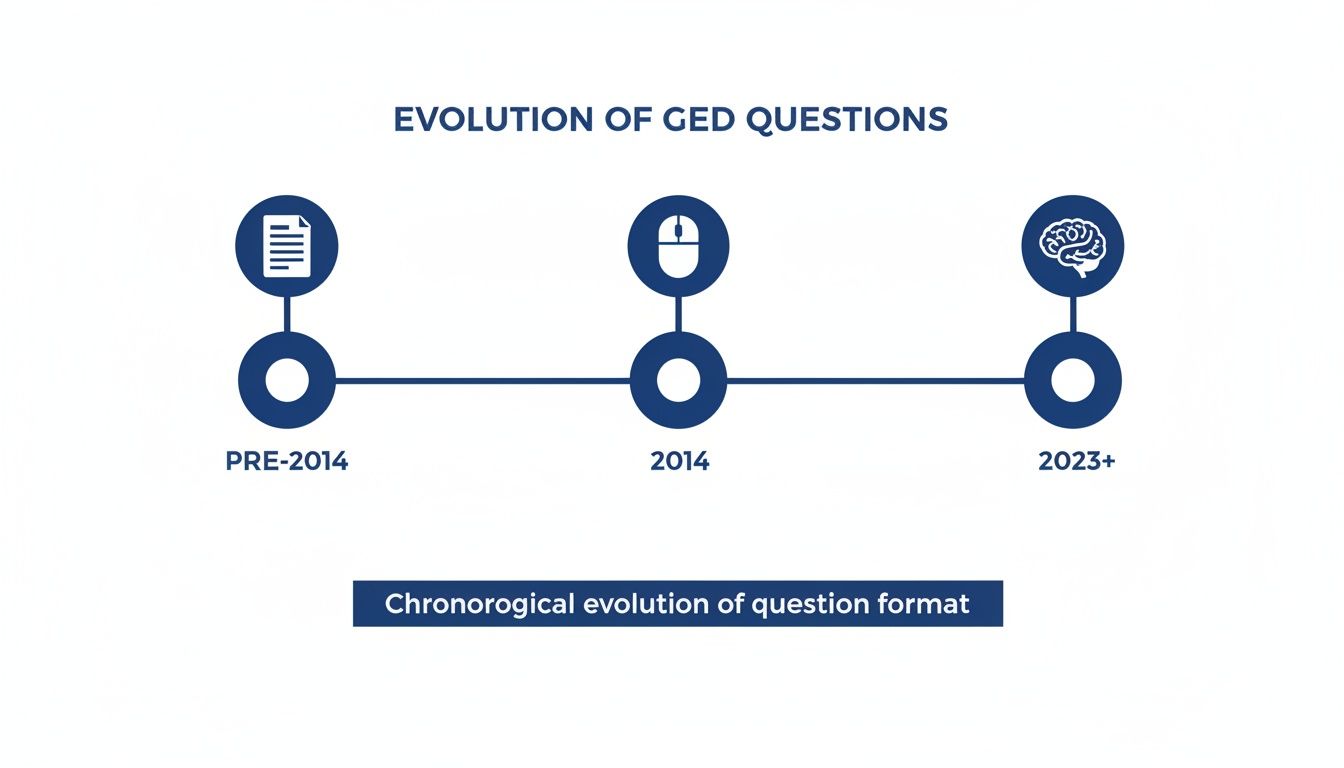
You can see the test has moved way beyond simple paper-and-pencil questions. Today's computer-based tasks demand a much deeper level of critical thinking.
Sample 8-Week GED Language Arts Study Schedule
Here’s a sample schedule to give you a starting point. Think of it as a template you can customize to fit your own needs.
| Week | Reading Focus | Writing & Language Focus | Practice Goal |
|---|---|---|---|
| Weeks 1-2 | Main Idea & Supporting Details | Sentence Structure (Fragments, Run-ons) | 1 Practice Test, Daily Reading |
| Weeks 3-4 | Author's Purpose & Point of View | Punctuation (Commas, Apostrophes) | 10 Grammar Drills, 2 Outlined Essays |
| Weeks 5-6 | Analyzing Arguments & Evidence | Word Choice & Verb Tense | Full-Length Timed Practice Test |
| Weeks 7-8 | Comparing Texts & Final Review | Essay Structure & Editing | Review Missed Questions, Write Full Essays |
Remember, this is just a guide. If you ace the punctuation questions but identifying the author's purpose is a struggle, then shift your time accordingly. Your study plan should be a living document—flexible, adaptable, and designed to lead you straight to a passing score.
For those who feel they need more structured guidance, expert-led GED tutoring and test preparation can create a plan that’s tailored specifically to your learning style and goals, helping you walk into test day ready for anything.
Managing Test Anxiety and Staying Focused

You can drill grammar rules and practice reading comprehension for weeks, but what happens when you sit down for the actual test and your mind goes blank? For so many students, the real challenge isn't the content—it's the crushing wave of anxiety that comes with a high-stakes, timed exam.
If the thought of the clock ticking down makes your heart pound, you’re not alone. The good news is that managing test anxiety is a skill. Just like identifying a main idea, it’s something you can practice and master.
Grounding Techniques for Test Day Calm
When anxiety kicks in, your brain flips into "fight or flight" mode. It’s a survival instinct that’s terrible for critical thinking. Your goal is to gently guide your nervous system back to a place of calm, and you can do it right at your testing station without anyone knowing.
One of the most powerful and discreet tools is box breathing. It’s a simple four-step rhythm:
- Inhale: Breathe in slowly through your nose for a count of four.
- Hold: Hold your breath for a count of four.
- Exhale: Breathe out slowly through your mouth for a count of four.
- Hold: Hold your breath again for a count of four.
Just repeating this cycle three or four times can slow your heart rate and quiet a racing mind. It creates just enough mental space to break the panic loop and refocus on the question in front of you.
Many people think they just have to power through anxiety. The truth is, acknowledging the feeling and using a simple tool like box breathing is a much smarter strategy for regaining control and focus.
Strategic Test-Taking for ADHD and Focus Challenges
The 150-minute duration of the GED Language Arts test can feel like a marathon, especially for learners who grapple with ADHD or focus issues. The key is to stop seeing it as one long, intimidating block of time.
Break it down into a series of short sprints. For example, think of the test as six 25-minute segments. After each one, give yourself a 10-second mental break to stretch or take a deep breath before starting the next sprint. This approach makes the whole experience feel far more manageable.
Another game-changer is the "flag for review" feature. Don't let a tough question derail your momentum and tank your confidence. Getting stuck on one problem wastes precious mental energy and feeds anxiety.
Instead, create a system:
- Flag it immediately. Don’t hesitate.
- Move on. Go answer the questions you do know to build momentum.
- Return with fresh eyes. After you’ve gone through the rest of the section, you can circle back to the flagged items, often with a clearer perspective.
This ensures you lock in all the points on questions you feel good about first.
For many students, particularly those with ADHD, specialized coaching can make all the difference. At Bright Heart, about 20% of our students are impacted by ADHD. We’ve seen that using nervous-system strategies helps them improve focus and boost essay scores by an average of 18%, turning that feeling of frustration into real confidence.
By learning these simple but powerful techniques, you can ensure your mindset is just as prepared as your academic skills are. For more ideas on managing stress, check out our guide on how to support stressed out students.
Common Questions About the GED Language Arts Test
When you’re gearing up for a big test, it’s the little unanswered questions that can pile up and create a ton of unnecessary stress. Getting clear, direct answers is the best way to quiet that noise so you can focus your energy where it actually counts: mastering the material.
Let's clear the air and tackle some of the most common questions we hear from students about the GED Language Arts exam.
What Score Do I Need to Pass?
The magic number you're aiming for is 145. A score of 145 out of 200 is what you need to officially pass the GED Language Arts test. This tells colleges and employers that you have the same skills as a graduating high school senior.
But passing is just the first step. Pushing for a higher score can really open up some doors for you down the road.
- GED College Ready (165-174): Scoring in this range shows you're ready to handle entry-level college courses without needing remedial classes.
- GED College Ready + Credit (175-200): A score this high is impressive. It might even let you skip placement tests or earn college credit at certain schools before you even step on campus.
Is the Essay Required to Pass the Test?
Yes, you absolutely have to complete the Extended Response—that’s the official name for the essay. While your final score is a blend of your performance across the whole test, you won't get a score at all if you don't at least attempt the essay.
Try to see the essay as an opportunity, not just a hurdle. A solid, well-argued essay where you pull evidence straight from the passages can give your overall score a serious boost, making it that much easier to pass.
Don't get hung up on your personal opinions. The graders aren't looking for what you believe; they want to see you act like a detective. Your job is to analyze the evidence in the texts and build a logical case for which author has the stronger argument.
Are Calculators Allowed on the Language Arts Test?
Nope! You won't need a calculator, and you won't be allowed to use one. The entire test is designed to measure your reading, writing, and grammar skills, so there’s no math involved.
You'll only be given a calculator for the test sections where it makes sense, like the Mathematical Reasoning and Science tests.
How Long Should I Prepare for the Test?
This is different for everyone, but most people find that 4 to 12 weeks of consistent study is the sweet spot. How much time you’ll need really depends on where you're starting from and how many hours you can realistically set aside each week.
The single best way to get a real answer for you is to take an official GED Ready practice test. It's like a diagnostic for your skills. It will show you exactly what you’ve already mastered and where you need to focus, letting you build a study plan that makes every minute count.
Feeling overwhelmed by the GED Language Arts test? The expert tutors at Bright Heart Learning can create a personalized study plan that builds your skills and confidence. Discover how our one-on-one tutoring can help you succeed.