

Executive Function Skills by Age: A Parent’s Guide to Milestones
Watching your child grow involves seeing them develop a whole set of mental tools that help them manage tasks, emotions, and goals. These tools are known as executive function skills, and they’re not something a child is born with. Instead, they build up over time, from the toddler years all the way through young adulthood, with important milestones at every stage.
What Are Executive Function Skills Anyway?
Have you ever wondered what’s happening in your child’s brain when they manage to follow a three-step direction, stop themselves from grabbing a cookie before dinner, or switch from playing to cleaning up without a full-blown meltdown? The magic behind all of that is their set of executive function skills.
Think of these skills as the CEO or the air traffic controller of the brain. They’re in charge of directing and managing all the mental traffic to make sure everything runs smoothly and on time.
Just like an air traffic controller has to manage planes taking off, landing, and navigating busy skies, a child’s executive functions help them manage all the information coming in and all the actions going out. They are the core abilities that let us plan ahead, stay focused, remember instructions, and juggle more than one thing at a time. These aren't just for school; they're the life skills we use for everything from getting dressed in the morning to navigating friendships.
The Three Core Components
At the heart of it all are three core skills that work as a team. Once you understand them, you’ll have a powerful new way to see your child's strengths and where they might need a little more support.
Working Memory: This is the brain’s mental "sticky note." It’s the ability to hold a piece of information in your mind for a short time and actually use it. When you ask your child to go to their room to get their socks, shoes, and jacket, their working memory is what helps them hold onto that list long enough to complete the task.
Inhibitory Control (or Self-Control): Think of this as the brain’s pause button. It's the skill that helps a child think before they act, resist an impulse, and stay focused even when there are distractions. Waiting for their turn in a game instead of just grabbing the toy is a perfect example of inhibitory control in action.
Cognitive Flexibility (or Flexible Thinking): This is the brain's ability to switch gears and adapt when things change. It allows a child to look at a problem from a different angle or adjust their plan when the first one isn't working out.
Executive function isn't about how smart a child is. It's about how well they can use what they know. A brilliant kid can still struggle if their brain's "management system" is underdeveloped and needs support.
These three skills are constantly working together. To follow a simple direction like, "Please turn off the TV and come to the table," a child has to use working memory to remember the instructions, inhibitory control to stop watching their show, and cognitive flexibility to shift their attention to the new activity.
As you start to notice these skills in everyday moments, you'll be better equipped to help your child build them. For a deeper dive into related techniques, you can explore the metacognitive strategies for learning in our detailed guide.
Executive Function Milestones in Early Childhood
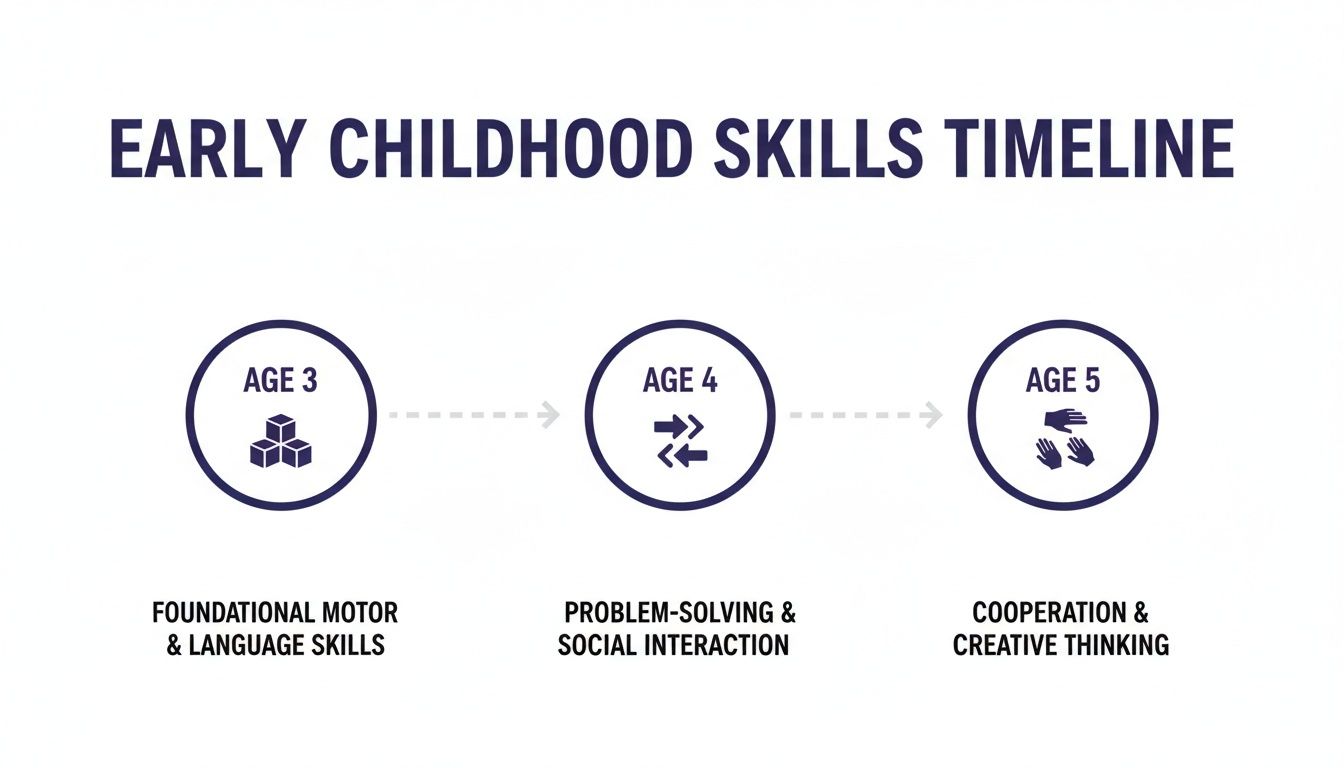
The whirlwind years of early childhood, from ages three to five, are when the very first seeds of executive function start to sprout. These skills aren’t about being a pint-sized genius; they’re about a child’s budding ability to manage their own thoughts, actions, and feelings in a world packed with exciting distractions and overwhelming emotions.
Think of it like a child learning to steer a bicycle for the first time. There will be wobbles. There will be a few tumbles. But with practice, they slowly start to gain control and find their direction. This early development is absolutely critical, setting the stage for more complex executive function skills by age as they grow.
Developing the Brains Pause Button
One of the biggest leaps you'll see is in inhibitory control—what you might call the brain's "pause button." At this age, a child begins to fight that powerful, primal urge to snatch a toy from a friend or shout out an answer. They won't get it right every time, but you’ll start to see those precious moments where they actually stop and think before they act.
Another key milestone is the growth of their working memory. This is like their brain's mental sticky note, and it’s getting bigger and stickier. You can see it in action when a child can finally follow a two-step direction, like, "Please put your cup in the sink and then get your shoes." They're learning to hold information in their mind just long enough to do something with it.
Watching a preschooler successfully wait their turn in a game is a huge win. It’s a real-time display of their developing self-control and working memory as they remember the rules and manage their impulse to jump ahead.
These abilities are deeply tied to a child's overall growth. To get a better sense of how these skills fit into the bigger picture, it’s helpful to explore the broader landscape of cognitive development in our resources.
Signs of Typical Development and Potential Challenges
It’s so important to remember that every child hits these milestones on their own timeline. Still, there are some general patterns you can look for.
Typical Milestones for Ages 3-5:
Following simple rules: They can play games with basic rules and understand classroom routines, like washing hands before snack time.
Shifting attention: With a little help from an adult, they can switch from one activity (like building blocks) to another (like story time) without a complete meltdown.
Basic impulse control: They're starting to show they can wait their turn or keep their hands to themselves, even if it's just for a short while.
Now, if a child consistently needs constant one-on-one direction to follow simple routines, has frequent and intense emotional outbursts that seem out of proportion for their age, or finds switching activities to be a major source of distress, it might be a sign that they need a bit more support.
Nurturing Skills Through Play
The absolute best way to build executive function skills in these early years is through play. Simple, everyday games are powerful workouts for a child's developing "air traffic control" system in their brain. And the best part? The activities make learning feel effortless and fun.
Simon Says: This classic game is a fantastic workout for inhibitory control (don't move if Simon doesn't say!) and working memory (remembering the command).
Red Light, Green Light: This one directly teaches kids to start and stop an action based on a cue, strengthening their self-regulation muscles.
Puzzles and Building Blocks: These activities are all about planning and problem-solving. They require a child to hold a goal in their mind—what the finished puzzle should look like—and figure out the steps to get there.
By weaving these simple, playful activities into your daily routine, you give your child countless opportunities to practice and strengthen these essential life skills without them even realizing it.
Building Blocks in the Elementary School Years
As kids trade the playful world of preschool for the structured halls of elementary school, the demands on their brains ramp up—big time. Suddenly, it’s not just about following one-step directions from a teacher. It's about remembering homework, keeping track of a backpack, and managing the frustration of a tricky math problem, all at the same time.
This leap, from ages six to eleven, is a critical period for executive function. Think of it as a major upgrade to a child’s internal operating system. The basic programs are installed, but now they need to run more complex applications without crashing. It’s a huge developmental jump, and it lays the groundwork for all future learning.
This period sees major growth in working memory, planning, and organization. By age six, a child's brain is typically ready to start juggling more information, allowing them to follow multi-step instructions and connect new ideas to what they already know.
The skills they built in early childhood—like cooperative play and listening to a story—are the direct foundation for the academic and social tasks they’ll face now.
Milestones for Ages 6 to 11
So, how can you tell if a child’s skills are on track? While every kid develops at their own pace, we tend to see common patterns of growth.
In early elementary (ages 6-8), you might see a child:
Starting to organize their school supplies, usually with reminders from a grown-up.
Remembering to do simple homework assignments without constant nagging.
Handling frustration a little better, maybe trying a new strategy instead of bursting into tears.
By late elementary (ages 9-11), these skills get more sophisticated. A fifth-grader, for example, might:
Begin breaking down a big book report into smaller, more manageable steps.
Keep their desk and backpack reasonably tidy with less and less oversight.
Follow classroom rules and social norms without needing constant reminders.
The real sign of progress is the shift from needing external reminders to using their own internal director. When a child starts packing their own soccer bag or remembers to return a library book on the right day without you saying a word—that’s their executive function muscle getting stronger.
To make these stages clearer, here’s a quick breakdown of what to expect and how you can support your child’s growth.
Elementary Executive Function Skills At-A-Glance
| Skill Area | Early Elementary (Ages 6-8) | Late Elementary (Ages 9-11) | Support Strategy |
|---|---|---|---|
| Organization | Can organize a backpack or desk with reminders. May need help sorting papers. | Starts to maintain an organized desk and binder independently. | Use visual checklists and color-coded folders to create simple, predictable systems. |
| Planning & Time | Can follow a simple schedule (e.g., morning routine). Struggles with future deadlines. | Begins to plan for tests and break down long-term projects into smaller steps. | Introduce a large family calendar to make time visible. Talk through upcoming events. |
| Working Memory | Can follow 2-3 step instructions. May forget homework or supplies. | Can follow more complex, multi-step directions and remember assignments. | Play memory games (Simon Says, Concentration). Give instructions one or two at a time. |
| Self-Control | Can wait their turn in a game. Still prone to impulsive outbursts when frustrated. | Better able to manage frustration and think before acting or speaking. | Use "time-in" instead of "time-out" to talk through big feelings. Model calm problem-solving. |
This table highlights the natural progression of these skills. What starts with heavy parental support in first grade should ideally transition to more independence by fifth grade.
Common Signs of a Struggle
When a child’s executive functions are lagging, the resulting behaviors are often mislabeled as laziness, defiance, or a bad attitude. It’s so important to look beyond the surface and ask why the behavior is happening.
Here are a few red flags to watch for:
Chronic Disorganization: Their desk, room, and backpack are constantly a disaster zone. Papers, books, and belongings seem to vanish into thin air.
Difficulty Starting Tasks: They just can’t seem to get going on homework or chores without a ton of adult prompting. This is sometimes called "task inertia."
Trouble with Time Management: They consistently underestimate how long things will take, leading to last-minute panic on projects and forgotten deadlines.
Emotional Dysregulation: They have surprisingly intense emotional reactions to small setbacks, which can seem immature for their age.
For kids facing these hurdles, school can feel like a daily battle. But the great news is that these skills are teachable, and there are simple ways to support them at home and in the classroom.
Practical Strategies to Build Independence
You don’t need complicated programs to help your child strengthen these critical skills. The most effective strategies are often simple, visual, and woven right into your family’s daily life.
Use Visual Checklists: A simple checklist with pictures or words for the morning routine, after-school tasks, or packing a backpack takes the load off a child’s working memory. It gives them a visual map to follow, which builds independence.
Create a Family Calendar: A big, centrally located calendar where everyone can see upcoming tests, projects, and activities helps make the abstract concept of time feel concrete.
Break It Down: Teach your child how to slice big assignments into "micro-tasks." A book report isn't one huge, scary thing; it's choosing a book, reading a chapter, writing a summary, and so on. This simple shift makes overwhelming projects feel totally doable.
Putting these kinds of systems in place can drastically cut down on homework battles and build your child’s confidence. For more ideas, check out our guide with 5 tips to keep your student organized.
The Wild Ride of the Teenage Brain

Adolescence is a time of massive growth and, let's be honest, massive chaos. The teenage brain is undergoing a huge renovation, especially in the prefrontal cortex—the command center for executive function. At the exact same time, school and social life get exponentially harder. It's the perfect storm of underdeveloped skills meeting high-stakes expectations.
This period, from about age 12 to 18, is when abstract skills like planning and prioritizing become absolutely essential. It’s no longer about just remembering one homework assignment. Suddenly, they're juggling a multi-week science project, a history final, soccer practice, and the incredibly complex world of friendships, all at once.
From Concrete to Abstract: A Whole New Ballgame
During the middle and high school years, the demands on executive function skills by age take a huge leap. A younger child just needs to manage what’s right in front of them, like cleaning a messy backpack. A teenager has to manage things they can't see—like time, competing deadlines, and future goals.
Their internal "air traffic control" system is suddenly managing long-haul flights instead of quick takeoffs and landings. This requires a completely new level of skill.
Key Milestones for Teens (Ages 12-18):
Strategic Planning: Teens start developing the ability to actually create and follow through on long-term plans. This is the high schooler who maps out a study schedule for finals weeks in advance or builds a timeline for college applications.
Advanced Prioritization: They begin to weigh the importance of different tasks. For example, they learn to prioritize studying for a test that’s 30% of their grade over finishing a small homework assignment due the same day.
Metacognition: This is the game-changing skill of "thinking about your thinking." Teens become more aware of their own process, asking questions like, "Is this study method actually working?" or "What do I need to do differently to get this project done on time?"
Flexible Problem-Solving: When their first plan fails, they get better at adapting. If a source for a research paper isn't available, they can pivot and find an alternative without having a complete meltdown.
A common myth is that a bright teen who misses deadlines is just lazy. More often, they are completely overwhelmed. Their brain's project manager simply hasn't developed the capacity to break a huge future goal down into small, actionable steps for today.
Common Struggles and What’s Really Happening
The teenage years are famous for procrastination, disorganization, and impulsivity. But these aren't character flaws. They're often just the visible symptoms of a brain that’s still building its executive function architecture. The part of the brain responsible for long-term consequences is still maturing, while the part responsible for immediate rewards is firing on all cylinders.
This internal tug-of-war leads to some very predictable struggles:
Procrastination: Starting a huge 10-page paper feels impossible. Scrolling through TikTok for "just five more minutes" provides an immediate dopamine hit and a welcome escape from the stress.
Digital Distractions: The constant ping of notifications makes it incredibly hard to maintain focus. A teen's developing impulse control is often no match for the powerful pull of their phone.
Overwhelming Disorganization: Without a solid system, managing assignments and notes for six or seven different classes can quickly turn into chaos. This is where you see the missed assignments and falling grades.
Teen-Friendly Strategies That Actually Work
Helping a teen build these skills means shifting from being their manager to being their consultant. The goal is to give them tools and frameworks, not to micromanage every move. The key is finding strategies that give them a sense of autonomy and control.
Practical Tools and Techniques:
Go Digital with Planners: Most teens will resist a paper planner, but they live on their phones. Apps like Google Calendar, Todoist, or even the basic Reminders app can help them track deadlines and schedule study time in a format they’ll actually use.
Introduce the Pomodoro Technique: This focus method is brilliantly simple. You work for a focused 25-minute burst, then take a 5-minute break. After four rounds, you take a longer break. It makes big tasks feel less intimidating and helps fight off digital distractions.
Do a "Brain Dump": When a teen is overwhelmed, have them write down every single thing they have to do on one giant piece of paper—assignments, chores, social plans, everything. Just getting it out of their head can lower anxiety and make it easier to see what needs to happen first.
Work Backwards from the Deadline: For long-term projects, teach them this simple trick. Start with the final due date and work backward, setting mini-deadlines for each step of the process. This turns a monster project into manageable chunks and prevents that last-minute panic.
By offering these kinds of structured, practical supports, you empower your teen to build the advanced executive skills they’ll need for high school, college, and the rest of their lives. If you need help finding the right approach, our academic coaches specialize in creating personalized systems that click for teens.
When to Consider Professional Support
Every kid forgets their homework sometimes. Every child has a meltdown over a frustrating task. It’s part of growing up. So, how do you know when these moments are just typical bumps in the road versus signs that your child needs more targeted help?
The key is looking for persistent patterns—struggles that consistently get in the way of their success and happiness. If the strategies you’re trying at home feel like they aren’t making a dent, and the daily battles are causing real stress for your child and your family, it might be time to bring in a professional.
This isn’t a sign of failure. It's a proactive and empowering step toward giving your child the right tools for their toolbox. Seeking help is about building skills and confidence, not just putting out fires.
Recognizing the Red Flags
Certain challenges go beyond occasional forgetfulness or a messy backpack. These red flags often signal that something deeper is going on with the development of executive function skills by age and suggest a more specialized approach could make all thedifference.
Here are a few key signs to watch for:
Chronic Academic Underperformance: You know your child is bright and understands the material, but their grades are sinking due to a constant stream of missed assignments, incomplete projects, or poor test preparation.
Constant Prompting Required: They seem stuck in neutral, unable to start or finish anything—from homework to chores—without you sitting right there, providing constant reminders. This is often called "task inertia."
Intense Emotional Dysregulation: Small setbacks trigger huge, overwhelming emotional responses that feel completely out of proportion for their age and the situation.
Pervasive Disorganization: Despite your best efforts to create systems, their backpack is a black hole, their desk is a disaster zone, and important papers vanish without a trace.
Significant Social Difficulties: They struggle to manage their impulses in conversations, can't seem to follow the flow of group activities, or find it hard to keep friends because of their emotional volatility.
A critical distinction to make is between can't and won't. When a child genuinely wants to do well but consistently fails to meet expectations despite clear consequences, it's almost always a sign of a skill deficit, not a will deficit.
The Connection to ADHD and Other Conditions
Difficulties with executive function are a hallmark of Attention-Deficit/Hyperactivity Disorder (ADHD). In fact, many experts now see ADHD primarily as a disorder of self-regulation and executive function. The classic challenges with focus, impulse control, and organization are direct reflections of a developing executive control system.
However, these struggles aren't exclusive to ADHD. They can also be linked to other learning differences and conditions like anxiety, depression, or processing disorders. For children showing these signs, learning more about the connection between executive function and ADHD can be an important step in finding the right path forward. The first step to effective support is untangling the root cause.
Types of Professional Support Available
Once you decide to seek help, you’ll find several different avenues to explore. The right choice depends entirely on your child’s specific needs and what your family hopes to achieve.
Here are some of the primary options:
Formal Assessments: A neuropsychological or psychoeducational evaluation provides a detailed map of your child's cognitive wiring—their unique strengths and weaknesses. This in-depth testing can pinpoint specific areas of executive dysfunction and diagnose conditions like ADHD, offering clear, actionable recommendations for school and home.
Executive Function Coaching: This is a highly practical, action-oriented approach. A coach works one-on-one with your child to build specific, real-world skills in planning, organization, time management, and getting started on tasks. It’s all about creating personalized systems your child can use right away.
Academic Tutoring with a Cognitive Focus: This goes way beyond just getting through tonight's math homework. A skilled tutor uses academic subjects as a training ground to teach the underlying executive function skills. They help your child learn how to learn more effectively.
Finding the right professional is like finding a partner who can help translate your child’s challenges into a clear plan of action. To get a better feel for this process, you might find it helpful to read our guide on what executive function support looks like for students.
Frequently Asked Questions About Executive Function
Diving into the world of executive function can bring up a lot of questions. As you watch your child grow, it’s completely natural to wonder what’s typical, what certain behaviors really mean, and how you can actually help. This section answers the questions we hear most often from parents, with clear insights you can use right away.
Can Executive Function Skills Be Improved in Older Kids and Teens?
Absolutely. It’s a common myth that if these skills aren’t solid by a certain age, the window has closed. The brain’s incredible ability to change and build new connections—a concept known as neuroplasticity—is in high gear through the teen years and well into early adulthood.
While the foundation is laid in early childhood, it's never too late to strengthen these skills. For teens, this often means learning explicit, concrete strategies for things like planning, organizing, and managing their time.
Things like using a digital calendar, breaking down a huge research paper into tiny micro-tasks, or even practicing mindfulness to sharpen focus can be game-changers. This is where academic coaching really shines—it provides personalized strategies and accountability, helping teens build durable habits they can take with them to college and beyond.
What Is the Difference Between Executive Function Coaching and Tutoring?
This is a crucial distinction. Both are designed to help students succeed, but they tackle the problem from completely different angles.
Think of it this way: a tutor is like a position coach on a sports team—they’ll teach your kid how to throw a better curveball. An executive function coach is the head coach, focused on overall game strategy, managing the clock, and knowing how to execute the plays under pressure.
Standard tutoring is content-focused. It helps a student master a specific subject, like algebra or chemistry. The goal is to learn the material for that class.
Executive function coaching, on the other hand, is process-focused. It’s all about the how of learning—how to plan out a study schedule, how to organize your binder, how to manage your time, and how to just start the work. A coach builds the underlying skills a student needs to become an independent learner across all subjects.
At Bright Heart Learning, we often blend the two. We use academic content as the real-world practice ground for building stronger executive function skills. This way, students don't just learn the material; they learn how to learn it effectively.
Is It Laziness or an Executive Function Challenge?
This is one of the most important and emotionally loaded questions we get from parents. The difference really comes down to intent versus impact. A child with executive function challenges genuinely wants to do well, but their brain struggles with the "how."
You might see baffling inconsistencies. They can focus for hours on a video game they love but can't bring themselves to start a five-minute homework assignment. They forget to turn in work they actually completed, or their backpack is a disaster zone no matter how many times you’ve helped them organize it.
"Laziness" implies a choice not to try. Executive function difficulties are skill deficits, not character flaws. If your child consistently struggles with planning, organization, or starting tasks—despite facing negative consequences and your best efforts to help—it’s a strong signal that there’s a skill gap that needs support.
What Simple Home Activities Support Executive Function?
Here’s the best news: you don’t need special programs or expensive kits. Building these skills can be woven right into the fabric of your daily family life, making it feel natural and fun.
These activities are like low-stakes workouts for the mental muscles needed for planning, remembering, and staying on track.
For Younger Children (Ages 3-7):
Play games with rules: Classics like 'Simon Says,' 'Red Light, Green Light,' board games, and card games like Uno are fantastic for building impulse control and working memory.
Cook together: Following a recipe involves sequencing steps, remembering what you just did, and managing time. Plus, you get cookies at the end.
For Older Children (Ages 8-18):
Involve them in planning: Ask for their help planning a family meal, a weekend outing, or even a small part of a vacation. This is real-world practice for planning and organization.
Create checklists: Have them make a visual checklist for their morning routine or for packing their soccer bag. This takes the load off their working memory and builds independence.
Estimate time: Before they start homework, ask them to guess how long an assignment will take. Afterward, compare the guess to the actual time. This simple habit builds time awareness and management skills.
By making these activities a regular part of your routine, you give your child countless opportunities to practice essential executive function skills by age in situations that matter.
At Bright Heart Learning, we know every child's brain is wired differently. Our expert coaches and tutors specialize in creating personalized strategies that build not just academic skills, but the confidence and executive function tools your child needs to thrive. If you're ready to move from frustration to progress, take a look at our academic coaching programs.