
Why Smart Students Still Struggle in School
Understanding the Learning Skills Continuum
Your child is smart.
You know it.
Their teachers probably know it too.
And yet… school still feels harder than it should.
Maybe homework takes hours.
Maybe writing assignments end in frustration or shutdown.
Maybe your child forgets directions, loses materials, melts down over simple tasks, or seems capable one day and completely overwhelmed the next.
For many families, this becomes deeply confusing.
Because from the outside, it can look like a motivation problem.
A focus problem.
A “not trying hard enough” problem.
But most of the time, that’s not what’s actually happening.
At Bright Heart Learning, we often work with students who are bright, thoughtful, creative, and working incredibly hard… while still struggling to keep up with the demands of school.
Not because they aren’t capable.
But because something underneath the surface is making learning far harder than it needs to be.
That’s where the Learning Skills Continuum comes in.
It’s one of the foundational models behind how we understand students, identify hidden learning roadblocks, and build lasting change.
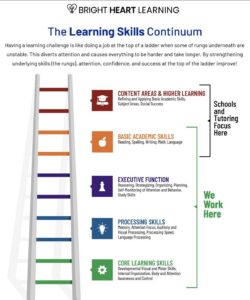
The Ladder Analogy
Imagine standing at the top of a tall ladder trying to do an important job.
Even if you’re highly capable, the work becomes exhausting if the rungs beneath you are shaky, unstable, or missing altogether.
You spend so much energy trying to stay balanced that there’s very little left for the actual task itself.
Learning works the same way.
The visible parts of school — reading, writing, math, test-taking, homework, essays, studying — sit at the top of the ladder.
But underneath those academic skills are deeper foundational skills that support learning:
- attention
- memory
- processing
- organization
- self-monitoring
- regulation
- executive function.
When those underlying systems are weak or overloaded, school can begin to feel frustrating, inconsistent, and emotionally exhausting.
Not because the student isn’t intelligent.
Because the foundation underneath learning is under strain.
This is why simply adding more tutoring, more pressure, or more repetition sometimes stops helping.
The issue often isn’t more content.
It’s that the learning foundation itself needs support.
The Five Layers of Learning
Research in cognitive science, educational psychology, and neurodevelopment consistently shows that learning develops in layers.
Higher-level academic success depends on lower-level foundational skills working together efficiently.
At Bright Heart Learning, we use a five-layer continuum to help us understand where students are struggling and what kind of support will actually move the needle.
1. Core Learning Skills
The Foundation Beneath Everything
This foundational layer includes things like body awareness, attention regulation, visual tracking, coordination, and internal organization.
These skills help students:
- stay physically regulated
- maintain focus
- track information on a page
- sustain attention
- manage their energy and awareness throughout the day
When these systems are under stress, students often look exhausted long before academic work even begins.
Sometimes these students are labeled as lazy, resistant, distracted, or unmotivated.
But many are actually working incredibly hard simply to stay regulated enough to function in a classroom environment.
2. Processing Skills
How the Brain Handles Information
This layer includes:
- working memory
- auditory processing
- visual processing
- processing speed
- language processing
- sustained attention
These are the systems responsible for taking in, organizing, storing, and using information.
Weaknesses here often look like:
- forgetting multi-step directions
- slow work completion
- difficulty retaining information
- needing repetition
- trouble retrieving knowledge under pressure
- understanding concepts verbally but struggling to apply them independently
These students are often trying very hard.
Their brains simply require more support and more efficient systems to process information successfully.
3. Executive Function
The Bridge Between Ability and Follow-Through
Executive function is one of the most important layers in the entire continuum.
This includes skills like:
- planning
- organization
- time management
- task initiation
- prioritization
- self-monitoring
- emotional regulation
- follow-through
Executive function is what allows students to take what they know and turn it into completed work.
This is often where parents begin feeling exhausted too.
Because many families slowly realize they’ve become their child’s external executive function system:
- managing assignments
- tracking deadlines
- organizing backpacks
- reminding constantly
- holding everything together
That level of support becomes unsustainable over time.
And for the student, it can quietly impact confidence and independence.
This is why executive function support is such a major part of our work at Bright Heart.
Not because students are incapable.
But because these are learnable skills that often need to be developed more directly and intentionally.
4. Academic Skills
Reading, Writing, Math, and Learning Content
This is where most schools and tutoring programs naturally focus.
Reading.
Writing.
Spelling.
Math.
Study skills.
Content mastery.
And when the foundational layers underneath are stable, students can often respond beautifully to direct instruction.
But when attention, processing, regulation, or executive function are under strain, academic work can begin to feel like pushing uphill constantly.
Students may relearn the same concepts over and over without lasting confidence or consistency.
That’s often the moment families realize: “This is about more than homework.”
5. Higher-Level Learning & Independence
Confidence, Ownership, and Lifelong Learning
At the top of the continuum is the ability to:
- think independently
- apply learning across settings
- problem-solve
- manage increasing academic demands
- develop confidence and ownership
This is where students begin to feel capable again.
Not just academically…
but emotionally too.
Because lasting success isn’t just about grades.
It’s about helping students experience themselves differently.
More confident.
More capable.
More resilient.
More independent.
Why Traditional Tutoring Sometimes Stops Helping
Traditional tutoring can be incredibly valuable.
Schools, tutors, accommodations, IEPs, and 504 plans all serve important purposes and often provide meaningful support for students.
But many of the families who come to Bright Heart have already tried those things and still feel like something deeper is being missed.
That’s because most educational systems are designed to focus primarily on the top layers of the ladder:
academic performance and content mastery.
At Bright Heart, we often work further down the ladder too.
We look at the underlying systems that support learning itself, because when those systems strengthen, students often experience:
- less frustration
- improved confidence
- greater independence
- stronger academic endurance
- and learning that finally starts to “stick”
What Working With Bright Heart Looks Like
Our work begins by understanding the whole student.
Not just grades.
Not just missing assignments.
Not just behaviors.
We look at patterns underneath the struggle.
Through assessments, observation, relationship-building, and ongoing support, we begin identifying which foundational skills may need strengthening.
From there, support may include:
- executive function coaching
- cognitive training
- academic support
- regulation strategies
- confidence-building
- processing support
- connection-centered learning approaches
And throughout all of it, relationship matters deeply.
Because real learning happens best when students feel safe, understood, and emotionally connected.
That’s the heart behind our “Connection Before Content” model.
The relationship is not separate from the learning.
It helps make the learning possible.
What Families Often Notice First
The first changes are not always academic.
Often families notice:
- less shutdown
- less resistance
- more willingness to try
- improved confidence
- reduced emotional overwhelm
- greater ownership
- more calm at home
Then, over time, the academic growth follows.
Because once the foundation underneath learning becomes stronger, students are finally able to use the intelligence and effort that were there all along.
You Are Probably Not Seeing the Full Story Yet
If your child’s struggles don’t seem to match their intelligence… there’s usually a reason.
And it’s often far more understandable than families realize.
At Bright Heart Learning, we help uncover what may be getting missed underneath the surface so students can build the skills, confidence, and support systems they truly need.
Not just to survive school.
But to feel successful in learning again.
Want to talk through your child’s situation? Learn more about our executive function coaching or read the complete coaching guide.
Book a free consultation or call us at 360-777-5224. We’ll help you figure out where the real bottleneck is — and what to do about it.