

How to Prepare for College Placement Tests and Succeed
Preparing for a college placement test is about more than just a quick study session; it's about playing the long game. The whole point is to map out a smart, targeted plan that starts with figuring out where you stand, zeroes in on your weak spots, and uses practice tests to get you ready for the real thing.
Why Your Placement Test Score Really Matters
Let’s get one thing straight right away: a college placement test is not an admissions test. Your score won’t get you accepted or rejected. The college is simply using it to figure out which entry-level math and English courses are the right fit for you.
That might sound low-stakes, but the results can seriously impact your entire first year. A good score puts you straight into the credit-bearing courses you need for your degree. A low score, on the other hand, almost always means you’ll be assigned to mandatory remedial classes.
These remedial courses are designed to get you up to speed, but they have three huge downsides:
- They cost money. You're paying full tuition for these classes.
- They don't count toward your degree. The credits don't help you graduate.
- They eat up your time. Each one takes a full semester, which can easily delay your graduation date.
The Real-World Impact on Your College Journey
Let's look at two students, Maria and David, who both had to take the ACCUPLACER placement test.
Maria spent a couple of weeks prepping. She took a practice test, realized her algebra was a bit rusty, and spent time reviewing those concepts. Because she prepared, she scored high enough to jump right into College Algebra—a required, credit-bearing course for her business major. From day one, she was on track.
David figured the test was no big deal and didn't prepare at all. His score landed him in a semester-long remedial math class that didn't earn him a single credit toward his degree. He had to pay tuition for a class that didn't move him closer to graduation, and it pushed back his timeline for taking other required courses. That one oversight cost him both time and money.
The difference here wasn't about who was smarter or who did better in high school—it was simply about preparation. Treating a placement test like just another administrative task is a costly mistake.
Connecting the Dots to Your Future Success
Your performance on a placement test gives the college a snapshot of your readiness for college-level work. While your high school transcript gets you in the door, these tests are what validate those grades in a practical sense. It's a big deal. National data shows that a shocking 60-70% of community college students end up in remedial courses, hitting a roadblock before they even really start. You can dig into more data on college readiness over at Pew Research.
This is exactly why figuring out how to prepare is so important. A good plan isn't just about dodging remedial classes; it’s about starting your college journey with confidence, saving thousands of dollars, and staying on track to graduate on time. It's your first real step toward building a successful academic career.
Create Your Personal Diagnostic Study Plan
Feeling swamped by everything you could be studying is one of the biggest hurdles students face. Instead of just guessing or cramming random topics, the smartest way to start is by creating a plan based on real data. That process begins with taking a diagnostic test to get an honest baseline of where your skills are right now.
This first step is all about trading vague anxiety for concrete information. You wouldn’t start a road trip without knowing your starting point, and the same exact logic applies to prepping for a college placement test.
First, Identify the Test and Grab Your Materials
Before you do anything else, you need to know exactly what test you're up against. Most colleges use standardized tests like the ACCUPLACER, but some schools have their own unique assessments. The quickest way to find this out is to check your college’s admissions or testing services website.
Once you’ve got the name of the test, your next move is to hunt down official practice materials. The companies that create these tests (like the College Board for the ACCUPLACER) almost always offer free sample questions and full-length practice tests. Sticking to these official resources is crucial because they'll perfectly mirror the question types, format, and difficulty you'll face on the actual test day.
Taking a baseline test isn't about acing it; it's about gathering intelligence. The goal is to uncover your specific strengths and—more importantly—the exact areas that need a little more work.
Simulate the Real Test Conditions
Just finding a practice test isn't enough. How you take it makes all the difference. To get a truly accurate diagnostic, you have to mimic the real testing environment as closely as you possibly can.
Here are the ground rules for your first practice run:
- Set a Timer: Follow the time limits for each section to the second. This is the only way to know if pacing is an issue for you.
- Kill All Distractions: Find a quiet spot where no one will interrupt you. That means putting your phone on silent and in another room.
- No Cheating: Don't look up answers or use a calculator unless it’s specifically allowed for that section. The whole point is to see what you know, right now, on your own.
This might feel a little intense, but the data you get from it is priceless. It shows you how your brain works under pressure, which is a huge part of any standardized test. Once you finish, you’ll have a raw score that becomes your starting point. You can improve your focus and other critical learning skills with the right strategies; you can learn more about powerful study skills for college students on our blog.
Now, Analyze Your Results—Deeply
That raw score is just a number. The real gold is in analyzing your mistakes. Go through every single question you got wrong and sort it into one of three categories.
To get started, create a simple table like the one below. As you review your test, put a tally mark in the appropriate box for each mistake.
Your Personalized Diagnostic Test Analysis
Use this table to analyze your first practice test. Tally each incorrect answer in the appropriate category to identify your primary areas for improvement.
| Subject Area (e.g., Algebra, Reading Comp) | Number of Careless Errors | Number of Concept Gaps | Number of Time-Pressure Mistakes |
|---|---|---|---|
| Example: Pre-Algebra | |||
| Example: Sentence Skills | |||
Once you’ve tallied everything up, you’ll see a clear pattern emerge. Here’s how to interpret the results:
- Careless Errors: These are the face-palm mistakes. You knew how to do the problem but made a simple slip-up, like a calculation error or misreading the question. This points to issues with focus or rushing, and the fix is usually about slowing down and double-checking your work.
- Concept Gaps: These are the questions where you genuinely had no idea how to find the answer. The underlying concept or formula was a total mystery. These are your top-priority study topics—you need to go back and relearn that material from the ground up.
- Time-Pressure Mistakes: You probably could have gotten these right, but the clock ran out. This tells you that you need to work on your pacing and time management strategies. Sometimes, it can also point to a concept gap that’s slowing you down.
Looking at your results this way transforms them from a score into an actionable battle plan. If you see a ton of careless errors, your prep should focus on mindfulness and checking your work. If concept gaps are the big problem, you now know exactly which chapters in your textbook need your attention. You can also integrate social learning concepts by forming a study group, which can be a huge help in deepening your understanding of tricky topics. This structured analysis is the bedrock of smart, efficient prep.
Conquer the Math Section with Targeted Strategies

For a lot of students, the math section is the single biggest source of stress on a placement test. I get it. The good news is that math skills are like muscles—with the right exercises, you can make them a whole lot stronger.
The key is to stop trying to study "everything." A strategic approach that breaks down intimidating topics into manageable pieces is what builds real confidence. Use your diagnostic results to focus your energy where it will count the most.
Building from the Ground Up: Pre-Algebra and Algebra
The vast majority of placement test math questions are rooted in algebra. If your diagnostic test showed some shaky spots here, this is your priority. Don't even think about jumping into complex equations if you aren't completely solid on the basics. It just won't work.
Start with the order of operations (PEMDAS/BODMAS). It sounds simple, but one mistake here can throw off an entire problem. From there, rebuild your skills systematically.
- Integers and Fractions: Get comfortable again with positive and negative numbers. Master adding, subtracting, multiplying, and dividing fractions until it's second nature.
- Solving for x: This is a core skill. Practice isolating variables in linear equations until you can do it in your sleep.
- Word Problems: Focus on translating sentences into math. This is often more about reading comprehension and logic than complex calculations.
A common pitfall is just memorizing formulas without understanding why they work. Focus on the logic behind them. When you know the 'why,' you can adapt and apply your knowledge to unfamiliar problems instead of just plugging in numbers.
This deeper understanding is what separates students who feel stuck from those who succeed. It gives you the flexibility to solve problems, not just follow recipes.
Tackling Geometry and Advanced Topics
Once your algebra foundation is solid, you can move on to other common areas like geometry. Placement tests usually stick to core concepts rather than complicated proofs. Your energy should be focused on understanding and applying formulas for the area, perimeter, and volume of common shapes—think circles, triangles, and rectangles.
A solid grasp of the Pythagorean theorem is also non-negotiable, as it shows up in all sorts of ways. And don't forget to brush up on your rules for angles and parallel lines.
This is where rigorous high school coursework really pays off. We often see that students who master AP-level math score 30-40% higher than their peers, allowing them to bypass remedial classes entirely. Recent data shows just how valuable this advanced prep is for everyone. For instance, Black students' credit-qualifying AP scores rose 117% and Latino students' scores went up 139% between 2015 and 2025. Given that general math achievement has seen some declines, targeted prep is more critical than ever. You can read more about these evolving trends in advanced placement.
The Role of Executive Function in Math Success
Getting through a long, tough math section isn't just about what you know; it's also about managing your brain under pressure. Executive functions—the mental skills that help you plan, focus, and juggle tasks—are absolutely critical.
Did your diagnostic test show a lot of careless mistakes? Did you feel rushed and make errors because of the clock? That could be a sign your executive function skills need some support.
This is where executive function coaching can be a game-changer. A coach helps you build practical, real-world strategies for:
- Sustained Attention: Techniques to stay locked in during a long test.
- Working Memory: Methods for holding multiple pieces of information in your head to solve those multi-step problems without getting lost.
- Time Management: Strategies for pacing yourself so you don’t get stuck on one hard question and run out of time for the easier ones.
For example, a coach might help you develop a "brain dump" habit where you jot down key formulas the second the test starts. Or they might teach you a system for flagging tough problems to circle back to later, ensuring you pick up all the easier points first.
By strengthening these underlying cognitive skills, you're building a more resilient and efficient problem-solving engine. Our team at Bright Heart Learning specializes in exactly this kind of support. We help students build not just academic knowledge, but the mental tools to use it effectively. Learn more by exploring our tutoring and academic coaching services.
Sharpen Your Reading and Writing Skills
While the math section of placement tests tends to grab all the attention, your reading and writing abilities are just as critical. In fact, they might be even more important for your long-term success in college.
These sections measure how well you understand complex information and communicate your ideas—skills that form the bedrock of pretty much every course you'll ever take. Math problems usually have one right answer. Interpreting a passage or building a persuasive argument, on the other hand, demands a totally different kind of thinking. It’s about spotting the main idea, understanding an author’s tone, and organizing your thoughts logically when the clock is ticking.
Mastering the Reading Comprehension Passages
The reading comprehension portion of your test isn't just about reading; it's about strategic reading. The passages can be dense, and the questions are often designed to see if you can analyze information quickly without getting lost in the weeds. The goal here is active, not passive, reading.
A great way to start is by previewing the questions before you even touch the passage. This simple step gives your brain a mission. You’re no longer just reading words; you’re hunting for answers. As you read, actively look for the main idea in each paragraph, which is often hiding in the first or last sentence.
Here are a few other active reading techniques that really work:
- Underline key phrases: As you read, highlight topic sentences, definitions, and any phrases that connect directly back to the questions you just previewed.
- Summarize in your head: After each paragraph, take a couple of seconds to mentally recap its main point. This keeps your mind from wandering and ensures you’re actually absorbing the content.
- Identify the author's purpose: Ask yourself: Is the author trying to inform me, persuade me, or entertain me? Understanding their goal makes it much easier to interpret the passage's true meaning.
Your only job is to find the answers within the text provided. You don’t need to be an expert on the topic or bring in outside knowledge. Stick strictly to what's written on the page and avoid making assumptions.
For a deeper dive into these strategies, check out our guide on how to improve reading comprehension skills. It’s packed with practical tips that can make a real difference.
Decoding Grammar and Sentence Skills
This is where the test gets technical, but the good news is that the rules are finite. Placement tests almost always hit a core set of common grammar and sentence structure mistakes. Your diagnostic results will point you to your specific weak spots, but you can bet you’ll see questions on these topics:
- Subject-Verb Agreement: Make sure your subjects and verbs match. For example, "The student studies" versus "The students study."
- Comma Usage: Know the rules for using commas in lists, with conjunctions, and after introductory phrases. This is a big one.
- Pronoun Agreement: Ensure pronouns match the nouns they replace (e.g., "Each student should bring their book" is now widely accepted, but it’s good to recognize older "his or her" constructions, too).
- Sentence Fragments and Run-ons: Every sentence needs a subject and a verb to be complete. Two complete sentences must be joined correctly, not just smashed together with a comma.
To really stand out on the reading and writing sections, it's also a great idea to actively build your academic vocabulary. A stronger vocabulary helps you navigate dense passages and express your own ideas with more precision.
Crafting a Winning Essay Under Pressure
If your placement test includes a timed essay, remember this: graders are not looking for a literary masterpiece. They’re looking for a clear, organized, and well-supported argument. The single biggest mistake students make is just diving in and writing without a plan.
Taking just two minutes to sketch out a simple outline can be a game-changer. It keeps you focused and prevents you from rambling when the pressure is on.
Here’s a powerful, straightforward structure that always works:
- Introduction (1 Paragraph): Start with a hook to grab the reader's attention. State your main argument or thesis clearly in the last sentence. No mystery here—tell them what you're going to prove.
- Body Paragraphs (2-3 Paragraphs): Each paragraph should focus on a single point that supports your thesis. Start with a topic sentence, give a specific example or piece of evidence, and then explain how that evidence proves your main idea.
- Conclusion (1 Paragraph): Briefly restate your thesis in a new way and quickly summarize your main points. End with a final thought that gives the reader something to consider.
This structure provides a rock-solid framework that makes your essay logical and easy to follow. Practice writing a few essays with a timer using this model, and you'll see your speed and confidence skyrocket.
Build Endurance and Test-Day Readiness
Knowing the material is only half the battle. The other half? Being able to perform when the clock is ticking and the pressure is on.
This is where you shift from just studying to training. Effective practice is about much more than getting questions right—it's about building the mental stamina to walk into that testing center feeling prepared, confident, and ready for anything.
The goal is to make the real test feel almost boringly familiar, like just another practice run you've done a dozen times before. By mimicking the official conditions, you systematically desensitize yourself to the pressure, turning anxiety into focused readiness.
From Practice to Performance Simulation
Once you've patched up the knowledge gaps you found on your diagnostic test, it's time to get serious about full-length, timed practice tests. This is a non-negotiable step. Untimed practice is great for learning the concepts, but timed practice is where you build the skills that actually boost your score.
To do this right, you need to replicate the real testing environment as closely as you possibly can.
- Find a Quiet Space: This means a room free of distractions. No music, no TV, and for heaven's sake, put your phone on silent and in another room.
- Set a Strict Timer: Use the official time limits for each section. When that timer goes off, you stop. Period. Even if you're mid-sentence.
- Follow the Rules: Only use the materials you're allowed on the actual test. If a section prohibits a calculator, don't you dare touch one during your simulation.
This disciplined approach does more than just show you what you know; it trains your focus. Think of it like a workout for your brain. Studies on cognitive endurance show that sustained mental effort, just like physical exercise, improves with consistent training. Each simulated test strengthens your ability to stay sharp from the first question to the very last.
Essential Strategies for Test Day Success
As you work through these timed practice runs, start actively using proven test-taking strategies. These aren't tricks; they're smart techniques to help you work more efficiently and squeeze every possible point out of the test.
One of the most powerful tools in your arsenal is the process of elimination. It's a simple mental flip. On a multiple-choice question, instead of hunting for the right answer, focus on immediately spotting and crossing out the wrong ones. You can often discard one or two answers right away, which dramatically increases your odds even if you have to make an educated guess between the last two.
Speaking of guessing, you need to know the rules of the game. Most placement tests, like the ACCUPLACER, don't penalize you for wrong answers. What does that mean for you? Never leave a question blank. A 25% chance of getting it right is infinitely better than the 0% you get by leaving it empty. Always make your best guess.
Time management is where so many students stumble. Practice is your chance to get this right. If a question has you completely stumped, mark it and move on. It is far better to answer three easier questions correctly than to burn five minutes wrestling with one difficult problem.
Managing Test Anxiety and Staying Calm
Look, all the prep in the world won't do you any good if anxiety hijacks your brain on test day. It's completely normal to feel nervous. The key isn't to eliminate the nerves but to have a plan to manage them so they don't undermine all your hard work.
Deep breathing is your secret weapon here. Seriously. If you feel your heart pounding or your thoughts starting to scatter, just pause. Close your eyes. Inhale slowly for four counts, hold your breath for four, and exhale slowly for four. Do this three or four times. It’s a biological reset button for your nervous system and can pull you right back into focus.
Your internal monologue also has a huge impact on your performance. Don't let thoughts like "I can't do this" run the show. Actively replace them with "I've prepared for this, and I can handle it."
For a deeper dive into practical strategies, our guide on how to reduce test anxiety offers a ton of actionable advice to help you stay calm and centered. Combining these mental tools with your academic prep is what creates a truly bulletproof plan for success.
Your College Placement Test Prep Checklist
When it comes to prepping for a placement test, consistency is your secret weapon. But staying consistent without a plan is nearly impossible. To help you stay on track and build momentum, I've pulled all the key strategies from this guide into one simple, week-by-week roadmap.
This visual timeline breaks everything down into three manageable chunks: the initial practice phase, the test simulation phase, and the final stretch leading up to the big day.
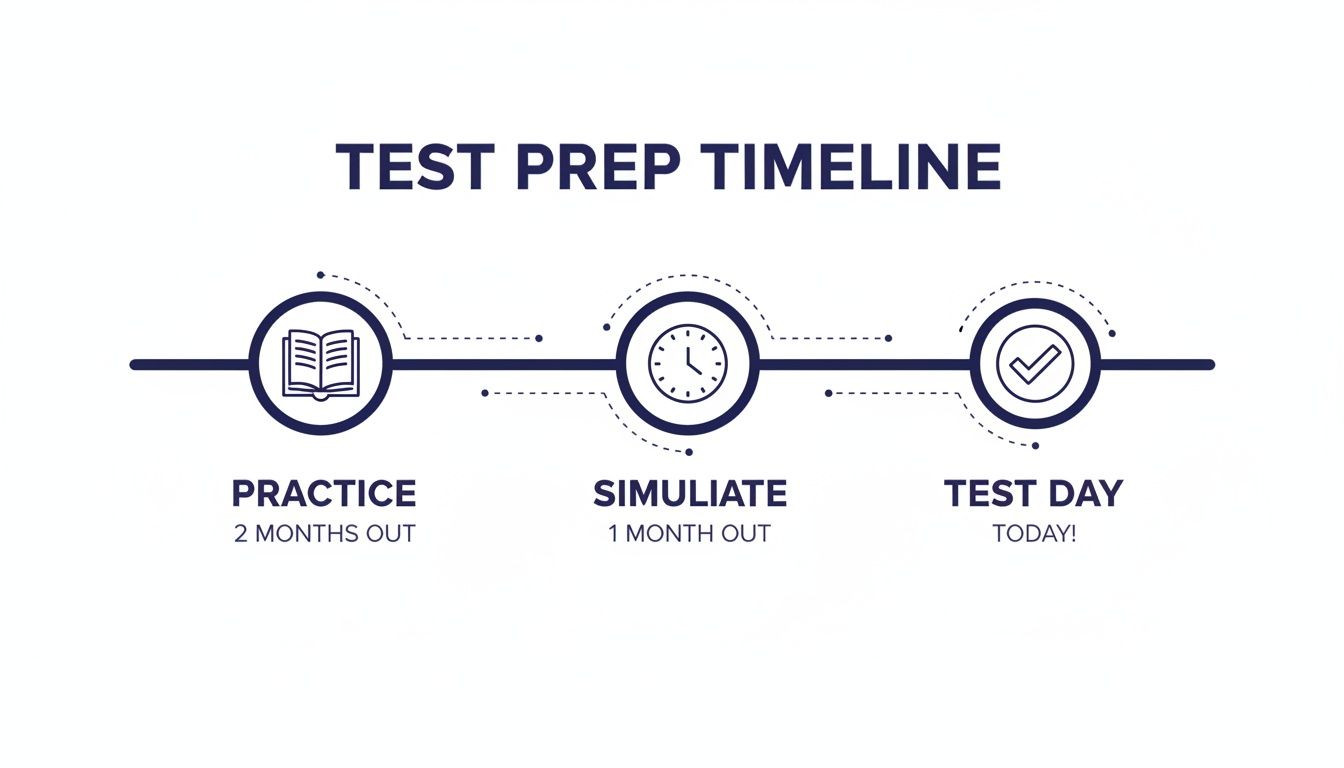
Think of it this way: each stage builds on the last, so you walk into that testing center feeling prepared, not panicked.
The 8-Week Countdown
8 Weeks Out
Your first job is reconnaissance. You need to know what you're up against.
- Find out the exact placement test your college uses. Is it the ACCUPLACER? The ALEKS? Get the name.
- Head to the official test-maker's website and download every single practice test and sample question set you can find.
- Take a full-length diagnostic test. And I mean the whole deal—timed conditions, no distractions. This gives you your baseline score.
- Now, analyze your results. Don't just look at the score. Dig into your mistakes and sort them into categories: concept gaps (stuff you never learned), careless errors (you knew it but messed up), and time-pressure mistakes.
6-7 Weeks Out
This is where the real work begins. You'll build your study schedule around what you learned from your diagnostic test.
- Map out your weeks. Dedicate specific, non-negotiable blocks of time to your weakest areas first.
- Start your targeted review. Dive into core math concepts like pre-algebra and algebra, and brush up on English fundamentals like grammar and sentence structure.
- Focus on understanding why formulas work. Rote memorization won't save you when a question is worded in a weird way.
4-5 Weeks Out
You've been reviewing concepts; now it's time to apply them.
- Continue your review but shift the focus to working through practice problem sets. Repetition builds muscle memory.
- Start using active reading strategies for those reading comprehension passages. Don't just read—underline, take notes, and ask yourself what the main point is.
- Write one timed practice essay per week. Stick to a standard five-paragraph structure. This isn't about writing a masterpiece; it's about getting comfortable with the format under pressure.
This checklist is a fantastic starting point, but true progress comes from listening to what the results are telling you. If a specific type of math problem keeps tripping you up, don’t just grind through more examples. Stop and seek out a better explanation.
2-3 Weeks Out
Time for a progress check.
- Take another full-length, timed practice test. This will show you how far you've come and what still needs work.
- Analyze the results just like you did the first time. Where are the remaining weak spots? Adjust your study plan to attack them.
- Practice your test-taking strategies. This means using the process of elimination and learning how to make a smart, educated guess when you're truly stuck.
The Final Week
The goal this week is to stay sharp, not to cram.
- Do a final, light review of your notes, key concepts, and important formulas. Seriously, do not try to learn new material.
- Get the logistics sorted. Confirm your test location and time. Double-check what you need to bring (ID, calculator, etc.) and what you need to leave at home.
- Make sleep, good food, and relaxation a priority. Your brain works better when it's rested.
Test Day
You've done the work. Now it's time to trust your preparation.
- Eat a solid breakfast, but don't overdo it. Arrive at the testing center with time to spare.
- If you feel the nerves creeping in, take a few slow, deep breaths. This simple trick can work wonders to calm your system.
- Breathe. You've got this. Just tackle it one question at a time.
For a completely personalized plan that includes expert tutoring and academic coaching, the team at Bright Heart Learning is here to help. You can find us at our office, conveniently located at 9327 Lincoln St NE, Poulsbo, WA 98370.
Your Top Questions About College Placement Tests, Answered
As the test date gets closer, it's totally normal for a few questions—and maybe a little bit of stress—to bubble up. Let's walk through some of the most common things we hear from students and parents. Getting clear answers is one of the best ways to quiet that pre-test anxiety and feel ready to go.
How Long Should I Really Study for a Placement Test?
This is the big one, right? While everyone's starting point is different, the sweet spot for preparation is usually 4-8 weeks before your test. That gives you enough time to move through the whole process without that awful last-minute cramming feeling.
Honestly, a consistent schedule of just 3-5 hours a week is way more effective than trying to pull an all-nighter. This timeline allows you to take a diagnostic test, really dig into the areas that need work, and get a few full-length practice tests under your belt. That’s how you build both knowledge and test-taking stamina.
Can I Retake the Test if I Bomb It?
Deep breath—in most cases, yes. The vast majority of colleges will let you retake a placement test at least once, though the exact rules can differ from school to school.
Before you bank on a retake, you'll want to check the college's testing services website for the specifics. Look for details like:
- Waiting Periods: Do you have to wait a certain amount of time before your next attempt?
- Fees: Is there a cost for the second try?
- Retake Limits: How many times can you retake it?
The most important thing? If you do need a do-over, treat that first score report like a gift. It's not a failure; it's a personalized roadmap showing you exactly what to focus on to nail it the second time around.
Think of your first score not as a final grade, but as a super-detailed diagnostic tool. It gives you a crystal-clear map of precisely what you need to study to guarantee a better outcome.
What if I Have a Learning Disability or Need Accommodations?
If you have a documented learning disability, like dyslexia or ADHD, and you had accommodations (like extended time) on tests in high school, you are almost certainly eligible for similar support in college.
But—and this is a big one—these things aren't automatic. You have to be proactive. Contact your college's disability services or accessibility office well in advance of your test date. They'll need to see official documentation of your disability to get any accommodations approved. Don't wait until the week before, because the verification process can easily take several weeks.
At Bright Heart Learning, we know every student's path is different. If you're looking for a personalized test prep plan that builds real skills, lasting confidence, and smart strategies for success, our team of expert tutors and academic coaches is ready to help. See how we can help at https://brightheartlearning.com.