
A Parent’s Guide to the Perimeter of a Shape
The perimeter of a shape is simply the total distance around its outer edge. Think of it like walking the boundary of a park—the total distance you cover is its perimeter. It's a measure of length, not the space inside the shape.
What Is Perimeter and How Do You Explain It?
When we talk about perimeter, we're dealing with one of the most fundamental ideas in math: length. It’s a concept we use all the time without even thinking about it, from wrapping a present to framing a picture. Getting a solid grip on perimeter is the first step to mastering more complex geometry.
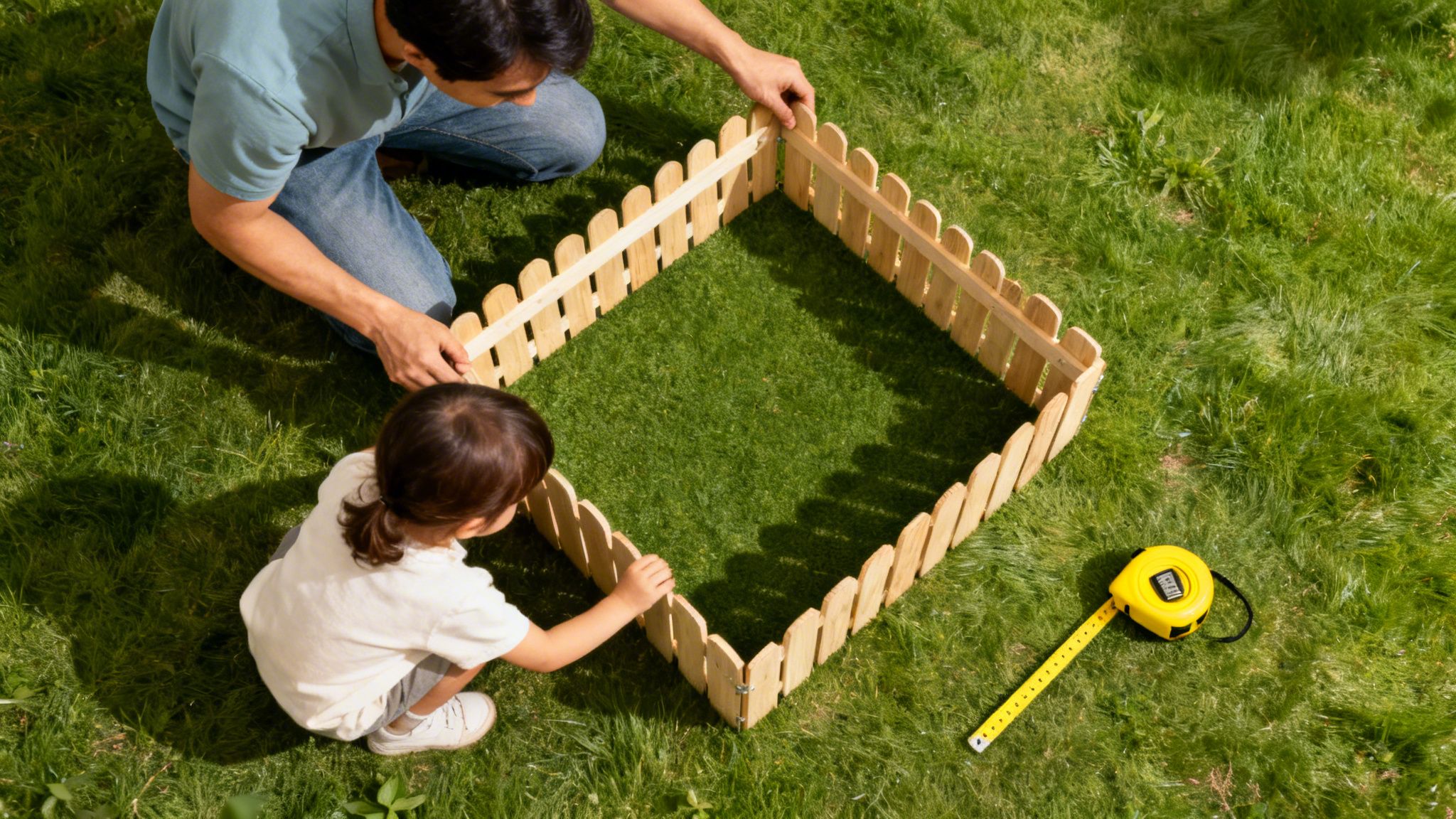
A perfect analogy is building a fence. If you want to fence in a garden, the total length of fencing material you need to buy is the garden's perimeter. You’re measuring the distance around the garden, not the space inside it where the vegetables will grow.
Making the Concept Tangible
To bring perimeter to life for a child, I love using the "walk the line" idea. Take any flat shape—a square, a star, or even a free-form blob—and imagine a tiny ant walking along its very edge. The total distance that ant travels to get right back to where it started? That's the perimeter.
This hands-on way of thinking connects an abstract math term to a physical, memorable action. A student can trace the edge of a book with their finger, walk the boundary of their bedroom, or use a piece of string to outline a shape on paper. The length of that string is the perimeter. This is exactly how our approach to elementary subjects tutoring works—we always start with these real-world, tangible connections.
Perimeter vs. Area: A Common Stumbling Block
One of the first big hurdles for students in geometry is mixing up perimeter and area. They are two completely different measurements, and getting them straight from the beginning prevents so much future confusion.
Perimeter measures the length of the boundary (the "fence"), while Area measures the amount of surface inside that boundary (the "yard").
This is a critical distinction. It’s the difference between measuring a line and measuring a surface.
To help clarify this common point of confusion, here's a quick side-by-side comparison.
Perimeter vs Area At a Glance
| Concept | What It Measures | Analogy | Units |
|---|---|---|---|
| Perimeter | The distance around a 2D shape. | The length of a fence around a yard. | Linear units (inches, cm, feet) |
| Area | The space inside a 2D shape. | The amount of grass inside the fence. | Square units (sq. inches, sq. cm) |
Think of a picture frame. The perimeter is the length of wood needed to build the frame itself. The area is the amount of glass needed to cover the photo inside. While they're related, they measure entirely different things. Mastering this difference sets a strong foundation for all the math that comes next.
Perimeter Formulas: Your Shortcut for Common Shapes
Alright, now that we’ve wrapped our heads around what perimeter actually is—the distance around a shape—let’s get into the practical side of things. How do we actually calculate it without having to measure every single side, every single time?
Thankfully, math gives us some handy shortcuts. For most common shapes, there are simple formulas that do the heavy lifting for us. Think of these formulas as your go-to toolkit for homework, class projects, and even weekend DIYs. They’re like recipes: if you have the right ingredients (the side lengths), you can follow a few simple steps to get the perfect result.
We'll start with the shapes students see most often: squares, rectangles, and triangles.
Perimeter of a Square
A square is special. Why? Because all four of its sides are exactly the same length. This unique feature makes finding its perimeter incredibly simple. Instead of adding the sides one by one, you can just multiply the length of one side by four.
The formula for a square’s perimeter is:
P = 4s
P is the Perimeter.
s is the length of one side.
Example: Building a Sandbox Border
Imagine you're building a small wooden border for a square sandbox in the backyard. You measure one side and find it’s 5 feet long. How much wood do you need to go all the way around?
Identify the side length (s): s = 5 feet.
Plug it into the formula: P = 4 x 5 feet.
Calculate the result: P = 20 feet.
That’s it! You’ll need 20 feet of wood to frame the entire sandbox.
Perimeter of a Rectangle
A rectangle also has four sides, but unlike a square, only its opposite sides are equal. You’ve got two longer sides (the length) and two shorter sides (the width). To find its perimeter, you just need to add up all four sides.
The formula for a rectangle’s perimeter is:
P = 2l + 2w or P = 2(l + w)
P is the Perimeter.
l is the length.
w is the width.
Both formulas work perfectly. Some kids find it easier to double the length, double the width, and then add them. Others prefer to add the length and width first, then double that total. Let your child use whichever one clicks for them!
Example: Framing a Favorite Poster
Let's say you have a cool poster that is 3 feet long and 2 feet wide. To put a frame around it, how much material will you need?
Identify the length (l) and width (w): l = 3 feet, w = 2 feet.
Use the formula: P = 2(3) + 2(2).
Do the math: P = 6 + 4.
Find the total perimeter: P = 10 feet.
You'll need exactly 10 feet of framing material. If you happen to be near our center, you can see this concept in action with the educational posters on our walls at 1759 NW Kekamek Drive, Poulsbo WA 98370.
Perimeter of a Triangle
Triangles come in all sorts of shapes and sizes—equilateral (all sides equal), isosceles (two sides equal), and scalene (no sides equal). But here’s the good news: finding the perimeter is the same no matter what type of triangle you have.
The perimeter of any triangle is simply the sum of its three side lengths. There's no multiplication shortcut unless you're working with a perfect equilateral triangle.
The formula is as straightforward as it gets:
P = a + b + c
P is the Perimeter.
a, b, and c are the lengths of the three sides.
Example: A Triangular Garden Plot
A gardener is planning a small triangular plot for a new herb garden. The three sides measure 6 feet, 8 feet, and 10 feet. What's the total perimeter?
List the side lengths (a, b, c): a = 6 ft, b = 8 ft, c = 10 ft.
Add them up using the formula: P = 6 + 8 + 10.
Calculate the total: P = 24 feet.
The perimeter of the herb garden is 24 feet. If these kinds of problems are causing frustration for your child, a dedicated geometry tutor can provide the one-on-one support needed to build both skills and confidence.
The Special Case of Circles: Circumference
So what about circles? They don’t have straight sides to add up. The "perimeter" of a circle gets its own special name: circumference. It’s the total distance around the outside of the circle.
To figure this out, we need a little help from a truly amazing number in math called Pi (π). Pi is what we call a constant, and it represents the ratio of a circle’s circumference to its diameter. For most calculations, we use the approximation 3.14159.
The formulas for circumference are:
C = 2πr or C = πd
C is the Circumference.
r is the radius (the distance from the center of the circle to its edge).
d is the diameter (the distance all the way across the circle, passing through the center; it's always twice the radius, or d = 2r).
π is Pi.
Example: A Bicycle Wheel's Journey
A standard bicycle wheel has a diameter of 26 inches. What is its circumference? In other words, how far does the bike travel with one full turn of the wheel?
Identify the diameter (d): d = 26 inches.
Choose the best formula: C = πd.
Calculate the circumference: C = π × 26, which is approximately 81.68 inches.
With just one complete rotation, that wheel travels about 81.68 inches along the ground
Tackling the Perimeter of Complex Shapes
So far, we’ve gotten comfortable finding the perimeter of simple shapes like squares and circles. But what happens when you’re faced with a shape that looks more like a Tetris block or an L-shaped room? These are often called composite shapes, and they pop up all the time on tests and in real-world problems.
At first glance, a complex shape can feel a little intimidating. There’s no single, easy formula to plug in. But the good news is you already have all the skills you need to solve it. The strategy is simple: break the complex figure down into the basic shapes you already know.
The Strategy: Deconstruct and Add
The key to finding the perimeter of a complex shape is to treat it like a puzzle. Your job is to find the length of all the outer edges and add them up. This is a critical point—you have to ignore any internal lines where the simpler shapes might connect.
Think of it like you’re walking the property line of an oddly shaped yard. You only walk along the outermost boundary. You wouldn’t cut through the middle, even if there’s an invisible line where a square patch of grass meets a rectangular one. Finding the perimeter works exactly the same way.
A common mistake is to calculate the perimeter of each small shape and then add them together. This will always give you an answer that’s too big because it incorrectly includes the internal connecting lines. Always, always focus only on the exterior path.
Let's walk through how it’s done, step-by-step.
Step 1: Find the Length of Every Outer Side
Often, problems with composite shapes won't give you the length of every single side. This is intentional! It’s where your problem-solving skills really get to shine. You’ll need to use the information you do have to figure out the missing lengths.
Look for parallel lines and use simple addition or subtraction to find what you need. For example, in an L-shaped figure, the total length of all the top horizontal segments will always equal the length of the bottom horizontal segment.
Step 2: Add All the Outer Side Lengths Together
Once you've figured out the length of every single outside edge, the final step is just straightforward addition. Carefully sum up each of the outer lengths to find the total perimeter. It’s always a good idea to double-check your work to make sure no side was forgotten or counted twice.
The simple shapes below are the building blocks that combine to form these more complex figures.
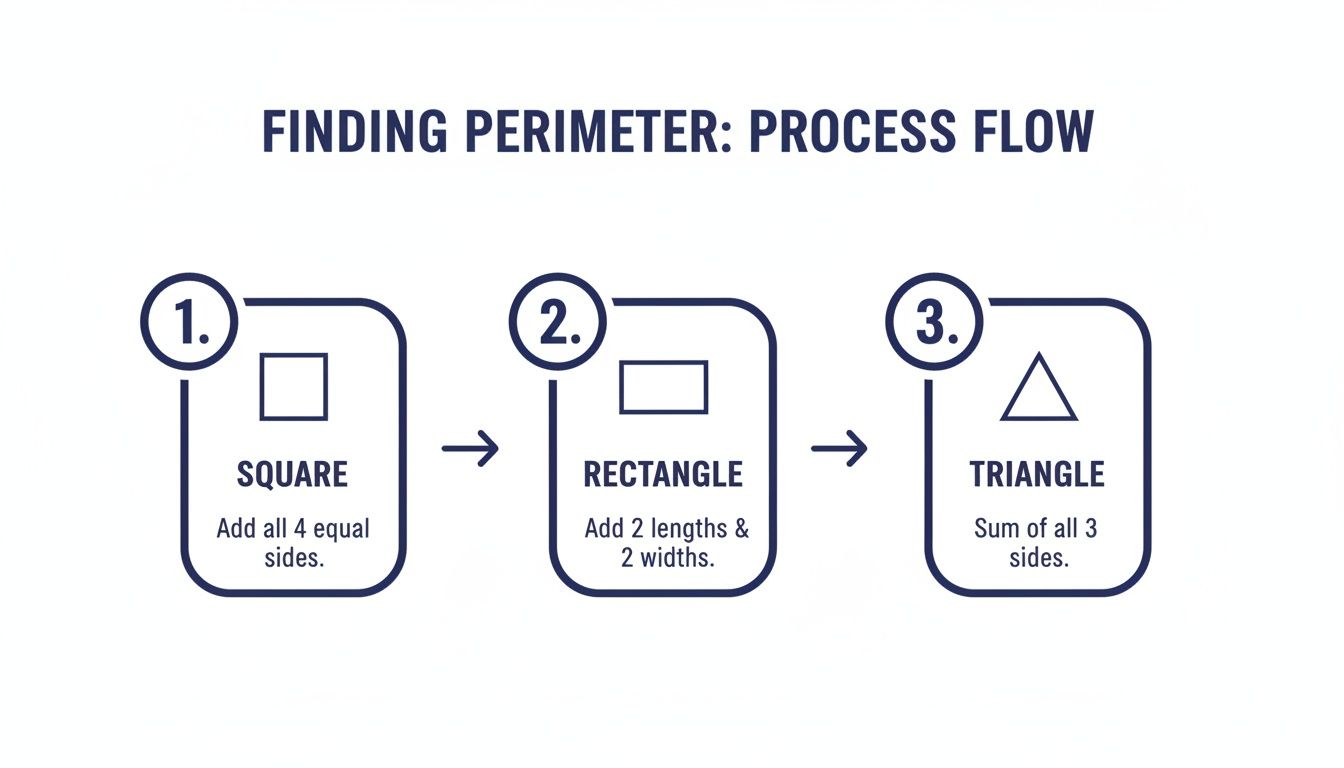
Mastering the perimeter formulas for these fundamental shapes is the first step toward tackling any composite figure you run into.
A Worked Example: The L-Shaped Room
Let’s put this strategy to work with a practical problem. Imagine you need to install new baseboards around an L-shaped living room. This is a classic composite shape problem.
The room's known dimensions are:
One long wall is 15 feet.
The adjacent long wall is 12 feet.
A shorter wall is 7 feet.
Another shorter wall is 5 feet.
But wait—two of the wall lengths are missing! Here’s how you find them.
Find the missing horizontal side: The total width of the room is 12 feet, and we know one of the horizontal segments is 5 feet. The missing piece is simply the difference: 12 – 5 = 7 feet.
Find the missing vertical side: The total length of the room is 15 feet, and we know one vertical segment is 7 feet. The missing vertical side must be 15 – 7 = 8 feet.
Now we have all six outer side lengths: 15, 12, 7, 5, 8, and 7. We're ready to calculate the total perimeter.
P = 15 + 12 + 7 + 5 + 8 + 7
P = 54 feet
You would need exactly 54 feet of baseboard. By breaking the problem down, what seemed complicated became a simple exercise in addition and subtraction. This method works for any rectilinear composite shape, no matter how many twists and turns it has.
Bringing Perimeter to Life with Real-World Examples
Perimeter can feel like just another abstract math problem stuck in a textbook. But what if we could show students that it’s a secret key to understanding the world they live in? This is how we answer the age-old question: “When will I ever use this?”
By connecting perimeter of a shape to tangible, everyday examples, we transform it from a chore into a tool. Suddenly, students see that math isn’t just about solving for x—it’s about building, designing, and exploring.
Perimeter in Architecture and Construction
Look around the room you’re in. From the floor to the ceiling, perimeter is everywhere. Architects and builders use it constantly, and it’s one of the first and most important calculations they make.
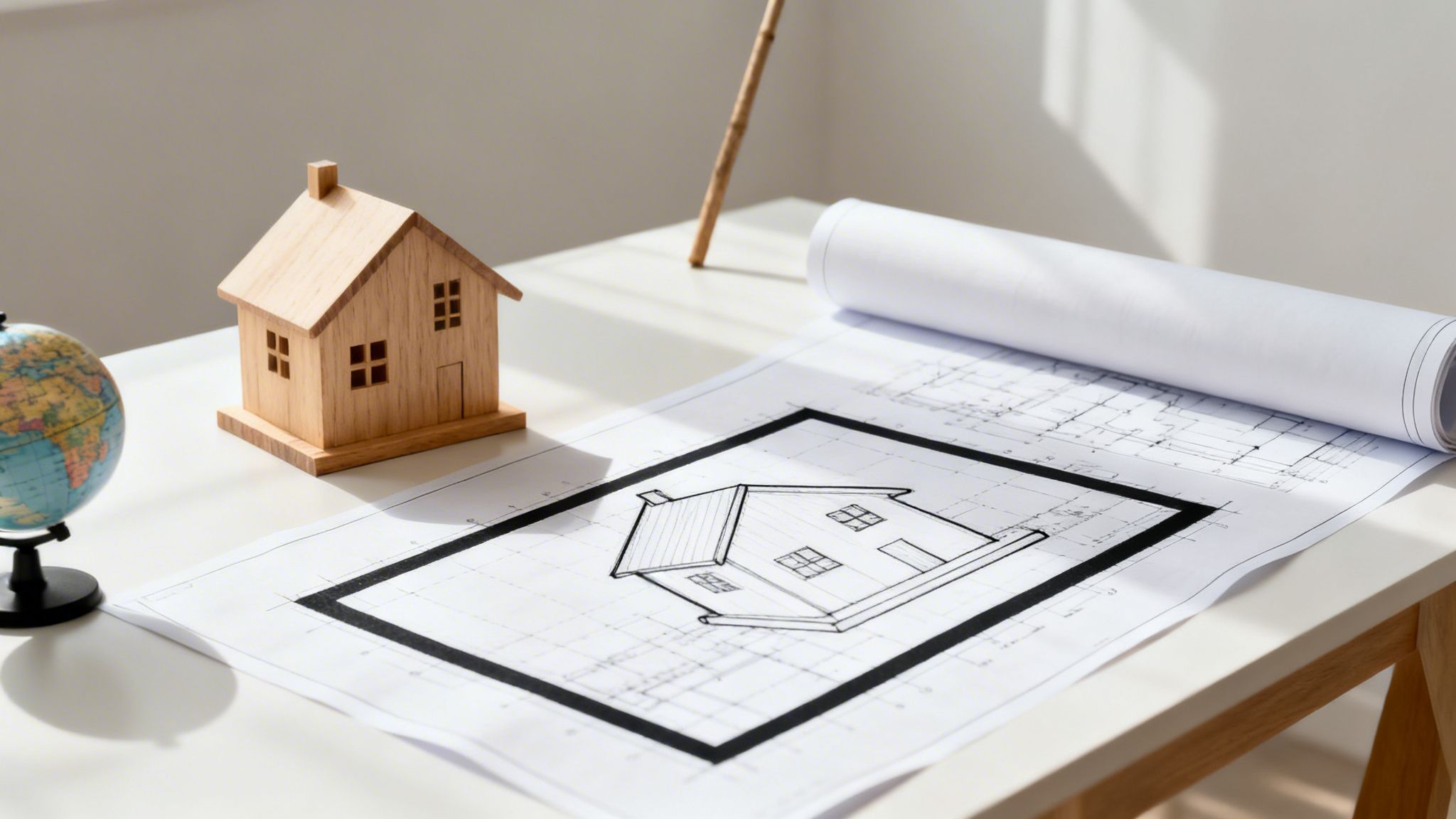
When an architect sketches out a blueprint, they are defining the perimeter of every single space. This one measurement affects everything from the amount of materials they need to order to the final cost of the project.
Foundation: Before a single wall goes up, builders calculate the perimeter to lay the foundation for the entire house.
Framing: They need to know the perimeter of each room to figure out exactly how much lumber to buy for the walls.
Finishing Touches: Installing baseboards, hanging wallpaper borders, or putting up crown molding all depend on getting the perimeter right.
An error in these calculations can lead to wasted materials and blown budgets. This is a perfect opportunity to make the concept hands-on. Grab a few simple tools, like a 12-inch plastic ruler and start measuring things around the house.
Urban Planning and Landscaping
Now, let's zoom out from a single house to the entire neighborhood. Perimeter plays a huge role in designing the parks, playgrounds, and public spaces we all enjoy.
When a city plans a new park, they use perimeter to figure out the length of a jogging path or how much fencing is needed to enclose a playground. A landscaper designing a garden calculates the perimeter of flower beds to know how many decorative stones to buy for the border.
Perimeter calculations are essential for budgeting and resource management in large-scale civic projects. From city parks to national forests, defining boundaries is always the first step.
These examples show that perimeter isn't just an exercise. It’s a fundamental skill for creating the beautiful, functional communities we live in.
A Historic Calculation of Earth's Perimeter
Looking for an amazing story to spark a student's curiosity? Go back to ancient Greece. Around 240 BC, a brilliant mathematician named Eratosthenes figured out the circumference—the perimeter—of the entire planet. And he did it with a stick.
He noticed that in one city, the sun cast no shadow at noon on the summer solstice. At the exact same time in a city 800 kilometers away, a stick cast a shadow at a 7.2-degree angle. He realized that 7.2 degrees was exactly 1/50th of a full 360-degree circle.
So, he did the math: he multiplied the 800 km distance by 50 and came up with a circumference of 40,000 kilometers. The incredible part? He was off by less than 1%. His calculation, made over two thousand years ago, is astonishingly close to what modern satellites tell us today.
Sharing stories like this does more than just teach a concept. It shows that math has always been a powerful tool for human discovery, turning a simple formula into a way to measure the world. It’s how we transform learning from a task into an adventure.
Building Your Child’s Math Confidence
This guide has walked you through the practical steps of understanding perimeter. We’ve covered what it is, the formulas for different shapes, and how it shows up in the world all around us. But our real work goes so much deeper than just explaining a math concept.
We believe that true, lasting learning only happens when a child feels confident and safe. For so many students, math anxiety is a huge roadblock. It’s a wall of fear that stops them from even trying, even when they are more than capable of succeeding. This is why we built our entire approach on a simple, powerful idea: Connection Before Content.
Our Philosophy: Connection Before Content
Before we ever introduce a formula or open a textbook, our first job is to build a real, supportive relationship with a student. When we create a safe space where asking questions is encouraged and making mistakes is just part of the process, something amazing happens. The stress that so often shuts down the learning part of the brain begins to fade away.
This approach acknowledges a simple truth about how we learn: anxiety is the enemy of curiosity. By focusing on connection first, we help calm a child's nervous system, opening the door for their natural motivation to shine through.
True mastery isn't just about getting the right answer; it's about building the resilience and self-assurance to tackle any problem without fear. We prioritize a student's emotional well-being to pave the way for academic success.
This method helps students see that they are more than a test score. Building real confidence isn’t about memorizing formulas. It’s when they develop problem-solving skills that empower them to face new challenges head-on. This is how we help turn frustration into a genuine sense of accomplishment.
Transforming Frustration into Mastery
With the right kind of support, any student can build the skills they need for success in school and in life. Our personalized tutoring services are designed to do just that. We move beyond figuring out why a student is struggling and focus on the now what—the clear, practical steps toward progress.
We invite you to learn more about how our unique approach to math and test prep can make a profound difference for your child. By pairing expert academic support with a foundation of trust and encouragement, we help students not only understand perimeter but also discover just how capable they truly are.
Your Perimeter Questions, Answered
Even when the basics seem to click, a few common questions always seem to surface. It’s completely normal! These are the hurdles we see students (and parents) run into all the time. Let's clear them up so you can move forward with confidence.
Are Perimeter and Circumference the Same Thing?
This is a fantastic question, and the short answer is: almost! Think of circumference as a VIP name for the perimeter of a circle. Both concepts measure the exact same thing: the total distance around the outside of a shape.
The only real difference is the how. For a shape with straight sides like a square or triangle, you simply add up the sides. But a circle doesn't have sides to add, right? That’s why it gets its own special formula using Pi (π), like C = 2πr.
So, while the idea is identical—measuring the outside edge—the name and the math change depending on whether you’re dealing with straight lines or a curve.
What Units Do You Use to Measure Perimeter?
Since perimeter is all about length, you’ll always use units of length. The right unit just depends on what you're measuring. You wouldn't measure a football field in inches, and you wouldn't measure your thumb in miles!
It’s all about matching the unit to the object:
The tiny perimeter of a postage stamp might be in millimeters.
The perimeter of a book cover would likely be in inches or centimeters.
The distance around a bedroom is perfect for feet or meters.
The boundary of a huge national park would be measured in miles or kilometers.
The key thing to remember is that perimeter is a line, not a space. That's why we use linear units (like inches) instead of square units (like square inches, which are for area). If you'd like to see some of these concepts in action in a supportive learning space, we'd love for you to visit us at 1759 NW Kekamek Drive, Poulsbo WA 98370.
How Do You Find a Missing Side Length?
Ah, the "working backward" problem! This is a classic, and it's actually a great sign when students get to this point. It means they're ready for a little detective work.
When a problem gives you the total perimeter but leaves one side blank, here's how you crack the case:
First, add up all the side lengths you do know.
Then, take that number and subtract it from the total perimeter.
Voilà! The number left over is your missing side length.
We love these kinds of problems because they go beyond simple addition. They encourage kids to think critically and understand the relationship between the parts and the whole, which is a huge step in mathematical thinking.
Why Can’t I Just Multiply Length by Width for Perimeter?
This is easily the most common mix-up we see, and it makes perfect sense why! Multiplying length by width is a very important formula, but it’s for area—the amount of space inside a rectangle, like the amount of carpet you’d need for a room.
Perimeter is the distance around the rectangle, like the trim or baseboards along the wall. To find it, you have to account for all four sides. The most reliable way is with the formula P = 2l + 2w (two lengths plus two widths). It’s a great little shortcut that guarantees you don’t forget any sides.
Understanding the little details of a concept like perimeter is what builds true math confidence. At Bright Heart Learning, making these ideas click is what we do best. If you feel your child could use that extra spark of understanding, learn more about our personalized tutoring programs.