

Study Skills for College Students: Master Time Management and Exam Prep
Let's be honest: the study habits that got you an 'A' in high school probably won't cut it in college.
Those late-night cram sessions and endless hours spent rereading notes? They're often the first things to fail when you're facing the increased rigor and independence of higher education. To really succeed, you have to trade in those old habits for a new set of study skills for college students—ones built for a totally different academic ballgame.
It’s all about shifting from being a passive reviewer to an active learner.
Why High School Study Habits Fail In College

The jump from high school to college is a massive academic leap. Suddenly, the strategies that once guaranteed good grades become fast tracks to burnout and disappointment. This isn't your fault; it's a predictable outcome when the rules of the game change so drastically. The main culprits are volume, pace, and autonomy.
Think about it: in high school, a teacher might spend two full weeks on a single chapter. In college, that same chapter could be covered in one lecture, with the professor expecting you to master the rest on your own. The sheer volume of reading and the complexity of the ideas demand a whole new strategy.
The structure of learning is also turned on its head. High school was all about daily check-ins, frequent small assignments, and constant reminders from teachers. In college, your entire grade might hinge on just a midterm and a final. The responsibility for pacing yourself and actually understanding the material is now squarely on your shoulders.
The Shift In Academic Expectations
One of the biggest hurdles I see students face is underestimating the time commitment. It's a classic mistake to treat a dense organic chemistry course like a breezy literature seminar. A student might budget two hours to read a biology chapter—just like they did in high school—only to realize the technical language requires double or even triple that time to truly sink in.
Another struggle is adapting to different teaching styles. Some professors lecture at a lightning pace, expecting you to pull out the key themes without them being explicitly stated. Your old habit of just copying down whatever's on the slide is no longer enough. You now have to listen, think, and organize information all at the same time.
The real issue is the shift from a highly structured, guided environment to one that demands complete self-direction. Success in college depends less on memorizing facts and more on your ability to manage your time, organize complex information, and truly engage with new ideas.
Embracing Independence and New Strategies
This new independence is both a blessing and a curse. Without someone else's rigid schedule, it’s incredibly easy to procrastinate. This leads to those frantic, all-night cram sessions that feel productive but rarely lead to real learning or good grades.
Relying on passive techniques like rereading textbooks or looking over highlighted notes is another trap. It creates a false sense of familiarity. Your brain recognizes the words on the page, but that doesn't mean you've actually learned the concepts well enough to apply them on an exam.
To thrive, you have to get intentional. It’s about working smarter, not just pulling more all-nighters.
- Go from passive to active: Instead of just reading, start quizzing yourself. Try explaining a concept out loud to an empty room. Work through practice problems without peeking at the solutions.
- Go from sprinting to pacing: Ditch the last-minute cramming. Replace it with consistent, spaced-out study sessions that build information into your long-term memory where it belongs.
- Go from following to planning: You are now the architect of your own education. It's up to you to break down big projects into smaller steps and plan your work weeks in advance.
This isn't an easy transition, and it's completely normal to feel overwhelmed at first. The most important step is simply recognizing that your old methods aren't built for this new challenge.
The good news is that effective, evidence-based study strategies are skills you can learn. For students who need a guide to help build these new habits, academic coaching at Bright Heart Learning provides that personalized support system. We can help you navigate these challenges and find your footing.
The rest of this guide will give you the tools you need to build that smarter, more sustainable system for success.
Build A Foundation With Time Management And Organization
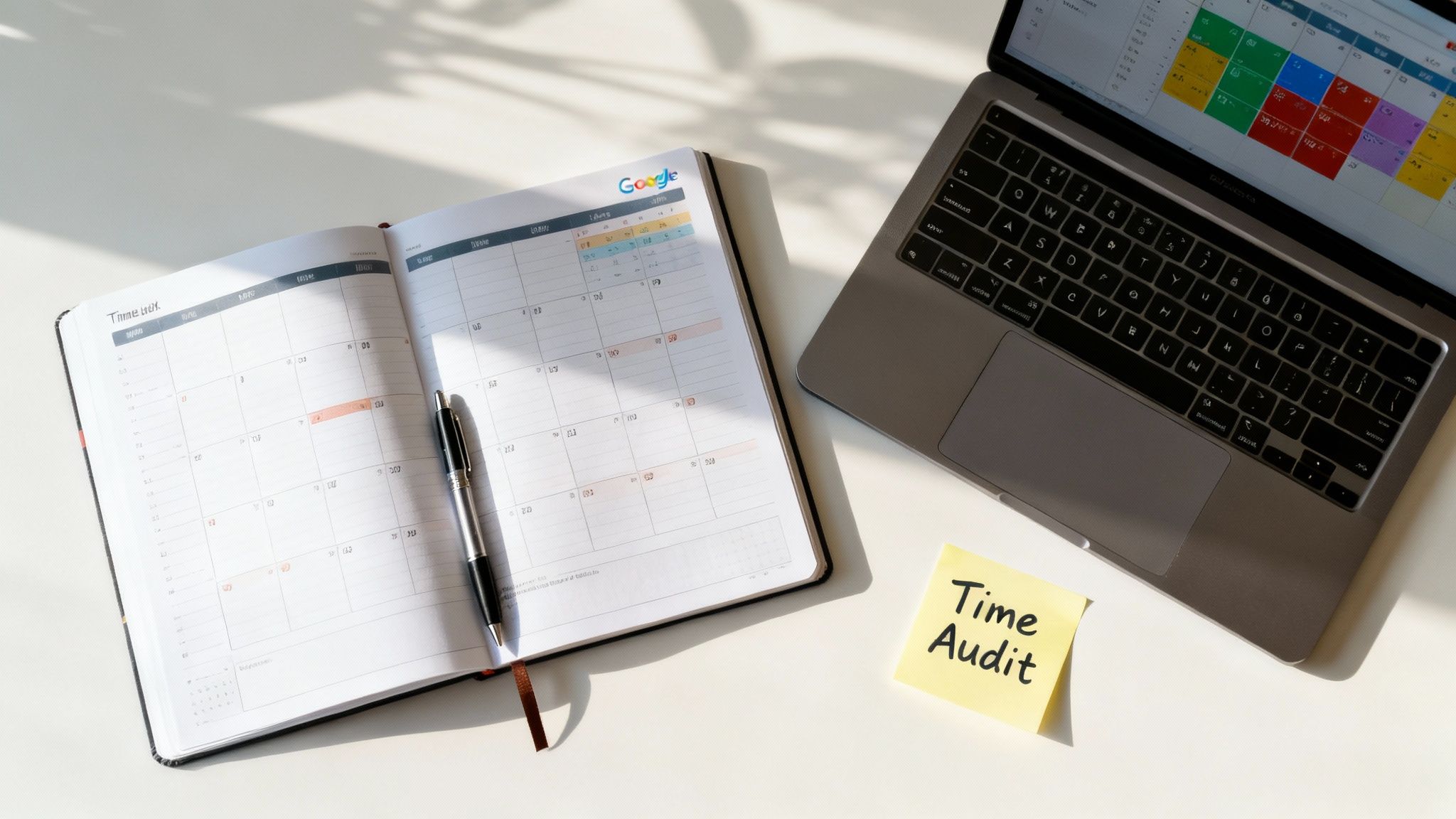
We've all heard the advice: "Just get a planner." But that advice often falls flat because a planner is just an empty tool. The real magic happens when you build a system around it that actually works for your brain and your schedule.
Mastering time management and organization is the absolute bedrock of effective study skills for college students. This is especially true when you're feeling swamped by competing deadlines and a never-ending to-do list.
This isn’t about becoming a robot who schedules every single minute. It's about taking back control of your time so you can cut down on stress, stop procrastinating, and start making real, consistent progress on your goals.
Start With A Simple Time Audit
Before you can manage your time, you have to know where it’s actually going. Most of us have a vague idea, but the reality is often a huge surprise. A time audit is a simple diagnostic tool that gives you a crystal-clear picture.
For just two or three days, track what you’re doing in 30-minute intervals. You don’t need a fancy app for this—a simple notebook works perfectly. Be honest with yourself. If you spent an hour scrolling through TikTok, write it down. The goal isn't to judge yourself; it's to gather cold, hard data.
After a few days, you'll see undeniable patterns. You might discover that the two hours you set aside for that psychology reading were actually split between a little bit of reading, a lot of texting, and a few "quick" YouTube videos. This information is your launchpad for making intentional changes.
Implement Practical Systems
Once you know where your time is going, you can start telling it where to go instead. This is where you move from fuzzy goals to a concrete game plan. Two of the most powerful techniques I teach are time-blocking and task decomposition.
Time-blocking is exactly what it sounds like: scheduling specific blocks of time for specific tasks directly into your calendar. Instead of a to-do list that just says, "Study for Chem," your Google Calendar will have a dedicated block from 2:00-3:30 PM on Tuesday labeled, "Review Chapter 4 Chem Notes & Practice Problems." This creates a real commitment and protects your study time from getting hijacked.
Task decomposition is the art of breaking down big, intimidating projects into small, manageable pieces. That 20-page research paper feels impossible. But "Find five academic sources for paper"? That's a concrete task you can knock out in an hour.
- Original Task: Write History Essay
- Broken-Down Tasks:
- Brainstorm three potential essay topics.
- Draft a one-paragraph thesis statement.
- Find and annotate three primary sources.
- Create a detailed outline with main points.
- Write the introduction paragraph.
This approach builds momentum and makes it so much easier to get started—which, let's be honest, is often the hardest part. You can strengthen these skills with dedicated support; learn more about how Bright Heart Learning helps students with personalized executive function coaching at https://brightheartlearning.com/executive-function-coaching/.
Effective organization isn't about having the neatest notes or the most colorful planner. It's about creating a system that reduces the mental energy required to decide what to do next, freeing up your brain to do the actual learning.
Choose Your Tools Wisely
The digital world offers a massive advantage for staying organized. To help you manage your time effectively and keep track of assignments, it's worth exploring the best student productivity apps that can help you implement these strategies.
Whether you go with a digital tool like Notion or a physical paper planner, the absolute key is consistency. Find one or two tools that you actually enjoy using and commit to them. This creates a reliable system you can trust to hold all your deadlines and commitments, which in turn reduces mental clutter and anxiety.
The link between strong time management skills and academic success is well-documented. Recent research shows that students who excel at planning and prioritizing not only demonstrate higher self-control but also experience deeper study engagement and are less dependent on distractions like their phones. A solid organizational foundation is your best defense against feeling overwhelmed.
Turn Lectures and Readings Into Actionable Knowledge
Just showing up to class and dragging a highlighter across a textbook page feels like work, but it rarely translates into real understanding. To truly master college-level material, you have to do more than just let information wash over you. The real magic happens when you turn that passive intake into deep, actionable knowledge.
This means actively engaging with every lecture and every assigned reading. The goal is to stop being a spectator in your own education and start being an active participant. It's a strategic shift in your approach, and it makes all the difference.
Find a Note-Taking Method That Actually Works for You
Not all classes are created equal, so your note-taking method shouldn't be one-size-fits-all. The way you take notes in a formula-heavy physics lecture should look very different from how you capture ideas in a discussion-based history seminar. Matching your method to the material is a game-changer.
The Cornell Note-Taking System is fantastic for those classic, structured lectures. You divide your page into three sections: a large area for your main notes, a smaller column on the left for cues or questions, and a summary section at the bottom. This format forces you to process the information multiple times—first as you write, again when you create questions, and finally when you summarize the big ideas.
For more conceptual or discussion-heavy classes, mind mapping can be a lifesaver. Instead of a rigid, linear format, you start with a central concept and branch out with related ideas, keywords, and questions. This visual approach helps you see connections between different topics that you might completely miss with traditional notes.
The most important part of any note-taking system isn't what happens in class, but what you do with the notes afterward. Reviewing or rewriting your notes within 24 hours is one of the most powerful ways to fight the 'forgetting curve' and lock that information into your long-term memory.
Master Your Readings With Active Engagement
Let's be honest: we've all read an entire chapter only to realize we have no idea what it said. That’s passive reading—your eyes scan the words, but your brain isn't really there. The antidote is a structured, active reading strategy like the SQ3R method.
SQ3R stands for Survey, Question, Read, Recite, and Review. It’s a system designed to force you to interact with the text on a much deeper level.
- Survey: Before you even start reading, skim the chapter. Look at headings, subheadings, bolded terms, and summary paragraphs. This gives you a mental map of where you're going.
- Question: Turn each heading into a question. If a section is titled "The Causes of the French Revolution," your question becomes, "What were the main economic and social factors that led to the French Revolution?"
- Read: Now, read the section with the specific goal of answering that question. This gives your reading a clear purpose and keeps you laser-focused on finding the key information.
- Recite: After reading a section, look away from the book and try to answer your question out loud, in your own words. This is a critical step. It’s active recall in action and immediately shows you what you actually understood versus what you just glossed over.
- Review: Once you've finished the chapter, go back over your notes and questions. This final pass helps solidify the material and cements it in your memory.
The academic world has changed, and students are having to adapt. Recent data shows that a whopping 81% of college students have changed their study strategies since the pandemic, often because of more demanding courses and new technology. At the same time, satisfaction with things like peer study groups has dropped to as low as 42%. You can get the full picture from McGraw Hill's study trends report. Actively engaging with your material is one of the best ways to take control of your own learning in this new environment.
Use Active Study Techniques That Build Long-Term Memory
Let’s be honest. Rereading your notes or highlighting a textbook feels like you’re studying. It’s comfortable. The material looks familiar, and your brain tricks you into thinking, “Yep, I’ve got this.” This is the illusion of competence, and it’s a dangerous trap.
Familiarity isn't mastery. Seeing information is not the same as being able to recall it from scratch, which is exactly what exams demand.
To make information stick, you have to shift from passively reviewing to actively pulling it out of your brain. It's the difference between looking at a map of a city and actually having to navigate its streets without GPS. Active study techniques force your brain to do the work, strengthening the neural pathways that lead to real, durable memory.
Master Active Recall (Or Retrieval Practice)
Active recall is the simple act of pulling information out of your head. Instead of just letting content wash over you, you’re constantly quizzing yourself. That little struggle to remember? That’s the magic. It sends a powerful signal to your brain: “This is important. Don’t lose it.”
Think of it as mental weightlifting. You don’t build muscle by watching someone else work out; you have to do the reps. Active recall is the rep work for your brain.
Here are a few ways to start doing the reps:
- The Blank Sheet Method: After a lecture or reading a chapter, close your book. Grab a blank sheet of paper and write down everything you can remember. Be messy. Use diagrams. Just get it all out. This immediately shows you what’s sticking and what’s not.
- Teach Someone Else: Try explaining a concept out loud to a friend, your dog, or even just the wall. Forcing yourself to articulate the ideas from start to finish reveals your weak spots in a way that silent review never will. If you stumble, you know where you need to go back and review.
- Do the Problems (No Peeking!): For subjects like math, chemistry, or physics, working through practice problems without looking at the solutions is the ultimate form of active recall. It’s a direct test of whether you can apply the concepts, not just recognize them.
This whole process is about flipping your focus from "getting information in" to "getting information out." If you want to dive deeper into this, exploring different metacognitive strategies for learning can help you get better at spotting your own knowledge gaps.
Choosing Your Active Study Technique
Not all active study methods are created equal for every situation. This table breaks down a few popular techniques to help you match the right strategy to your course material and learning style.
| Technique | Best For | How It Works | Pro Tip |
|---|---|---|---|
| Blank Sheet Method | Conceptual courses (History, Sociology, Biology) after a lecture/reading | After a study session, write down everything you remember on a blank page without looking at your notes. Then, compare and fill in gaps. | Use different colored pens to fill in the missing information. The colors will highlight your weak spots. |
| Feynman Technique | Complex topics or formulas (Physics, Economics) | Explain a concept in the simplest terms possible, as if you were teaching it to a child. Identify where you get stuck or use jargon. | Record yourself explaining it. Listening back can be incredibly revealing. |
| Practice Problems | Quantitative subjects (Math, Chemistry, Accounting) | Solve problems from the end of the chapter or past exams without looking at the answer key first. The struggle is the learning. | Work with a study group, but make sure everyone attempts the problems solo first before comparing answers. |
| Smart Flashcards | Vocabulary-heavy courses (Languages, Anatomy, Law) | Use apps like Anki or Quizlet with spaced repetition. Write questions, not just terms, to force deeper recall. | Add images or create your own mnemonics on your flashcards to make them more memorable. |
The key isn't to use just one method but to build a toolkit of different strategies you can pull from depending on what you're studying. A diverse approach keeps your brain engaged and makes learning far more effective.
Use Spaced Repetition to Beat the Forgetting Curve
Your brain is a forgetting machine by design. It has to be, or you’d be overwhelmed with useless information. Spaced repetition is how you tell it what not to forget.
Instead of cramming a subject for five hours straight, you review the material in shorter sessions spread out over time. For example, you might review your notes for 30 minutes on Day 1, then for 15 minutes on Day 3, and then for 5 minutes a week later. Each time you almost forget something and then successfully remember it, you lock that memory in stronger. It’s infinitely more effective than cramming.
Spaced repetition is your best defense against last-minute panic. It transforms studying from a high-stress sprint into a manageable, low-stress marathon, ensuring the information is there when you need it on exam day.
Use Technology for Smarter Flashcards
Flashcards are a classic for a reason, but most students use them wrong. They create cards that test recognition ("Mitochondria" -> "Powerhouse of the cell"), not recall. To make them truly effective, you have to force your brain to do more work.
For truly effective learning, check out modern methods to create flashcards to remember everything.
Here’s how to do it right:
- One Idea Per Card: Keep it simple. Don’t try to summarize a whole lecture on one card.
- Frame it as a Question: Instead of a term and a definition, write a question. For example: “What is the primary function of mitochondria in a eukaryotic cell?” This forces you to generate the answer from scratch.
- Use Spaced Repetition Apps: Tools like Anki or Quizlet are game-changers. They use algorithms to show you cards you struggle with more often and cards you know well less frequently. This automates the spaced repetition process and makes your study time incredibly efficient.
The flowchart below can help you decide which note-taking style to use in the first place, which is the foundation for creating great study materials later on.
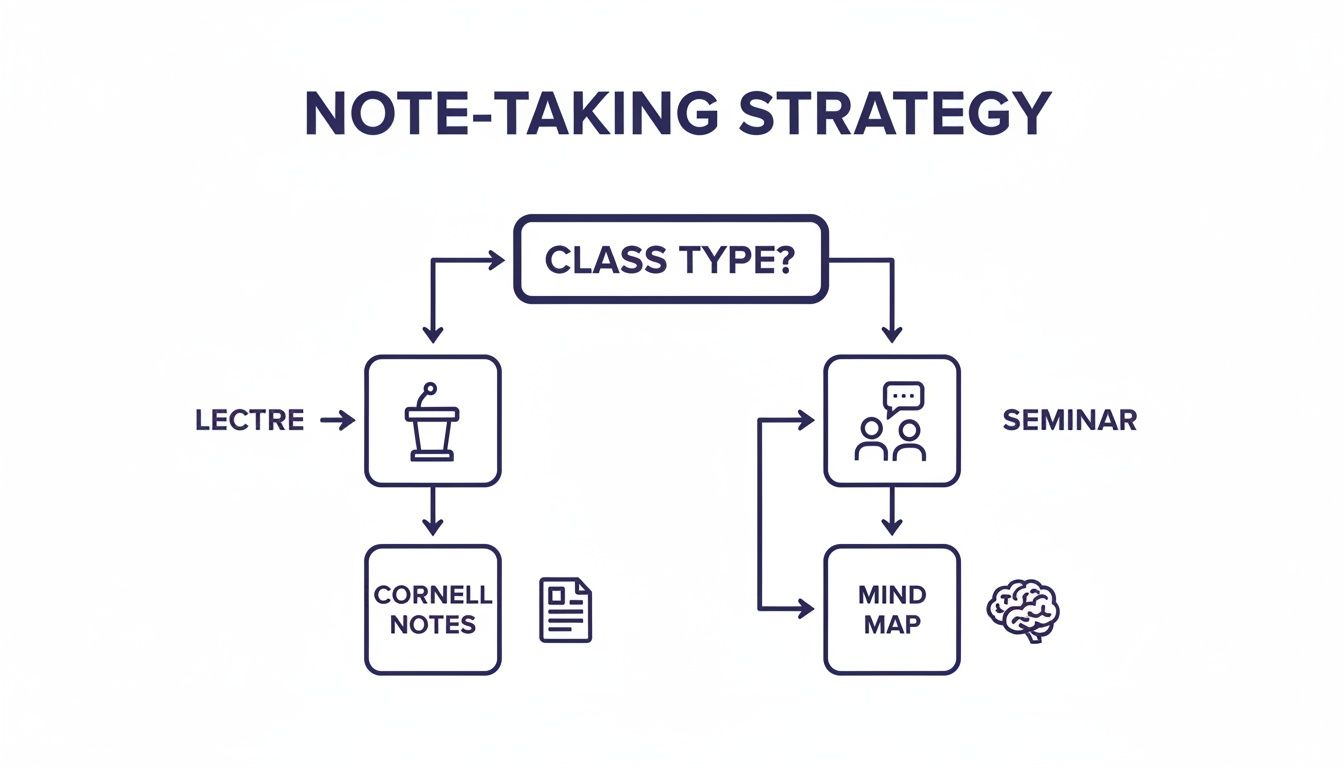
As the visual shows, a structured format like Cornell Notes works well for dense lectures where you need to capture a lot of information, while a more creative method like Mind Mapping is great for connecting ideas in a discussion-based seminar. Choosing the right tool from the start makes active studying that much easier down the road.
Prepare For Exams Without The Panic
Let's be honest: the last-minute, caffeine-fueled cram session is a recipe for disaster. It might feel like you're accomplishing something, but that knowledge rarely sticks. Real exam prep isn’t a sprint; it’s a marathon that starts weeks in advance.
The goal is to walk into that exam room feeling calm and prepared, not panicked. This isn't about just passing—it's about genuinely knowing the material so you can show the professor what you've learned. A strategic approach turns that pre-test dread into focused confidence.
When you cram, you're stuffing information into your short-term memory, which is notorious for letting go of details right when you need them most. A smart, spaced-out study plan builds knowledge into your long-term memory, which is exactly where it needs to be when the clock starts ticking.
Build a Strategic Study Schedule
Your syllabus is your best friend here. It’s a roadmap that lays out every topic for the entire semester, often hinting at what the professor considers most important. Use it to build your study schedule, starting at least three weeks before the exam.
Don't just block out "Study for Bio." That's too vague and easy to put off. Instead, break it down into small, concrete tasks. Your calendar should have entries like, "Review Chapters 3-4 and make flashcards" on Monday, and "Do practice problems for Chapter 5" on Tuesday.
This is called task decomposition, and it’s a game-changer for procrastination. It turns a mountain of a task into a series of small, manageable hills, making it so much easier to get started and build momentum.
Prioritize and Plan Your Attack
Not all topics carry the same weight. Pay attention to the clues your professor has dropped throughout the semester—concepts they spent extra time on, things they specifically said were "important," or anything highlighted in a study guide.
Use these clues to sort the material into three simple categories:
- "Know It Well": Topics you could teach to someone else.
- "Know It Okay": You understand the basics but get fuzzy on the details.
- "Don't Know It At All": These are the concepts that make your brain go blank.
Now, allocate your study time accordingly. The bulk of your energy should go to the "Don't Know It" pile, followed by the "Okay" list. The stuff you know well just needs a quick review every few days to keep it fresh. This is how you use your limited time to make the biggest impact on your grade.
Make Study Groups Actually Productive
Study groups can be amazing, or they can be a massive waste of time where everyone just socializes. The difference is structure. A good study group isn’t for learning material for the very first time; it's for clarifying tough concepts and testing your understanding.
Set a clear agenda before you meet. A fantastic strategy is to have each member come prepared to teach one difficult concept to the group. This forces everyone into active recall and quickly shows you where the knowledge gaps are—all in a low-stakes setting.
The best practice? Study alone first to get a solid grasp on the basics. Then, use the group session to tackle the really complex ideas and practice explaining them out loud.
Manage Test Anxiety Before It Starts
A few butterflies before a big test are totally normal. But when that nervousness turns into overwhelming anxiety, it can seriously sabotage your performance. The trick is to manage your body's stress response, both in the days leading up to the exam and during the test itself.
Simple breathing exercises are incredibly effective. Try the box breathing technique: inhale for a count of four, hold your breath for four, exhale for four, and hold again for four. Doing this for just a minute or two can physically calm a racing heart and help clear your head.
Another powerful tool is visualization. Spend a few minutes each day picturing yourself sitting at the desk, calmly and confidently working through the exam questions. This kind of mental rehearsal can significantly dial down feelings of dread. If you want more strategies to stay calm under pressure, check out our guide on how to reduce test anxiety.
Master The Exam Day Itself
All your preparation comes down to this. When you sit down for the test, your goal is to have a clear mind and a simple plan.
- Do a Brain Dump: The second you get your scratch paper, write down any key formulas, dates, vocabulary, or mnemonics you've memorized. This gets them out of your head and onto paper, so you don’t have to waste mental energy worrying you'll forget them.
- Scan the Entire Test: Before you answer a single question, take two minutes to flip through the whole exam. Get a sense of the layout, the point values, and the types of questions. This helps you budget your time and spot the easy wins to tackle first.
- Tackle Different Question Types: For multiple-choice, always eliminate the answers you know are wrong before picking the right one. For essays, spend one minute creating a quick outline. It will make your writing more organized and coherent.
Managing your time is one of the most vital study skills for college students during an exam. If you hit a question that stumps you, mark it and move on. Don't let one hard problem derail you. You can always circle back if you have time at the end, and you won't risk losing easy points on questions you never got to.
Find Expert Support And Tutoring Near You
Sometimes, the best study strategy isn't a new app or a different way to take notes. It's knowing when to ask for help.
Reaching out for support is one of the most powerful things a college student can do, but it’s also the one they overlook the most.
One-on-one guidance can completely change the game, especially when you’re wrestling with a tough subject or just trying to build the kind of academic confidence that lasts. Professional support isn't about just getting through one exam; it's about getting strategies that actually fit your brain and the specific challenges you're facing.
Whether it’s a single class that’s tripping you up or you want to build a stronger foundation for your entire college career, personalized tutoring helps you clear those academic hurdles with proven methods that actually lower your stress and boost your grades.
Seeking help is not a sign of weakness; it's a strategic move made by successful students who understand the value of expert guidance. It's about working smarter, not just harder.
At Bright Heart Learning, our expert tutors specialize in helping students master the real demands of college. We focus on creating a supportive space where you can ask any question, fill in the knowledge gaps, and develop the skills you genuinely need to thrive.
We're here to see you succeed. Find our tutoring center location and see how we can help you hit your goals.
Your Top Study Questions, Answered
Navigating college academics brings up a lot of the same questions for students. As you figure out what works for you, it helps to get straight answers to the most common challenges.
Here’s our take on the questions we hear all the time.
How Many Hours a Day Should I Study?
You’ve probably heard the old rule of thumb: study two to three hours for every one hour you spend in class. For a typical 15-credit semester, that could mean 30-45 hours of studying a week. Yikes.
But let’s be real—the quality of your study time matters so much more than the sheer number of hours you put in.
Two hours of focused, active work will beat four hours of distracted, passive review every single time. Instead of just watching the clock, pay attention to how engaged you are with the material.
What’s the Single Best Study Skill?
If I had to pick just one, it would be active recall. You might also hear it called retrieval practice. This is all about pulling information out of your memory, not just cramming it in. It’s the difference between recognizing a term on a page and being able to define it from scratch without any cues.
Simple things like making flashcards (and actually using them from memory), doing practice problems without peeking at the solutions, or explaining a concept out loud to an empty room are all powerful forms of active recall. Science backs this up—it’s proven to build stronger, more durable memory pathways.
That little mental struggle you feel when you’re trying to remember something? That’s a good thing. It’s your brain’s version of lifting weights. The effort is what strengthens the memory, making the information way easier to access later—like during an exam.
How Do I Stay Motivated When I Feel Totally Overwhelmed?
Here’s the secret: motivation almost always follows action, not the other way around. The key is to make that first action ridiculously small. When you’re feeling overwhelmed, your brain is going to fight against big, vague tasks.
Instead of telling yourself, "I have to study for biology," make the first step tiny. Something you can't say no to. Try "read the first two pages of chapter 5" or "spend ten minutes reviewing my notes from today's lecture." Checking that tiny task off creates momentum.
It also helps to connect the dots between your daily grind and your bigger goals. Taking a moment to remember why you’re putting in all this work can be a huge boost when you feel stuck or anxious about a single assignment.
Is It Better to Study Alone or in a Group?
Honestly, you need both. They each serve a different—and equally important—purpose in the learning process. The trick is knowing when to use each one.
- Study Alone First: This is non-negotiable for the initial learning and memorization. You need focused, deep-work time to read, take notes, and use active recall to really get the information into your head.
- Then, Study in a Group: Group sessions are perfect for the next stage. Use them to hash out complicated ideas, teach concepts to each other (the ultimate test of your own understanding!), and get fresh perspectives on material that’s tripping you up.
Think of it like this: learn the material on your own, then master it with your peers.
At Bright Heart Learning, we know that every student’s brain is different. If you need a more personalized strategy to build these skills or get a handle on tough coursework, our academic coaches and tutors are here for you. Discover how our one-on-one approach can change your entire college experience.