

Organizational Skills for Students: Master Time Management Today
When we talk about organizational skills for students, we're not just talking about color-coded folders and tidy backpacks. We're talking about the actual methods students use to manage their time, tasks, and materials to hit their academic goals. These are the abilities that create systems to reduce stress, improve grades, and build lifelong competence.
Why Organizational Skills Are Crucial for Student Success

Let’s be honest, the modern academic world is a pressure cooker. Juggling multiple classes, project deadlines, sports, and a social life can feel completely overwhelming. So many students feel like they’re constantly playing catch-up, which leads straight to late nights, forgotten homework, and a low-level hum of anxiety that never seems to go away.
Think about a high school student named Alex. He’s bright and totally capable, but his backpack is a black hole of crumpled papers. His digital folders are a mess. He often realizes an important test is tomorrow with zero time left to study.
This constant state of reacting, instead of planning, doesn't just hurt his grades—it chips away at his confidence.
This isn’t an uncommon story. But the solution isn't just to "try harder." The real answer is to build a toolkit of practical organizational skills. This is what transforms that feeling of being overwhelmed into a sense of control and clarity.
Moving Beyond the Report Card
While better grades are an obvious win, the true value of organization runs much deeper. These skills are the very foundation of strong executive function—the part of the brain that governs planning, focus, and self-control.
When students learn to manage their responsibilities, they're also learning to manage themselves. It's a powerful shift that builds the kind of independence and resilience they'll need long after they leave the classroom.
This creates a positive feedback loop that touches every part of a student's life:
Reduced Academic Anxiety: When you have a plan, you stop worrying that you’ve forgotten something important.
Improved Performance: A structured approach to studying and homework leads to higher-quality work and better test scores.
More Free Time: Handling schoolwork efficiently frees up precious time for hobbies, rest, and friends—all vital for a balanced life.
Increased Confidence: Successfully managing their own schedule gives students a powerful sense of accomplishment and self-reliance.
Organization isn't about restriction; it's about creating the freedom to thrive. It’s the framework that lets students focus their energy on learning and growing, not just surviving the day-to-day chaos.
The benefits of these skills don't just disappear after graduation; they are foundational for both personal well-being and professional success.
The Real-World Impact of Organizational Skills
The table below highlights just how much these skills matter, translating directly into better academic outcomes, improved mental health, and the competencies employers are actively looking for.
| Area of Impact | Key Benefit | Supporting Statistic |
|---|---|---|
| Academic Performance | Students proficient in organization complete assignments 25% faster. | Source: Global Skills Trends |
| Mental Well-being | Organized students report 40% less stress during final exams. | Source: Global Skills Trends |
| Career Readiness | 85% of bachelor's degree holders rank time management among the top five skills employers seek. | Source: Global Skills Trends |
As the data shows, building these skills today is a direct investment in a student's future.
Building Skills for a Future Career
These aren’t just "school skills"—they are professional prerequisites. The ability to manage projects, meet deadlines, and juggle priorities is highly valued in any career. Employers consistently rank these competencies at the top of their wish lists for new hires.
The research is clear. According to a report on global skills trends, 85% of bachelor's degree holders consider time management and organizational skills to be among the top five competencies employers want.
The same study found that college graduates with strong organizational skills completed their assignments 25% faster and reported 40% less stress during finals week.
The journey toward better organization starts with small, actionable steps—which is exactly what we at Bright Heart Learning are so passionate about teaching.
Building Your Organizational Foundation
Real organization isn't about having a perfectly clean desk or a color-coded binder (though those can help!). It’s about building a reliable system that actually works for your child, cutting down on the mental energy they spend just trying to keep up.
This solid foundation rests on four core pillars: Time, Space, Tasks, and Digital.
When students get a handle on these areas, they shift from feeling reactive and overwhelmed to proactive and in control. Each pillar supports the others, creating a sturdy framework for not just academic success, but overall well-being. Let's break down what each of these looks like in the real world.
Mastering Your Time
Time management is usually the first—and biggest—hurdle. Without a clear plan, an entire evening can vanish into a black hole of distractions, or an assignment that needed hours gets just a few minutes. The secret is to make time a visible, tangible resource.
For a high schooler juggling AP classes and maybe a part-time job, a basic calendar won't cut it. This is where time-blocking becomes a game-changer. They learn to schedule every part of their day—from classes and homework to meals and actual downtime. This creates a visual map of their commitments and helps them protect those crucial study periods.
Younger kids, on the other hand, need something more concrete. A visual timer, like a Time Timer that shows the minutes physically disappearing, makes an abstract idea like "30 minutes of reading" real. It helps them build focus and understand how long a task takes without constantly asking, "Is it time yet?"
A common mistake is scheduling only the "have-to-do" items. An effective schedule must also include breaks, hobbies, and rest. A student's brain needs downtime to recharge and process information; scheduling it in ensures it actually happens.
Organizing Your Physical Space
A student’s environment has a massive impact on their ability to focus. A chaotic physical space leads to a chaotic mental space, making it tough to find what they need, get started, and stay on track. This pillar is all about bringing order to two key zones: the study area and the backpack.
The dedicated homework zone doesn't have to be a whole room, but it must be a consistent, distraction-free spot. Find some practical student desk organization ideas to create a space that inspires focus by keeping all necessary supplies within reach and removing temptations (yes, that means the phone!).
Then there's the infamous backpack, which can feel like a bottomless pit. A simple system can prevent the "black hole" effect and end the daily scavenger hunt for papers.
Designated Folders: One sturdy, color-coded folder for each class. Simple.
"To Do" and "Done" Pockets: Inside each folder, label one side "Homework to Do" and the other "Completed Work to Turn In." This takes all the guesswork out of it.
Weekly Clean-Out: Block out 10 minutes every Sunday night for a "backpack reset" to file old papers and restock supplies for the week ahead.
This small routine makes a huge difference, ensuring nothing important gets lost in the shuffle. As you build these habits, you can explore how executive function skills by age differ to tailor your support even more.
Deconstructing Your Tasks
Big projects are intimidating. When a student sees "10-page research paper due in three weeks" on the syllabus, the natural response is often to freeze. This paralysis, known as task initiation difficulty, is a huge roadblock.
The solution is to teach them how to break down large assignments into small, actionable steps. That daunting research paper suddenly becomes a series of manageable to-dos:
Choose a Topic & Get Approval: Due this Wednesday.
Find Five Credible Sources: Due this Friday.
Write an Outline: Due next Tuesday.
Draft the Introduction: Due next Thursday.
Write Body Paragraphs 1-3: Due next Saturday.
Each step feels achievable, has a clear mini-deadline, and provides a hit of dopamine when it's checked off. This builds momentum and makes procrastination far less tempting. You’re not climbing a mountain; you're just taking the next small, easy step.
Taming Your Digital World
In today’s world, digital disorganization is just as disruptive as a messy backpack. A desktop cluttered with random screenshots, a chaotic Google Drive, and an inbox overflowing with unread notifications create a constant, low-level hum of stress.
A simple digital filing system is non-negotiable. The key is a consistent and logical naming convention. A student could structure their folders first by the school year, then by subject, and then by the unit.
[School Year]>[Subject]>[Unit Name]For example:
2024-2025>American History>Unit 1 - Colonial Period
Individual files should also be named systematically, like [Last Name]_[Assignment Name]_[Date]. This makes finding a specific document effortless, saving precious time and frustration. The same logic applies to managing online assignments—using a digital calendar to pull all due dates from different platforms into one central, reliable place.
Adapting Strategies for ADHD and Anxiety
Standard organizational advice often falls flat for students navigating ADHD, anxiety, or other executive function challenges. Telling a student with ADHD to "just focus" or an anxious student to "just make a list" isn't just unhelpful—it can feel invalidating. It completely misses the mark on how their brains are wired.
The reality is, their nervous systems respond differently to demands. Effective strategies have to work with their brain, not against it. This means we have to shift away from one-size-fits-all solutions and lean into techniques that are nervous-system-aware.
For these students, getting organized isn't just about being tidy or efficient. It's a critical tool for managing their mental and emotional well-being. The Chegg.org Global Student Survey 2023 found that 73% of students pointed to disorganization as a key reason for sleep deprivation and stress. A staggering 62% said they miss deadlines every single week because of it.
Brain-Friendly Techniques for ADHD
For a student with an ADHD brain, motivation is a different beast altogether. It’s driven by interest, novelty, and urgency. Traditional, monotonous tasks can feel physically painful to even start—a phenomenon sometimes called task paralysis.
The key is to make organization feel like a game, not a chore.
One of our go-to strategies is gamification. Instead of a boring to-do list, reframe homework as a "quest log" with points for each completed task. Set a timer for a 20-minute "sprint" to see how much they can get done, followed by a genuinely rewarding break. This injects the novelty and sense of challenge that the ADHD brain craves.
Another powerful technique is body doubling. This is as simple as having another person present—physically or virtually—while the student tackles a boring or tough task. The quiet presence of a friend, parent, or even an online study group provides a bit of external accountability and a calming effect that makes it easier to get started and stay focused. Many families also explore effective non-medication treatments for ADHD, which often include behavioral strategies like these.
The goal isn't to eliminate all distractions. It's to make the important task the most interesting thing in the room. This might mean letting a student listen to music while studying or using colorful pens and sticky notes to visually map out a project.
Calming Strategies for Student Anxiety
Anxiety thrives on uncertainty and the feeling of being completely overwhelmed. For students struggling with anxiety, organizational systems need to create predictability and a sense of control. Their brains are constantly scanning for threats, so a chaotic binder or an unstructured schedule can send their stress levels through the roof.
The brain dump is a simple but incredibly effective tool. At the end of the day, or whenever they feel that sense of overwhelm creeping in, have the student take five minutes to write down every single worry, task, and reminder cluttering their mind. Getting these thoughts out of their head and onto paper externalizes the mental load, making everything feel more manageable.
Creating predictable routines is also a game-changer. A consistent morning routine, an after-school checklist, or a set time for homework each day reduces decision fatigue and helps calm the nervous system.
Here are a few practical ideas:
Visual Checklists: For younger kids, a "Get Ready for School" chart with pictures for each step (get dressed, eat breakfast, brush teeth) can cut down on morning chaos and power struggles.
Transition Time: Anxious students often have a hard time with abrupt changes. Building in a 5-10 minute buffer between activities—like just relaxing for a few minutes after school before starting homework—gives their nervous system time to regulate.
Weekly Previews: On Sunday evening, take a few minutes to walk through the week ahead. Highlighting tests, projects, and appointments on a calendar makes the upcoming week feel known and predictable, which helps reduce that anticipatory anxiety.
And when academic pressures start to mount, it's always helpful to have tools ready. If you're looking for more ways to support your child, our guide on how to reduce test anxiety is a great place to start.
By tailoring organizational skills to a student's specific neurological needs, we give them tools that don't just help them in school. We empower them to manage their own mental health with confidence and self-compassion. This approach builds resilience and sets them up for a lifetime of success.
A Parent and Coach's Guide to Fostering Independence
As parents and academic coaches, our real job is to eventually make ourselves obsolete. The end goal isn’t to become a student’s long-term manager but to guide them toward genuine, self-driven independence. This is our playbook for teaching those crucial organizational skills without the constant nagging that just fuels power struggles and shuts everyone down.
The secret is a subtle but powerful shift from directing to collaborating. Instead of pointing out a messy backpack and saying, “You need to get that organized,” try opening a door: “That history project looks big. Want to map out a game plan together?” Right away, the dynamic changes from a lecture into a partnership. This small change reinforces the core philosophy we live by at Bright Heart Learning: Connection Before Content.
Model the Behavior You Want to See
Let's be honest: kids learn way more from what we do than from what we say. If our own desk is a chaotic mess or we’re constantly scrambling to find our keys, the "be organized" lecture falls pretty flat. You don't have to be perfect, but letting your child see you use a planner, tidy your workspace, or prep for the next day models the exact skills you want them to build.
Small, visible habits can make a huge difference:
Think Out Loud: When you’re making a grocery list, say something like, “I’m writing this down so I don’t forget the milk again.” This simple act makes your internal organizational process visible to them.
Share Your Tools: Show them your digital calendar or the planner you keep on the counter. Briefly explain how you use it to keep track of appointments and deadlines. It normalizes the whole process.
Create a Family Hub: A shared calendar or command center in the kitchen isn’t just for logistics. It makes organization a visible family value, something everyone participates in.
This approach quietly teaches that organization isn’t some punishment for being a student. It’s a life skill that helps everyone feel less stressed and more in control.
Implement the Weekly Check-In
One of the single most effective routines you can build is the weekly check-in. This is a dedicated, calm time—maybe 15-20 minutes on a Sunday evening—to simply look at the week ahead together. It's not a performance review; it's a team huddle.
The idea is to anticipate challenges and create a plan as a team. Pull up the school portal, open their planner, and look at the family calendar. Together, you can map out upcoming tests, project due dates, and after-school commitments. This collaborative planning is a low-pressure way to build executive function skills like foresight and prioritization.
It also establishes a powerful routine. A 2021-2023 cohort study found that students with established routines aced 47% more exams, with failure rates dropping from 22% to just 7%. You can learn more about these powerful academic findings in this report.
Troubleshooting Common Hurdles
Even with the best game plan, you’re going to hit roadblocks. Resistance and procrastination are part of the process, but they aren't usually signs of defiance. They're signals pointing to a deeper issue.
Here’s how to read those signals and respond effectively:
When you see resistance: This is almost always a cry for more autonomy. The student feels micromanaged and is pushing back to gain a sense of control. The fix: Offer choices. Let them pick their own planner, decide the order they'll tackle their homework, or design their study space. When they have ownership over the system, they're far more likely to actually use it.
When you see procrastination: This is often rooted in anxiety. The task just feels too big, too hard, or too overwhelming to even start. The fix: Help them break it down into ridiculously small first steps. "Work on your essay" is intimidating. But "Open a new doc and type the title"? That's doable. Celebrating these tiny wins builds the momentum they need to keep going.
Remember, the goal is progress, not perfection. Every small step toward self-management is a victory worth celebrating. Acknowledging their effort—“I noticed you packed your bag for tomorrow without me reminding you, that’s awesome!”—builds their confidence and reinforces the new habit far more effectively than any lecture ever could.
Choosing Organizational Tools That Actually Help
With a seemingly endless sea of apps, planners, and digital systems, just finding the right organizational tool can feel more chaotic than the mess you're trying to fix. It's a classic case of overwhelm.
But here’s the secret: the "perfect" tool isn't the one with the most bells and whistles. It's the one that clicks with a student's natural habits and learning style. What’s a game-changer for one kid might be a total distraction for another.
The first big question is always: Analog or Digital? There’s no right answer here, only what’s right for your student. A kid who gets easily sucked into the black hole of phone notifications will probably do better with a simple paper planner. On the other hand, a tech-loving student might thrive with a digital project board they can customize.
The Case for Analog Tools
Never, ever underestimate the power of pen and paper. For so many students, the physical act of writing something down actually helps lock it into their memory. Tangible tools also create a much-needed, distraction-free zone for planning—a true gift in a world of non-stop digital pings.
Physical Planners: The classic weekly or monthly planner is a classic for a reason. It gives students a clean, visual map of their commitments without the temptation of opening another app.
Binder Systems: Using color-coded binders and folders for each subject is a simple, effective way to tame the paper beast. This hands-on approach helps students physically sort their work, making it way less likely that an important assignment gets lost in the shuffle.
Whiteboards or Cork Boards: A big visual space in a study area is fantastic for mapping out long-term projects, brainstorming ideas, or just keeping the week's most important deadlines front and center.
The biggest advantage of analog tools is their beautiful simplicity. They do one job, and they do it well. For a student who feels overwhelmed by complicated apps and notifications, that single focus can be incredibly calming.
This flowchart can help you figure out the best way to guide your student toward taking ownership of their own systems.
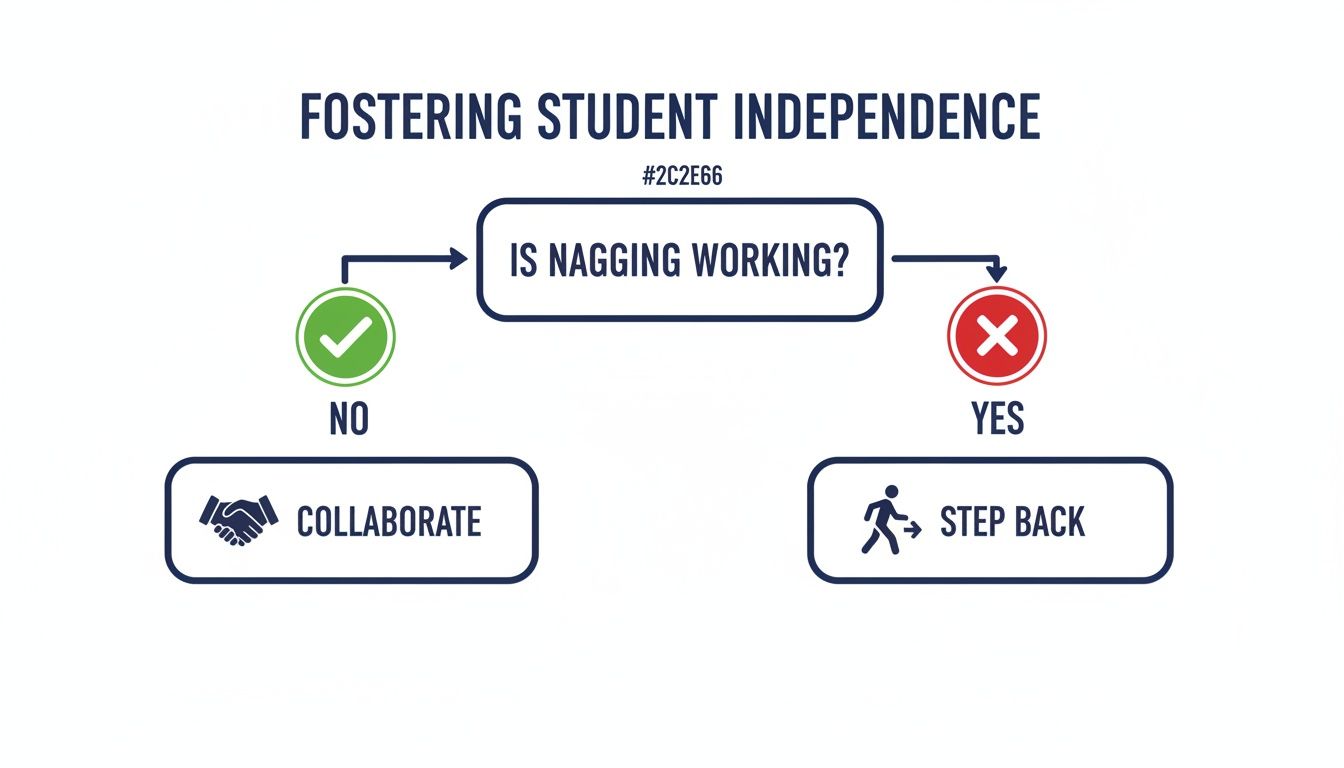
It highlights a simple but powerful truth: if nagging isn’t getting you anywhere, the answer is to collaborate, not to apply more pressure.
Navigating Digital Systems
For students who are already comfortable with technology, the right digital tools can be incredibly powerful. They offer features like automated reminders, syncing across devices, and collaboration tools that paper just can't match.
The trick is choosing wisely and setting things up to support focus, not fracture it.
We have a whole list of our favorite tools to support student learning that goes into much more detail on this.
Here’s a quick look at a few popular digital options and who they’re really for:
Task Management (Todoist, Asana): These are perfect for breaking huge projects into small, concrete steps. They're ideal for high school and college students juggling multiple complex assignments with different due dates.
Note-Taking (Notion, Evernote): These are way more than just digital notebooks. They let students organize research, clip articles from the web, and build their own interconnected study guides. A great fit for students doing heavy research or visual learners who love to create their own systems.
Calendar Management (Google Calendar): A shared digital calendar is pretty much non-negotiable for modern students. It can pull assignments from different school platforms into one central place and send timely reminders for everything from big exams to dentist appointments.
Choosing the Right Organizational Tool
Finding the right system often comes down to matching the tool's features to your student's personality and needs. This table breaks down some of the most common options to help you see what might be the best fit.
| Tool Type | Examples | Best For | Key Feature |
|---|---|---|---|
| Analog Planner | Passion Planner, simple weekly notebooks | Students who need a distraction-free space and benefit from the memory boost of writing. | Simplicity and focus. One task, one purpose. |
| Digital Calendar | Google Calendar, Apple Calendar | Managing time-sensitive events, appointments, and deadlines across multiple devices. | Automated reminders and shareability. |
| Digital Task List | Todoist, Microsoft To Do | Breaking down large assignments into smaller, actionable steps and tracking progress. | Checklists and sub-tasks for project management. |
| Visual Board | Whiteboard, Trello, Asana | Visual thinkers who like to see the entire workflow of a project from start to finish. | "Kanban" style drag-and-drop cards. |
| Digital Notebook | Notion, Evernote, OneNote | Organizing research, class notes, and web clippings into a searchable database. | Flexibility and powerful organization features. |
| Binder System | Color-coded binders, accordion folders | Managing physical papers, handouts, and returned assignments for different classes. | Tactile organization and clear subject separation. |
Ultimately, the best organizational tool is the one a student actually uses. Encourage them to experiment, try things out for a week, and see what feels natural. It’s also perfectly fine—and often very effective—to create a hybrid system that combines the best of both the analog and digital worlds.
Common Questions About Student Organization
When you’re trying to help your child get organized, questions are going to come up. As academic coaches, we’ve heard just about all of them from parents and students who are feeling stuck. Here are our honest answers to the questions we get asked the most, based on what we see work every single day.
How Long Does It Take to See Improvement in Organizational Skills?
There's no magic number here, but what I can tell you is this: consistency is everything. When families commit to a supportive, collaborative approach, they often start to see small, meaningful wins within a few weeks. It might just be fewer frantic mornings or one less forgotten homework assignment, but those little victories are huge.
True, lasting habits? Those often take a few months to really lock in. The real goal is progress, not immediate perfection. We often advise parents to track just one or two specific behaviors—like packing their backpack the night before—because seeing that tangible progress is what keeps everyone motivated.
What Should I Do When My Teenager Resists Help?
Ah, the teenager. Resistance at this age is almost always a bid for independence and control. Instead of laying down the law with a new system you’ve created, try flipping the script and making it a team effort.
Frame it as a problem you need their help to solve. Try something like, "Hey, I've noticed mornings have been super stressful for both of us. I have a couple of ideas, but I really want to know what you think would actually help."
Give them a voice and a choice—it’s the fastest way to get buy-in.
Let them pick out their own planner or try a few organizational apps.
Ask them when a good time would be for a quick 10-minute check-in each week.
Involve them in designing their own homework space.
This simple shift can turn a classic power struggle into a genuine partnership. And if the resistance is really dug in, sometimes bringing in a neutral third party, like an academic coach, can help them build a system they feel like they actually own.
Are Digital Tools Better Than Paper Planners?
Honestly, no. The best tool is the one your student will actually use consistently. That’s it. Digital tools are fantastic for setting recurring reminders and juggling big projects, but for many students, that phone or laptop is a black hole of distraction.
A simple paper planner offers something different: a tangible, single-focus experience that can feel a lot less overwhelming. We see many students thrive with a hybrid approach—using a digital calendar for the big deadlines and a paper planner for their daily to-do list. The key is to experiment and find what clicks with their brain and personality.
How Do I Know if Disorganization Is a Sign of ADHD?
While every student has their moments of chaos, persistent and severe disorganization that’s impacting school, home life, and their friendships might point to an underlying executive function challenge like ADHD.
Look for the patterns. Is your child constantly struggling to get started on tasks, plan ahead for big projects, or manage their time, no matter how much support you offer?
If these challenges are causing real stress, chipping away at their self-esteem, or leading to serious academic trouble, it might be time to talk to a professional. Your pediatrician, a school psychologist, or one of the specialists at our center in Poulsbo, WA can help you get a clearer picture of what's going on.
At Bright Heart Learning, we know that building organizational skills is about so much more than clean binders and color-coded calendars. It’s about giving students the confidence and tools they need to take control of their own success. If your child is struggling, our academic coaches are here to help.
Learn more about our personalized approach to tutoring and executive function coaching and see how we can help your student finally feel capable and confident.