
Your Guide to Learning Assessments for Students
Learning assessments for students are tools that go far beyond a simple report card. Think of them as a detailed, personalized map of your child's academic and cognitive landscape. They aren't just about measuring what your child knows; they're about deeply understanding how your child learns.
The goal is to pinpoint specific strengths, uncover hidden challenges, and create a clear path forward for support. It’s a process that builds a complete picture, helping your child find confidence and truly thrive.
What Are Learning Assessments and Why Do They Matter?
Imagine trying to navigate a new city with a map that only shows major highways. You might get to the general area, but you'll miss all the side streets, landmarks, and potential roadblocks. A standard report card is like that basic highway map—it tells you if your child is passing a subject but offers little insight into why.
Learning assessments for students are the detailed, street-level GPS that every learner deserves.
This "learning GPS" gives you a comprehensive view of your child's unique cognitive profile. It moves beyond just grades to explore the underlying processes that either drive academic success or create obstacles. It's all about answering the critical questions that grades alone simply can't.
A Deeper Look Beyond Grades
An assessment doesn't just show that a student is struggling with reading comprehension; it digs deeper to find out why. Is it an issue with decoding words? Is a slow processing speed making it hard to keep up? Or maybe a working memory deficit makes it tough to recall details from a paragraph?
Similarly, a student who constantly misses homework deadlines might not be lazy. They could be grappling with underdeveloped executive functions that make planning and organization feel impossible. For parents trying to get to the bottom of these struggles, a comprehensive evaluation like psychoeducational testing can be the key to unlocking their child's potential.
These evaluations provide the clarity needed to build an effective, targeted support system. Once we identify the root cause of a challenge, we can finally move from frustration to focused, productive action.
When to Consider a Learning Assessment
Sometimes, the signs of a learning struggle are clear, while other times they're more subtle. Here’s a quick guide to help you recognize when an assessment might be the right next step.
| Common Concern | What an Assessment Can Reveal | Potential Outcome |
|---|---|---|
| "My child's grades are slipping, and I don't know why." | Specific academic skill gaps, processing speed issues, or attention challenges. | A targeted tutoring plan to address the exact skills needed. |
| "Homework is a nightly battle that ends in tears." | Underlying executive function weaknesses (e.g., planning, organization, task initiation). | Strategies and support for building executive function skills. |
| "They seem bright, but school is just not clicking." | Possible learning disabilities (like dyslexia or dysgraphia) or cognitive processing disorders. | Access to school accommodations (IEP/504) and specialized instruction. |
| "They get so anxious and frustrated with schoolwork." | The specific cognitive load that's causing the stress (e.g., weak working memory). | Tools to reduce anxiety and build confidence by addressing the root cause. |
This table is just a starting point. If you have a gut feeling that something isn’t right, an assessment can provide the data-driven answers you need to move forward with confidence.
The True Purpose of an Assessment
Ultimately, the goal of a learning assessment is not to label a child but to empower them. It provides a clear roadmap for targeted, effective intervention. The insights we gain help educators, parents, and students themselves create a personalized plan that addresses specific needs.
You can learn more about how crucial cognitive skills develop over time in our guide to executive function skills by age.
An effective assessment shifts the conversation from "What's wrong with my child?" to "What does my child need to succeed?" It's a proactive, supportive step toward building skills, reducing school-related anxiety, and reigniting a love for learning.
This process offers some powerful benefits, including:
Pinpointing Strengths: Every child has things they are great at. We identify those strengths so they can be used to bolster areas of difficulty.
Clarifying Challenges: We get to the bottom of what's really going on, whether it's a specific learning disability, a processing disorder, or a cognitive gap that's getting in the way.
Guiding Interventions: The results give us clear, actionable data to inform tutoring strategies, school accommodations (like an IEP or 504 plan), and support at home.
Building Confidence: When students understand their own learning profile, it's a game-changer. It reduces self-blame and empowers them to advocate for what they need.
Navigating the Different Types of Student Assessments
The world of learning assessments for students can feel like it’s full of confusing jargon. But once you get a handle on the purpose behind each type, it all starts to click. Think of these assessments as a team of specialists, each one brought in to answer a different, very specific question about your child's learning.
Some are quick checks, like taking a temperature. Others are deep dives, more like a full diagnostic workup at a mechanic's shop when an engine keeps stalling. Each one has a unique and valuable role in building a complete picture of who your child is as a learner. Understanding the difference is the first step toward finding the right kind of support.
This diagram cuts through the noise and gets to the heart of what any good assessment should do: center on the learner to identify both their strengths and their challenges.
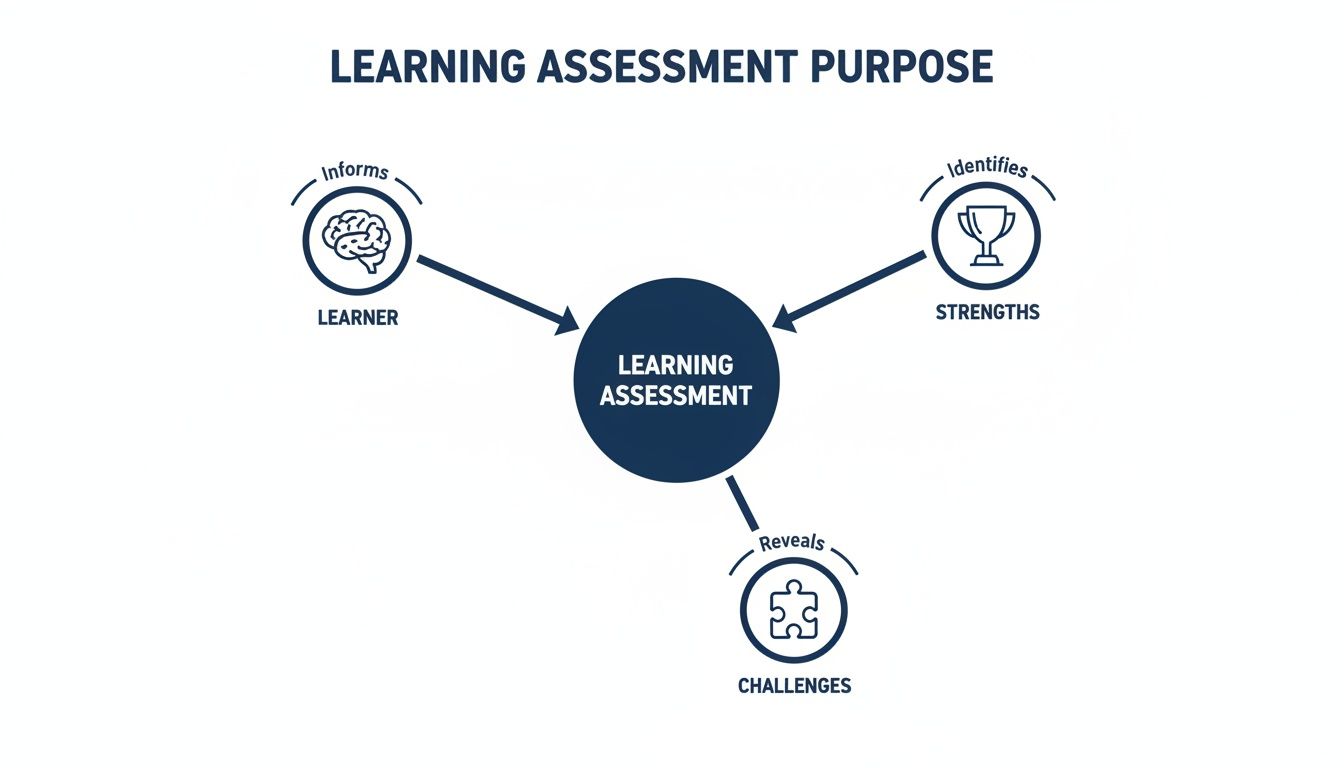
As you can see, every evaluation should ultimately serve the student. It’s all about getting a balanced view of their abilities so we can create strategies that actually work.
H3: Diagnostic and Formative Assessments
Let's go back to that car mechanic. Before they start replacing parts, they run a diagnostic test to find the root cause of the problem. A diagnostic learning assessment does the exact same thing for a student, digging deep to pinpoint the specific reason behind a learning struggle. Is a reading issue caused by phonics, fluency, or comprehension? This is the tool that gives you the answer.
Then you have formative assessments. These are the ongoing, in-the-moment checks that happen during the learning process, not at the end of it.
Think of a coach giving a basketball player real-time feedback during practice—"bend your knees," "follow through on your shot." This isn't for a grade; it's for immediate improvement.
In a classroom, this could be an exit ticket, a quick poll, or a brief quiz. The whole point is to see if students are getting a new concept before the teacher moves on, allowing for quick adjustments to the lesson.
These two types work hand-in-hand. A diagnostic assessment identifies the core problem, while formative assessments help track progress and make small adjustments along the way.
Summative and Standardized Assessments
While formative assessments are about the process of learning, summative assessments are all about the final product. This is the "big game" at the end of the season or the final performance after weeks of rehearsal.
Summative tools are designed to evaluate what a student has learned over a longer period. You’ve seen them a million times:
Final exams that cover an entire semester.
End-of-unit projects designed to showcase everything a student has learned.
Term papers that require students to pull together and synthesize information.
These assessments give you a summary of a student's mastery at a specific endpoint.
Closely related are standardized assessments, which are given and scored in a consistent, or "standard," way. This is what allows for fair comparisons between large groups of students. The SAT and ACT are classic examples. Their goal is to measure a student's readiness for college-level work against a national benchmark.
While these big tests provide valuable data, they only offer a broad snapshot, not a detailed diagnostic picture. They can tell you what a student knows compared to their peers, but they won't tell you how they learn or why they might be struggling with certain concepts.
Specialized and Comprehensive Evaluations
Sometimes, a student's challenges run deeper than typical academic skills and need a more specialized lens. This is where comprehensive evaluations come in, offering a much richer understanding of the whole learner.
A psychoeducational evaluation is one of the most thorough assessments available. It's administered by a licensed psychologist and looks at cognitive abilities (like IQ and memory), academic skills, and social-emotional functioning all at once. This is the gold standard for identifying specific learning disabilities like dyslexia, dyscalculia, and ADHD.
Another crucial specialized tool is an executive function assessment. Executive functions are the brain's management system—the skills that help us plan, organize, manage time, and control our impulses. A student might be brilliant in math but constantly forget to turn in homework. An executive function weakness could be the culprit.
This type of assessment can pinpoint specific deficits in areas like:
Working Memory: The ability to hold and use information in your mind.
Task Initiation: The skill of just getting started on something without procrastinating.
Organization: The capacity to manage materials, time, and ideas effectively.
At Bright Heart Learning, we use a mix of these assessment tools to create a truly individualized plan for every student we meet. This personalized approach ensures we're not just treating symptoms but addressing the root causes of academic challenges, paving the way for lasting confidence and success.
To learn more about how we can support your child's learning journey, you can schedule a consultation with us today.
How the Big Picture Shapes Your Child's Success
While a personalized learning assessment gives us a detailed map of your child's individual brain, it's also incredibly helpful to zoom out. Think of it like a satellite view. Large-scale global benchmarks and national standards show us educational trends across entire countries and school systems, highlighting what’s working and what isn’t on a massive scale.
Why should a parent care about this? Because this bigger picture directly influences the strategies we use to help your child. This global research is what points us toward the most effective, evidence-based methods for tutoring and academic coaching. It’s how we know which teaching approaches consistently deliver the best results for all kinds of learners.
Why a Global Perspective Matters
It's a lot like modern medicine. Your doctor runs tests to diagnose you as an individual, but the treatment they recommend is backed by massive clinical trials involving thousands of people. In the same way, large-scale educational studies show us which learning strategies are most effective across diverse student populations.
This data-driven approach is especially critical when we're supporting students with specific needs. For example, international tests consistently show that deep problem-solving skills are far more valuable than rote memorization. This is a game-changer for how we design support for students with ADHD or executive function challenges. They often thrive when they learn how to think, not just what to memorize.
Understanding these benchmarks confirms that personalized support isn't just a different approach—it's an approach aligned with what broad, data-backed research shows is most effective for building durable skills.
This wider view ensures the support your child receives at Bright Heart Learning is grounded in proven, world-class educational practices.
PISA: A Global Yardstick for Education
One of the most important large-scale assessments is the Programme for International Student Assessment (PISA). This isn't just another standardized test. It’s a global study that measures how well 15-year-olds can apply what they know to solve real-world problems in math, reading, and science. The focus isn't on memorized facts but on practical application, which makes the results so valuable.
PISA evaluates students across 81 different countries, giving us an incredibly rich pool of data. For instance, the 2022 results showed that U.S. students scored 465 in math, just below the average of 472 for developed nations. Findings like this are what drive educational reform. They push schools to prioritize critical thinking over simple recall—a shift that is especially beneficial for students who struggle with attention or executive function. You can read more about the PISA findings and see how these global comparisons are shaping education right here at home.
By seeing what the most successful education systems are doing, we can constantly adapt and refine our own methods. This cycle of continuous improvement, fueled by global data, allows us to give your child the most effective, research-backed support possible—helping them not only catch up but truly get ahead.
What to Expect During the Assessment Process
Starting the journey of a learning assessment can feel a bit like heading into the unknown. It's totally normal for both you and your child to have some butterflies. Our goal is to pull back the curtain and make the whole process feel clear, supportive, and even empowering, right from our very first conversation.
The best way to think about it isn't as a single, scary test, but as a series of conversations and activities we do together. It’s a collaborative journey to get to know your child as the unique learner they are. Each step builds on the last, helping us create a complete picture of their strengths and the specific places where things aren't quite clicking. We work hard to create a warm, low-stress space where kids feel comfortable enough to show us what they can really do.

The First Step: Consultation and Intake
It all starts with a conversation. This first consultation is where we get to listen—really listen—to your concerns, your goals, and what you’ve been seeing at home. After all, you are the world’s leading expert on your child, and your insights are the most valuable tool we have.
During this chat, we'll talk about your child's developmental history, their school experiences, and any specific struggles that have you worried. This helps us map out which assessment tools will get us the clearest answers. From day one, this is a partnership, making sure the entire process is focused on your family's unique needs.
What Happens During the Assessment Sessions
Once we have a solid plan, we’ll schedule the assessment sessions. These are not your typical, fill-in-the-bubble school tests. We’ve designed them to be engaging and dynamic, often feeling more like a series of brain games and interesting puzzles than a formal exam.
The activities are varied and might include things like:
Puzzles and Block Designs: These tasks give us a window into your child’s visual-spatial reasoning and problem-solving skills.
Conversational Questions: We’ll chat and ask questions to see how they organize their thoughts, their vocabulary, and their verbal reasoning.
Academic Tasks: We’ll look at reading, writing, and math skills in a one-on-one setting. This lets us see their process—how they arrive at an answer—not just the final result.
Memory and Attention Games: Fun, game-like activities help us measure key cognitive skills like working memory, processing speed, and the ability to stay focused.
Each session is paced to your child’s energy and needs. We take plenty of breaks to make sure they feel comfortable and can give their best effort. Our number one priority is to capture their true abilities in a supportive environment.
How to Prepare Your Child (Hint: It’s Not About Studying)
Getting your child ready for an assessment is all about setting a positive, relaxed tone. The real goal here is to dial down any anxiety they might be feeling.
Try framing the assessment as a cool opportunity to figure out how their brain learns best. Explain that it’s not about getting a grade, but about finding the right tools to make school easier and more fun. This one little shift in perspective can make a huge difference.
Here are a few simple, practical tips:
A Good Night's Sleep is Non-Negotiable: A well-rested brain is a happy brain. Make sure your child gets plenty of sleep the night before a session.
Fuel Their Brain with a Healthy Breakfast: Good food equals good focus. A balanced meal will help keep their energy and attention steady.
Keep the Pressure Off: Remind your child there's no "pass" or "fail." Their only job is to have fun and try their best. If test-taking is a source of serious stress, our guide on how to reduce test anxiety has more great strategies.
Beyond managing nerves, it's always helpful to improve your test-taking skills with general strategies that can boost performance and confidence.
The Feedback Meeting: Putting It All Together
The final step is our feedback meeting. Once we've scored and analyzed all the data, we’ll sit down together and walk you through the results. We translate all the numbers and clinical observations into a clear story about your child’s learning profile—no jargon, just straightforward answers.
This is where all the pieces of the puzzle come together. We’ll highlight your child’s unique strengths, explain the root cause of any challenges we found, and give you a clear, actionable plan. You'll leave this meeting with a roadmap for the future and the confidence to take the next right step for your child.
Turning Assessment Data into Actionable Steps
So you have the report. It’s a comprehensive look at your child’s learning profile, filled with percentiles, standard scores, and clinical observations. It’s powerful, but it can also feel like trying to read a complex blueprint written in a foreign language.
The real value of learning assessments for students isn’t in the numbers themselves, but in turning that data into a clear, actionable plan.
Think of it like getting a detailed diagnostic report from a car mechanic. The report might list engine compression ratios and electrical readings, but what you really need to know is which part to fix first. This section is your guide to moving from the “why”—the data points and diagnosis—to the “now what”—the concrete steps that will make a real difference for your child.
This is where insight becomes impact. The numbers and notes in the report aren't labels; they are clues that point us directly toward the most effective support strategies.
Decoding the Language of Assessments
Before you can build a plan, you have to speak the language. Your assessor will walk you through the report in detail, but here’s a quick primer on a few common terms.
Standard Scores: These scores simply compare your child's performance to a large, representative sample of same-age peers. An average score is typically 100, so you can quickly see if your child is performing at, above, or below the expected level for their age.
Percentile Ranks: This number tells you the percentage of peers your child scored higher than. For example, a percentile rank of 75 means your child performed as well as or better than 75% of students in the comparison group.
Qualitative Observations: Don’t skip these! The assessor’s notes on how your child approached tasks—their persistence, frustration tolerance, or creative problem-solving—provide crucial context that numbers alone can’t capture.
Understanding these pieces helps demystify the report, allowing you to see the complete picture of your child’s unique cognitive profile.
Connecting Findings to Personalized Support
Once you understand the data, the next step is to draw a straight line from each finding to a specific, targeted intervention. This is where the assessment’s true power comes to life. It creates a bridge between a diagnosed challenge and a practical solution.
The goal is to build skills, not just find temporary workarounds.
An assessment should never be the end of the journey. It's the starting line for providing precise, effective support that builds skills, fosters confidence, and reignites a student's love of learning.
This connection in action might look something like this:
If the assessment reveals weak working memory: The action plan would include targeted cognitive training programs like our AMPS program, which are specifically designed to strengthen this skill, alongside strategies like breaking down multi-step instructions.
If the findings point to executive function deficits: The next logical step is specialized executive function coaching to build foundational skills in planning, organization, and time management.
If the report identifies gaps in academic skills (like phonics or math fluency): The clear solution is one-on-one, personalized tutoring that focuses directly on closing those specific gaps with evidence-based methods.
This targeted approach ensures every intervention is directly addressing a root cause identified in the assessment. Instead of guessing what might help, you have a data-driven roadmap designed for your child’s unique brain. It guarantees that your time and resources are invested in strategies that will actually work.
Your Next Steps After the Assessment
Getting your child's assessment report is a huge moment. You finally have a detailed, data-driven map that explains how their unique brain works. But the journey doesn't stop here—in many ways, it's just getting started. The next steps are all about turning those powerful insights into a real, practical plan that makes a difference.
This is where we shift from understanding the “why” behind the struggles to activating the “now what.” With a clear picture of your child's strengths and challenges, you’re in the perfect position to advocate for their needs and build the right team to support them. Let’s walk through how to do that.
Scheduling a Follow-Up and Sharing the Report
Your very first move should be to schedule a follow-up meeting with the person who did the assessment. This conversation is your opportunity to ask questions, get clarity on anything that seems confusing, and make sure you truly understand the recommendations. Don’t be shy about digging into the details—the more you know, the better you can advocate for your child.
Once you feel confident with the report, it’s time to bring it to your child’s school. This is a team effort. Set up a meeting with key people, which might include their teacher, a school counselor, or the special education coordinator.
Approach this meeting as a partnership. Your goal is to work with the school, using the assessment data as a shared tool to create a supportive learning environment for your student.
This report provides the evidence you need to discuss formal accommodations, like an IEP (Individualized Education Program) or a 504 Plan. These plans can unlock critical support, like extra time on tests, sitting closer to the teacher, or access to assistive technology that can level the playing field for your child.
Choosing the Right Support Services
With the school collaboration in motion, the next step is finding the right outside support to build your child's skills directly. The assessment will point you toward specific needs, whether that’s subject tutoring, test prep, or specialized executive function coaching. Choosing the right person is everything.
When you're interviewing potential tutors or coaches, you're not just hiring help—you're building your child's team. To find the best fit, here are some questions you absolutely need to ask:
How will you use these assessment results to create a personalized plan? A great provider will never offer a cookie-cutter solution. They should be able to tell you exactly how the data from the report will shape their strategies for your child.
What’s your approach to building rapport and trust? At Bright Heart Learning, our philosophy is "Connection Before Content." A strong, trusting relationship is the foundation for all real learning, especially for students who feel anxious or defeated.
How do you track progress and adjust your plan? Learning isn't a straight line. Ask how they measure growth over time and how often you'll get updates. A solid plan includes regular check-ins and evolves as your child develops new skills.
What is your experience with my child's specific challenges? Whether it's dyslexia, ADHD, or math anxiety, make sure the provider has direct experience and uses proven, evidence-based methods for those specific needs.
Getting answers to these questions will help you find a partner who can genuinely help your child thrive. If you're still exploring whether this kind of support is necessary, our article on how to know if your student needs tutoring offers some great clarity.
This whole phase is about building a supportive, adaptable plan. By teaming up with the school and finding the right specialists, you create a powerful network that can make all the difference. To see how we put these principles into practice every day, Visit Our Learning Center in Poulsbo, Washington.
Answering Your Questions About Learning Assessments
Thinking about a learning assessment for your child often brings up a flood of questions. That’s completely normal. Below, we’ve answered some of the most common things parents ask, cutting through the jargon to give you the clarity you need to move forward.
How Do I Know if My Child Needs an Assessment?
Trust your gut on this one. You're not looking for a single bad test grade or one tough homework night; you're looking for a pattern.
Is your child putting in the effort but the results just aren't there? Do they get overwhelmed with anxiety when it's time for school? Have their grades suddenly tanked, or are you hearing the same feedback from teachers over and over about focus or organization? If your child says they feel "stupid" or "stuck," or you see a gap between the bright kid you know and the one who struggles in class, an assessment can finally explain what’s really going on.
What's the Difference Between a School Assessment and a Private One?
This is a big one. While both can be valuable, they’re designed to answer very different questions.
A school-based evaluation is usually trying to figure out if your child is eligible for special education services, like an Individualized Education Program (IEP). The main goal is to identify a specific, qualifying disability that's getting in the way of their school performance.
A private assessment, on the other hand, is usually much broader. We can dig deeper into a whole range of cognitive skills, executive functions, and even emotional factors to create a detailed, personalized roadmap for support. The focus isn't on qualifying for a program—it's on intervention and giving you the tools to help your child thrive, period.
It really comes down to this: A school assessment asks, "Does this student qualify for services?" A private assessment asks, "What does this student need to thrive?"
What Do Assessments Involve and What Do They Cost?
The time and cost really depend on how deep we need to go to get you answers. A focused assessment looking only at specific academic skills might just take a few hours.
A comprehensive psychoeducational evaluation is a much bigger undertaking, often spanning multiple sessions over several weeks. Because of that, the costs can range from a few hundred dollars to several thousand. We always start with a detailed intake call to figure out exactly what's needed, so we can recommend the most direct and cost-effective path to get you and your child the answers you deserve.
At Bright Heart Learning, we know this process can feel overwhelming. We’re here to walk you through every single step. If you still have questions or feel ready to explore what’s next, let’s talk. Schedule a free consultation today.