

How to Improve ACT Score: Proven Strategies for Success
To improve your ACT score, you have to know where you're starting. The first, most critical step is to establish a clear baseline by taking a full-length, timed practice test. This isn't just about getting a score; it's a diagnostic that shows you exactly where your strengths and weaknesses are.
Without this crucial first step, you end up studying blind, wasting precious time on topics you’ve already mastered while ignoring the real point-killers.
Find Your Starting Point for a Higher ACT Score
The journey to a better ACT score doesn’t begin with random drills or the thickest prep book you can find. It starts with something much simpler and far more powerful: taking one complete, timed practice test under realistic conditions.
Think of it like a doctor running a diagnostic before writing a prescription. You wouldn't want a generic treatment—you want one that targets the actual problem. A baseline test is your academic diagnostic, giving you the data you need to build a smart, effective study plan.
You might spend weeks grinding through algebra problems you already know, all while the geometry questions you don't know continue to drag your score down. A diagnostic test is your map, highlighting the exact areas where a little focused effort can make the biggest impact.
Why a Realistic Simulation Matters
To get an accurate baseline, you absolutely have to simulate the real test environment. This goes way beyond just setting a timer on your phone.
A true simulation means mirroring the official test day experience as closely as possible:
Strict Timing: Use the official time limits for every section. No cheating, not even by a minute or two. The pressure is part of what you’re measuring.
No Distractions: Find a quiet spot where you won’t be interrupted for the full 3-hour stretch. Tell your family, put your phone in another room, and close your laptop.
Follow the Rules: That means no phone, no snacks during the sections, and only taking breaks when they are officially scheduled between sections.
Use a Paper Test: The ACT is a paper-and-pencil test. Print out an official practice test and use a bubble sheet. The physical act of bubbling in answers takes time and is part of the test-day reality.
This process reveals so much more than just your content knowledge. It shows you how you handle pressure, manage your pacing, and maintain focus over a long haul. Maybe you nail the first half of the Math section but start making sloppy mistakes when you feel rushed. Or perhaps your reading speed tanks on the final passage because you're mentally drained.
These are the exact patterns a diagnostic test is designed to uncover.
The goal of a baseline test isn't to get a perfect score; it's to collect information. Every wrong answer is a clue that tells you exactly what to study next, turning a vague goal into a concrete action plan.
From Score Report to Study Plan
Once you've taken the test and scored it, the real work begins. The composite score is the least interesting piece of data. You need to dig into the details, section by section.
Get curious and ask yourself some targeted questions:
In the English section, what kind of questions did I miss most? Was it punctuation rules? Sentence structure? Rhetorical skills?
Looking at the Math section, were my errors mostly in algebra, geometry, or trigonometry? Were they careless mistakes or concepts I truly didn't know?
Did I run out of time on the Reading or Science sections? If so, which passages or questions ate up the most time?
Answering these questions turns a simple number into a powerful tool. You can now build a study schedule that dedicates more energy to your specific areas of need.
Here are the essential first steps to accurately assess your current ACT performance level.
Quick Guide to Your ACT Diagnostic
| Action Step | Why It Matters | Pro Tip from Our Tutors |
|---|---|---|
| Download an Official ACT Test | Using retired official tests ensures the questions, difficulty, and format are 100% authentic. | The ACT website offers free practice tests. Start there before buying any prep books. |
| Schedule a 3.5-Hour Block | This forces you to experience the full mental fatigue of test day, revealing how your performance changes over time. | Do it on a Saturday or Sunday morning to mimic the actual test schedule. Get up at the same time and eat a good breakfast. |
| Grade It & Analyze Errors | Don’t just count the number wrong. Categorize each missed question by topic and error type (e.g., content gap, careless mistake, timing issue). | Use a simple spreadsheet or notebook. This log will become the foundation of your entire study plan. |
By starting with a clear-eyed diagnostic, you set yourself up for efficient, targeted preparation from day one. To get a head start, researching comprehensive ACT preparation resources can be a great next move.
Of course, knowing when to start this whole process is just as important, which is why we put together a guide on when to prepare for the SAT or ACT.
Build a Study Schedule That Actually Works
You've got the diagnostic results. Now what? The next move is turning that raw data into a real-world battle plan. A generic, one-size-fits-all study schedule is the fastest way I've seen students burn out and get frustrated. The secret to making real, sustainable progress is building a schedule that fits your life, targets your weaknesses, and respects your limits.
Trying to cram for eight hours every Saturday is a classic mistake. It's far less effective than dedicating focused, 45-minute blocks five days a week. We know from countless studies that "distributed practice"—spreading out your study sessions—is the key to long-term retention. Cramming just doesn't stick. The goal isn't just to study hard; it's to study smart.
This is all about building a routine that becomes a habit, not just another chore on your to-do list. A great schedule works with your classes, sports, job, and social life, making sure you can prep consistently without sacrificing your sanity.
Mapping Your Prep Timeline
How you lay out your schedule really depends on one big thing: how much time you have until test day. Whether you've got six months or just one, you can make it work.
Six-Month Plan (The Marathoner): This is the ideal timeline for steady, low-stress improvement. You can get away with 2-4 hours per week, focusing on one section at a time while consistently reviewing the others. This long runway gives you the breathing room to dive deep into content gaps and turn weaknesses into strengths without that panicked, rushed feeling.
Three-Month Plan (The Sweet Spot): For most students, this is the perfect balance. You'll need to commit 4-6 hours per week. The strategy here is to dedicate serious time to your two weakest sections while doing regular, lighter practice on your stronger ones to keep those skills sharp.
One-Month Plan (The Sprinter): Okay, this is an intensive, all-in approach requiring 8-10 hours per week. Your entire focus has to be on targeted practice tests and ruthless error analysis. You don't have time to relearn every single concept from scratch, so you have to patch the biggest holes and master test-day strategies.
This whole process of starting your ACT prep—which is the foundation for your schedule—can be boiled down to a simple loop.
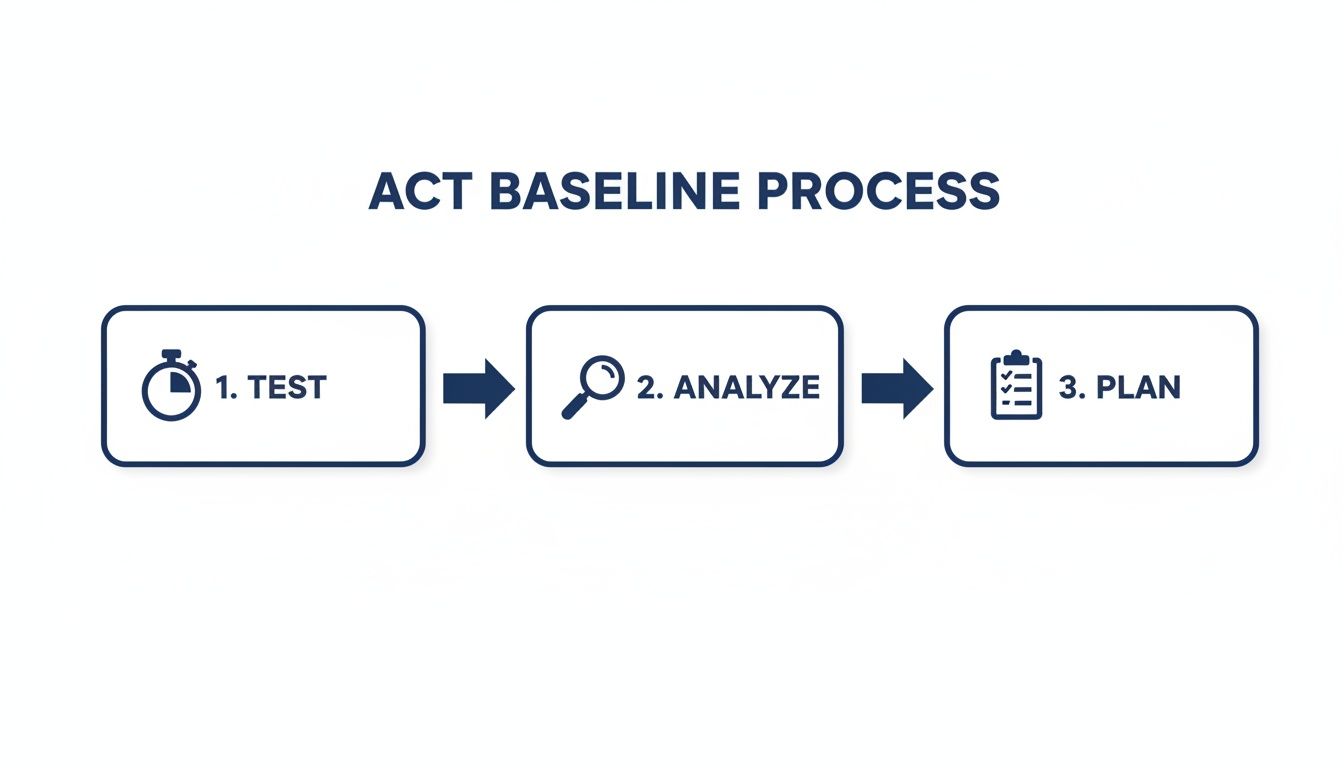
It’s really that straightforward. You test to get the data, you analyze that data to find your patterns, and then you plan your studies around what you found. This cycle is the engine that will drive your score up.
Designing Your Weekly Study Blocks
Now, let's get granular and translate that timeline into what you’re actually doing each week. Forget vague goals like "study for the ACT." Your calendar needs specific, actionable tasks. This is how you beat the feeling of being overwhelmed and make it easy to just get started.
For example, a student who’s shaky in Math and Science but solid in English could map out their week like this:
| Day | Focus (45-60 min session) | Activity |
|---|---|---|
| Monday | Math (Weakness 1) | Review 10 missed geometry problems; watch a video on triangle theorems. |
| Tuesday | Science (Weakness 2) | Complete and review two "Conflicting Viewpoints" passages from a practice test. |
| Wednesday | Reading (Maintenance) | Timed practice on one full Reading passage; analyze the question types. |
| Thursday | Math (Weakness 1) | Drill trigonometry concepts; practice SOHCAHTOA problems. |
| Friday | English (Strength) | Quick review of comma rules; complete 15 practice questions. |
See how that works? You're consistently hammering your weak areas while making sure your strengths don't get rusty. Every session is short and has a crystal-clear goal. To make those sessions count, you’ll also want to explore some effective study note-taking strategies that actually help you remember what you've reviewed.
A great schedule is both structured and flexible. Life happens. If you miss a session, don't scrap the whole week. Simply adjust and pick up where you left off. Consistency over perfection is the motto for raising your ACT score.
Balancing ACT Prep with a Busy Life
For students juggling AP classes, sports, a part-time job, and a social life, adding ACT prep can feel totally impossible. The trick is to integrate, not just add. You have to find those small pockets of time and use them wisely.
Here are a few strategies I give my students:
The 20-Minute Rule: Got 20 minutes before practice starts or while waiting for a ride? That’s plenty of time to review 10 English questions or break down a Science passage. These micro-sessions really add up.
Use a Planner: I don't care if it's digital or on paper—schedule your ACT prep like it's a doctor's appointment. When you block it out on your calendar, you're so much more likely to actually do it.
Accountability Partner: Find a friend who's also studying. You can review practice tests together, quiz each other, or just check in to make sure you're both staying on track. It makes a huge difference.
Master the Strategies for Each ACT Section
This is where the real work begins. Knowing how to raise your ACT score isn’t just about memorizing facts—it’s about learning to play the game. Each section of the test has its own rhythm, its own set of rules, and its own sneaky traps. A high score comes from understanding these quirks and building a specific plan of attack for each one.
Being good at math in your algebra class is one thing; being good at ACT Math is a completely different beast. The same goes for English, Reading, and Science. You have to shift your thinking from "student" to "test-taker."
Let's break down the practical, no-fluff strategies you need to walk into each section with confidence and a clear head.
Conquering the ACT English Section
The ACT English test isn't about writing beautiful essays. It's about pattern recognition. With 75 questions crammed into just 45 minutes, this section is a sprint that rewards speed and precision. The questions boil down to two main buckets: Usage/Mechanics (grammar) and Rhetorical Skills (style and structure).
For the grammar stuff, your goal is to become an expert on the rules the ACT tests over and over again.
Commas: You need to know them inside and out—how they separate clauses, set off extra information, and organize lists.
Apostrophes: It’s all about mastering the difference between possessives (the student's book) and contractions (it's raining).
Subject-Verb Agreement: Can you find the subject and verb in a long, complicated sentence and make sure they match?
Pronoun Agreement: A pronoun has to agree with the noun it's replacing. "The team" is a single unit, so it gets an "its," not a "their."
Rhetorical Skills questions are a bit different. They ask you to think like an editor—should you add, delete, or reorder a sentence? The golden rule here is context. Always read the sentences before and after to understand what the author is trying to accomplish.
A killer strategy for the English section is to trust your ear but always verify with a rule. If a sentence sounds clunky or weird, it’s probably wrong. But before you bubble in an answer, ask yourself why it's wrong. Can you name the specific grammar rule being broken?
Decoding the ACT Math Section
The Math test throws a lot at you: 60 questions in 60 minutes, covering everything from pre-algebra to a dash of trigonometry. That one-minute-per-question pace feels brutal, but a smart approach makes it totally doable. You don't have to be a math prodigy, but you absolutely have to be efficient.
First, get your essential formulas locked in. Some are obvious, but others can be easy to forget under pressure.
Geometry: Area formulas (circle, triangle, trapezoid), the Pythagorean theorem, and good old SOHCAHTOA.
Algebra: Slope-intercept form (y = mx + b), the quadratic formula, and the distance formula.
Number Properties: Rules for exponents and logarithms.
Second, learn how to dismantle word problems. The ACT loves to wrap simple math in confusing stories. When you hit a wall of text, don't freak out. Just follow this process:
Find the Goal: What is the question actually asking for? Underline that part.
Pull Out the Numbers: Jot down all the numerical values they give you.
Pick Your Tool: Decide which formula or concept fits the problem.
Plug and Solve: Carefully put the numbers into your formula and do the math.
This methodical approach keeps you from getting lost in the narrative and lets you focus on the calculation.
Navigating the ACT Reading Section
The Reading section is all about speed and strategy. You've got four passages—Prose Fiction, Social Science, Humanities, and Natural Science—and just 35 minutes to answer 40 questions. The single biggest mistake students make is reading every passage like it’s assigned for English class.
Your goal isn't deep literary analysis; it's to hunt for answers. One of the most powerful ways to do this is to read the questions first. A quick scan of the questions (not the answer choices) before you start the passage primes your brain. You’ll know which names, dates, and ideas to look for.
Another great technique is to "map" the passage as you go. Underline the main idea of each paragraph and circle key terms. This creates a quick-reference guide, so when a question asks about "Dr. Evans's theory," you can jump right to that spot instead of re-reading everything from the beginning.
Data from recent tests underscores why a balanced approach is so important. One analysis, for example, showed that female students tended to score higher on the English and Reading sections, while male students often had an edge in Math and Science. You can see the full breakdown in the report on new graduates' ACT scores from EdWeek.org. This just goes to show that targeting your personal areas for improvement is the most reliable path to a higher score, no matter what the general trends say.
Interpreting the ACT Science Section
The Science section is the most misunderstood part of the ACT. Let’s be clear: it is not a science test. It's a reading-and-interpreting-data test. You don't need to know advanced physics formulas; you just need to be able to read charts, graphs, and tables like a pro.
The passages come in three main flavors:
Data Representation: These are all about visuals. Your job is to pull specific values from graphs and tables.
Research Summaries: These describe a few experiments. You need to identify the controls, variables, and outcomes.
Conflicting Viewpoints: This passage presents two or more competing theories. You have to figure out the main argument for each side and what evidence they use to back it up.
For every single passage type, the best strategy is to go straight to the questions. Many questions will literally tell you where to look ("According to Figure 1…"). Don't get bogged down trying to become an expert on the experiment's topic. Find the data, answer the question, and move on.
If you’re hitting a wall with certain question types or just can't get your pacing down, that's a sign that more personalized strategies might be needed. Our expert team provides specialized ACT tutoring designed to help you turn these tricky sections into your highest scores.
Turn Practice Tests into Real Score Gains
Knowing the content is one thing. Performing under the pressure of a three-hour exam is a completely different beast. This is where strategic, timed practice tests become your single most powerful tool for turning what you know into actual score gains. They build the mental stamina and pacing instincts you absolutely need on test day.
Simply drilling random questions won't prepare you for the marathon that is the ACT. It's the full-length, timed simulations that train your brain to stay sharp from the first English question to the final, frantic Science passage.
Simulate Test Day to Master It
The whole point of a practice test isn't just to get a score; it's to experience the mental and physical demands of the real thing. Simulating test day conditions is non-negotiable if you want to see your score climb because it systematically kills surprises and dials down the anxiety.
Every time you sit for a full, timed test, you're building a crucial mental muscle. You start to get a feel for the rhythm of the exam, learning what 35 minutes really feels like in the Reading section or how to manage your final minutes in the Math section without panicking. This process builds an internal clock that is absolutely essential for peak performance.
The Real Work Happens After the Test
Here’s a secret that separates the students who improve from those who don't: the biggest gains come from what you do after the test is over. The real gold is in the meticulous, question-by-question review of your mistakes. A quick glance at what you got wrong is a completely wasted opportunity.
You have to become a detective and diagnose the root cause of every single error. This kind of deep analysis is what turns your study sessions from random guessing into a targeted, effective strategy.
Your first official ACT score is just a baseline—it's the starting line, not the finish line. The students who see the biggest improvements are the ones who treat every practice test as a rich source of data, not a judgment of their ability.
A System for Meticulous Error Review
For every single question you missed, you need to ask yourself which of these three categories it falls into. This system moves you beyond just correcting the answer to fixing the underlying problem for good.
Knowledge Gap: You just flat-out didn't know the content. This could be a forgotten geometry formula, a specific grammar rule you've never learned, or a type of science graph you've never seen. These are actually the easiest problems to fix—they give you a crystal-clear map of what to study next.
Careless Error: You knew exactly how to do the problem but made a simple mistake. Maybe you misread the question, bubbled in the wrong answer, or goofed up a simple calculation. These are frustrating, for sure, but they’re a huge signal that you need to practice slowing down and double-checking your work.
Pacing Issue: You ran out of time, or you rushed through the question because you were behind schedule and had to guess. This is your brain telling you that your time management strategies for that specific section need serious work.
By categorizing your mistakes, you create a powerful feedback loop. A page full of "knowledge gaps" means you need more content review. A bunch of "careless errors" means you need to practice mindfulness and checking your work. If it's all "pacing issues," then timed drills on individual passages or problem sets should be your next move.
This kind of focused persistence pays off. In fact, research shows that students who retake the ACT often see significant score improvements. Data from ACT's Grad Class Database shows that among the 35% of high school graduates who retested, the average boost was 2.4 points on their Superscore compared to their first attempt. These numbers prove that your first test is just a starting point, and with a smart strategy, real growth is achievable. You can find more details in the ACT's official data report.
This reinforces our philosophy at Bright Heart Learning that persistence paired with a smart strategy unlocks a student's true potential. We've seen firsthand how a structured approach to practice and review can transform a student's confidence and score. For more support and personalized guidance, we invite you to connect with our team.
Manage Test Anxiety and Build Lasting Confidence

Let’s be honest. You can drill every math formula and grammar rule in the book, but none of it matters if your mind goes blank the second the timer starts.
Your mindset on test day is a powerful, often overlooked, piece of the puzzle. Tackling the mental game of the ACT is just as important as all the academic prep you’re doing.
Confidence isn’t something you just show up with; it's a skill you build. When you learn to manage test anxiety, you’re taking control of your performance. You're ensuring you can actually access all the information you’ve worked so hard to learn. This is how you turn nervous energy into focused execution.
Taming the Test Day Jitters
Anxiety isn't just in your head—it's a physical response. Your heart races, your breathing gets shallow, and your focus shatters. But you don't have to fight it. Instead, you can work with your body to stay grounded when the pressure is on.
One of the most effective tools I teach students is box breathing. It’s discreet, simple, and works almost instantly.
Inhale slowly through your nose for 4 seconds.
Hold your breath for 4 seconds.
Exhale slowly through your mouth for 4 seconds.
Hold your breath again for 4 seconds.
Do this three or four times between sections or anytime you feel that wave of panic rising. It’s a direct signal to your brain that you're safe and in control, helping to clear the fog so you can focus on the next question.
Another powerful technique is visualization. The night before the test, take five minutes. Close your eyes and mentally walk through a successful test day. See yourself waking up refreshed. Picture yourself moving through each section with focus and calm. Imagine walking out of that testing center feeling proud of your effort. This mental rehearsal literally prepares your brain for success.
At Bright Heart Learning, our philosophy is 'Connection Before Content.' We know that a confident, composed student will always outperform an anxious one. Mastering your mindset is the final, critical piece in learning how to improve your ACT score.
Rewiring Your Inner Monologue
That little voice in your head—the one whispering, "I'm going to fail" or "I'm not smart enough"—is your biggest enemy. Learning to challenge and reframe this negative self-talk is a total game-changer.
When a negative thought pops up, don’t just try to ignore it. Actively challenge it with something realistic and positive.
Instead of: “There’s no way I’ll finish the Science section.”
Try: “I have a solid pacing strategy for Science. I will focus on one passage at a time and do my best.”
This isn't about blind optimism. It's about swapping a defeating narrative for an action-oriented one. Recognizing the signs of stress is the first step, and providing the right kind of encouragement is essential. You can learn more by exploring our guide on how to support stressed-out students.
This kind of structured mental preparation has a massive impact. One study on test prep showed jaw-dropping results: 62 participants achieved an average 3.8-point ACT score increase. For the 86% of students who improved, their gains averaged an incredible 4.7 points. That shows just what a focused intervention can do.
Before the big day, use this checklist to set yourself up for a calm, confident experience. A little preparation goes a long way in keeping anxiety at bay.
Your Pre-Test Anxiety Reduction Checklist
Follow these steps the week and morning of the ACT to arrive calm, focused, and ready to perform.
| Timeframe | Action to Take | Desired Outcome |
|---|---|---|
| The Week Before | Pack your test-day bag (ID, ticket, calculator, snacks). | No last-minute scrambling or panic. |
| The Week Before | Do a trial run to the testing center at the same time. | Familiarity with the route and timing reduces stress. |
| The Night Before | Stop studying by 7 PM. Do something relaxing. | Your brain needs rest to consolidate information. |
| The Night Before | Set two alarms and lay out your clothes. | Eliminates morning decision-making and fear of oversleeping. |
| Morning Of | Eat a balanced breakfast with protein. Avoid heavy sugar. | Sustained energy without the crash. |
| Morning Of | Leave 15-20 minutes earlier than you think you need to. | Arrive calm and un-rushed, avoiding traffic anxiety. |
| During Breaks | Step away from your desk, stretch, and use your breathing technique. | Reset your mind and body for the next section. |
This proactive approach puts you in the driver's seat, turning potential stress points into moments of calm control. You've done the work—now it's time to create the right conditions to let that work shine.
Common Questions About Lifting Your ACT Score
As you dig into ACT prep, you're bound to have questions. It's totally normal. Below are some straightforward answers to the questions we hear most often from students and parents. Think of this as your go-to guide for clearing up confusion so you can move forward with a solid plan.
How Much Can My Score Realistically Go Up?
This really depends on the student, but with focused, consistent work, a 2-4 point jump is a very achievable goal. Honestly, students starting with a lower score often have the room to make even bigger gains.
The secret isn't just logging hours—it's about making those hours count. The biggest improvements always come from zeroing in on your specific weak spots, whether that's trigonometry concepts or comma rules, and really dedicating your energy to mastering them.
Should I Focus on My Weakest Section or All of Them?
Your biggest and quickest point gains are almost always hiding in your weakest section. That's why we recommend dedicating about 50% of your total study time to that one area where you have the most room to grow.
Use the other half of your time to keep your skills sharp in your stronger sections. This balanced approach stops you from losing easy points on test day while still giving you the best shot at a higher overall score.
How Many Practice Tests Should I Actually Take?
When it comes to practice tests, quality smashes quantity every single time. Instead of burning through a dozen tests and feeling exhausted, aim to take 3 to 5 full-length, timed practice tests under conditions that mimic the real thing.
But here’s the most important part: the real learning happens after the test is done. What truly moves the needle is meticulously reviewing every single question you got wrong. You have to understand why you made a mistake to keep it from happening again.
Should I Guess If I Don't Know the Answer?
Yes! Absolutely, one hundred percent, yes. The ACT doesn't penalize you for wrong answers, which means you should never, ever leave a bubble blank on your answer sheet.
Every single question is a chance to score a point. If you're running out of time or just completely stuck, eliminate any answers you know are wrong and make your best educated guess from what's left. You have literally nothing to lose and a point to gain.
A lot of students worry that retesting looks bad to colleges. It’s actually the opposite. Retesting shows grit and a drive to improve. Plus, many schools now "superscore," meaning they take your best section scores from different test dates to create a new, higher composite score.
Is It Really Worth Retaking the ACT?
Retaking the ACT isn't just common—it’s a smart move. An analysis from Education Week found that 35% of students who took the ACT retested multiple times, and they saw their scores go up by an average of nearly 3 points.
That stat alone shows the huge advantage you get by giving it another shot. This is especially true for students who might not have access to private coaching, since targeted support can make a massive difference. You can read more about these findings on ACT score trends here. Your first score is just a baseline—it’s not the final word.
At Bright Heart Learning, we get that every student's path is different. If you're looking for a personalized plan to turn your hard work into a higher score, we’re here to help. Our expert tutors use a "Connection Before Content" approach that reduces anxiety and builds real, lasting confidence. Take a look at our tutoring and coaching services to get started.