

Tutoring for Students with Learning disabilities: A Practical Guide
When a student has a learning disability, standard tutoring often feels like patching cracks in a wall when the real problem is a shaky foundation. Specialized tutoring is different. It's not just about getting through tonight's homework; it's about rebuilding that foundation from the ground up.
Beyond Homework Help: The Goal of Specialized Tutoring

Think of a specialized tutor as a personal trainer for your child’s brain. Their first job isn’t to explain a math problem again, but to figure out why the problem is hard in the first place.
Is it a challenge with decoding words, organizing thoughts, or staying focused? Once they diagnose the specific hurdle, they create a personalized "workout" plan to strengthen those core skills. It’s a shift from temporary fixes to building lasting ability.
Connection Before Content: A Foundational Philosophy
Before any real learning can happen, a child needs to feel safe, understood, and supported. This is the heart of the “Connection Before Content” philosophy. A great tutor knows that building trust is the essential first step, especially for a student who has come to associate school with frustration.
When that connection is there, the brain is far more open to learning. Frustration and anxiety start to give way to confidence and resilience. This is also where a tutor can address the emotional side of learning, using proven strategies to overcome math anxiety and rebuilding a student's belief in themselves.
The goal is to move beyond the "why" of the struggle to the "now what" of the solution. By focusing on practical, actionable strategies, we help students regain control over their learning journey and see real, meaningful progress.
The Real Need for Targeted Support
This kind of personalized support isn't just a nice-to-have; it's a critical need for millions of students. Roughly 15% of students worldwide—around 250 million children—live with a learning disability.
Historically, the system has failed to meet this need. Before the Individuals with Disabilities Education Act (IDEA) was properly amended, a staggering 36% of students with learning disabilities dropped out of high school, with only 12% receiving the individualized support they required.
Effective tutoring provides the tools these students need to thrive. It’s about more than better grades—it's about building a stronger, more confident learner for life. Explore the specialized academic coaching programs at Bright Heart Learning to see how we put this philosophy into practice.
Decoding the Strategies That Actually Work
When you’re looking for a tutor for a student with a learning disability, it’s easy to assume it’s just about more practice. More homework help, more drilling, more repetition. But that approach often misses the mark.
Effective tutoring isn't about simply repeating a lesson that didn't stick the first time. It’s about using specific, evidence-based methods that get to the root of the struggle and actually build new pathways in the brain. Think of it less like a temporary crutch and more like giving your child a whole new set of mental tools they can use for life.
It's like this: if a student can't read fluently, just handing them more books is like telling someone who doesn’t know how to swim to "just try harder" in the deep end. A specialized tutor doesn't push them in; they get in the water with them and teach them the fundamental strokes—the techniques that make navigating the water possible.
To give you a clearer picture, let's look at what these strategies actually look like in practice. Not all learning challenges are the same, and neither are the solutions. The table below breaks down some common learning disabilities and the kinds of powerful, targeted interventions a trained tutor will use.
Evidence-Based Tutoring Strategies for Common Learning Challenges
| Learning Challenge | Common Symptoms | Effective Tutoring Intervention |
|---|---|---|
| Dyslexia | Difficulty with decoding, spelling, and recognizing words; slow or inaccurate reading. | Multisensory Structured Literacy: Using programs like Orton-Gillingham that engage sight, sound, and touch to build connections between letters and sounds. |
| ADHD | Trouble with focus, organization, time management, and starting tasks. | Executive Function Coaching: Teaching concrete strategies for planning, breaking down projects, and using tools like planners and timers to manage tasks. |
| Dysgraphia | Slow or illegible handwriting; difficulty with spelling and putting thoughts on paper. | Assistive Technology & Multisensory Writing: Combining keyboarding skills and speech-to-text software with hands-on activities to strengthen fine motor skills. |
| Dyscalculia | Difficulty understanding number concepts, math facts, and multi-step problems. | Concrete-Representational-Abstract (CRA) Approach: Using physical objects (like blocks) to represent math concepts before moving to drawings and then to abstract numbers and symbols. |
As you can see, the right support goes far beyond just reviewing homework. It’s about arming students with the specific tools their unique brains need to succeed.
Multisensory Reading Support
For a student with dyslexia, the link between a letter on a page and the sound it makes can feel totally disconnected. Multisensory instruction is designed to forge that connection by pulling in more than one sense at a time. This approach creates stronger, more diverse neural pathways, making it easier for the brain to retrieve information.
Instead of just seeing a letter and hearing its sound, a student might:
- Trace the letter 'b' in a tray of sand while saying the /b/ sound out loud.
- Use tactile letter tiles to physically build words, feeling the unique shape of each letter.
- Tap out the syllables of a word on their arm to feel its rhythm and structure.
This method, which is the foundation of gold-standard approaches like Orton-Gillingham, turns reading from a passive chore into an active, physical experience. It grounds abstract symbols in concrete, sensory feedback, which is exactly what a dyslexic brain needs to make sense of it all.
Executive Function Coaching
Ever feel like your child’s brain is a brilliant but messy office? That’s where executive functions come in. These are the crucial management skills—planning, organization, time management, emotional control—that are run by the prefrontal cortex. For many students with learning disabilities, especially ADHD, this "CEO of the brain" is completely overworked and needs an assistant.
That's exactly what executive function coaching provides. It’s not about nagging a student to “just be more organized.” It’s a partnership where a coach helps the student build practical, real-world systems that take the pressure off. You can dive deeper into some of these ideas in our guide to metacognitive strategies for learning.
A tutor might help a student set up a simple, color-coded folder system that visually separates subjects. Or they might teach them how to use a digital planner with automated reminders to break down a huge research project into small, non-scary steps. The goal is to make these organizational strategies external and visible until the student internalizes the habits.
This kind of targeted support works. Research shows that tutored students with ADHD can improve their executive skills by 35% in just six months. That improvement leads to fewer battles over homework and an average GPA boost of 0.5 points. In places like the UK and China, where nearly 30% of high schoolers use tutors, students with disabilities who get this support see 25% higher college acceptance rates. You can explore more on these trends and their impact here.
Cognitive Training and Accommodations
Beyond targeting specific academic skills, specialized tutoring often includes cognitive training to strengthen the brain’s underlying machinery—things like working memory, processing speed, and attention. This might look like playing targeted brain-training games or doing exercises designed to improve focus and the ability to hold onto information.
At the same time, tutors help students actually use the accommodations and assistive technology available to them. These tools aren't a cheat code; they are designed to level the playing field so a student's true abilities can shine through.
Here are a few game-changers we often use:
- Text-to-speech software reads digital text out loud, allowing students with dyslexia to access complex, grade-level material without getting stuck on decoding.
- Speech-to-text software lets a student speak their ideas and watch them appear as text, completely bypassing challenges with spelling or handwriting.
- Graphic organizers are visual maps that help a student brainstorm and structure their ideas for an essay, making the writing process feel a thousand times less intimidating.
By combining direct skill-building with smart accommodations, tutoring doesn't just help a student keep up. It empowers them to work around their challenges while actively strengthening their core cognitive abilities, building a rock-solid foundation for a lifetime of independent learning.
Creating a Personalized Roadmap to Success
A successful tutoring journey starts long before the first session. Think of it like a master architect designing a custom home—they wouldn't dream of pouring the foundation without a detailed blueprint. In the same way, an effective tutor needs a deep, holistic understanding of your child's unique learning profile to build a truly meaningful plan.
This is where a generic, one-size-fits-all curriculum gets left behind. We move beyond just looking at report cards or past test scores. It’s about getting to know the whole child—their passions, their frustrations, their academic history, and what they hope to achieve. We need to find out what makes them light up and what makes them shut down.
The Initial Consultation and Assessment
The first step is always a conversation. We start with an initial consultation, which isn't a high-pressure test, but a collaborative meeting with you, your child, and the tutor or program director. The goal here is simple: create a safe space where your child feels heard and understood. This sets the stage for the "Connection Before Content" philosophy that is the engine for real progress.
From there, we begin the assessment process to pinpoint specific areas of need. This isn't about labeling; it's about illuminating the path forward. This can involve a mix of approaches:
- Informal Assessments: This might look like observing how your child tackles a tricky problem, reviewing past schoolwork together, or using low-stress activities to see their skills in action without the pressure of a formal test.
- Formal Diagnostic Tools: We might also use specific, targeted assessments to measure things like phonological awareness, reading fluency, or working memory. These tools give us concrete data to find the root cause of a learning challenge.
The whole point of an assessment is to get a clear, objective baseline. It allows everyone—you, your child, and the tutor—to see exactly where the journey is starting and to define what success will look like together.
The data we gather from these assessments directly informs which evidence-based strategies we'll use in our plan.
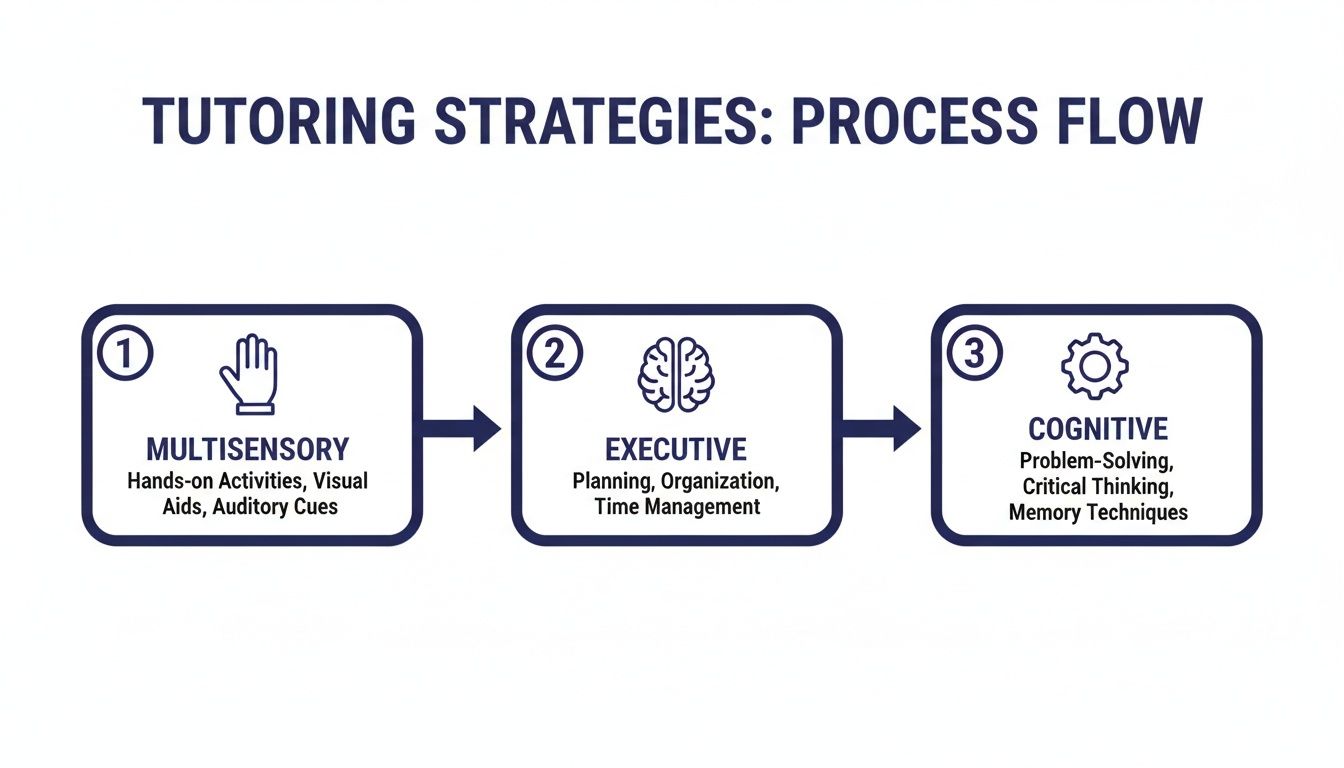
As the visual shows, a truly personalized plan pulls from multisensory, executive function, and cognitive techniques, all tailored to your child's specific learning profile.
Crafting the Custom Learning Plan
Once we have all this valuable information, we synthesize it into a custom learning plan. This document is the roadmap. It outlines specific, measurable, achievable, relevant, and time-bound (SMART) goals.
So, instead of a vague goal like "get better at reading," a personalized plan might aim to "increase reading fluency by 20 words per minute and correctly use three new decoding strategies within 12 weeks." See the difference?
This plan is a living document, not something set in stone. It guides the first few sessions and is constantly reviewed and adjusted based on your child's progress and feedback. Often, the foundation of a powerful plan comes from understanding a student's cognitive profile, which can be uncovered through comprehensive neuropsychological testing for learning disabilities. This deeper diagnostic insight ensures we're targeting the right skills from day one.
Ultimately, this whole collaborative process ensures that our tutoring is never a cookie-cutter solution. By taking the time to truly understand the individual, we set the stage for meaningful, lasting change. To get a better sense of how we build these supportive structures, check out our article explaining what executive function support looks like.
How to Find the Right Tutor for Your Child
Choosing a tutor can feel like a huge, high-stakes decision. You aren't just looking for someone to help with homework; you're searching for a guide who truly gets your child and can help them see their own potential.
The right person becomes more than an instructor—they become a partner in your child's education. This makes finding them one of the most important things you can do on their learning journey. The key is to look past generic qualifications and zero in on what actually matters for students with learning disabilities. You need someone with a deep understanding of the unique way your child's brain is wired.
Key Qualifications and Experience
A great tutor’s value isn't measured by their college GPA or a fancy degree. Instead, you should look for specific credentials and real-world experience that prove they're equipped to provide specialized, evidence-based instruction. Think of this as your first filter.
Here are the non-negotiables:
- Direct Experience: Has the tutor worked with students who share your child's specific diagnosis (like dyslexia, ADHD, or dyscalculia)? Ask for examples of strategies they've used that actually worked.
- Specialized Certifications: Training in evidence-based methodologies is a massive green flag. Look for certifications in programs like Orton-Gillingham for dyslexia or specific executive function coaching to know you're dealing with an expert.
- Understanding of Assistive Technology: A modern tutor must be comfortable with tools that level the playing field. This includes text-to-speech software, digital graphic organizers, and other tech that empowers your child.
The need for high-quality tutoring for students with learning disabilities has never been greater. In the U.S. alone, the Individuals with Disabilities Education Act (IDEA) serves 7.5 million students. For these kids, supplemental tutoring is linked to a 28% higher graduation rate.
Despite this, a proficiency gap remains. Only 61% of students with disabilities meet standards, compared to 80% of their peers, which just underscores how critical effective, specialized support really is. You can explore more data on the private tutoring market to understand these trends.
Critical Questions to Ask a Potential Tutor
Once you've found a few candidates who look good on paper, the interview is your chance to see if they're a true fit. Your goal is to understand their methods, their philosophy, and how they’ll communicate with your family.
The best tutor isn't just an instructor; they are a communicator, a strategist, and a coach. The answers to these questions will reveal if they are the right fit for your child's unique needs and personality.
Go into the conversation prepared with a list of questions. This isn't just about vetting their skills—it's about finding a personality and communication style that clicks with your family.
Checklist for Evaluating Tutoring Programs
Finding the right program can feel like searching for a needle in a haystack. This checklist is designed to help you ask the right questions during your research and interviews, so you can feel confident you're choosing a true partner for your child's journey.
| Evaluation Area | Key Questions to Ask | What to Look For in a Response |
|---|---|---|
| Teaching Philosophy | How do you build rapport with a new student? What is your approach when a student is frustrated or unmotivated? | Look for a "Connection Before Content" philosophy. They should talk about patience, building trust, and specific strategies to lower anxiety. |
| Progress Tracking | How do you measure success beyond grades? How often will you provide updates on my child's progress? | A strong answer will include data-driven methods, clear goal-setting, regular feedback loops, and a focus on skill mastery, not just test scores. |
| Communication | What is your process for communicating with parents? How would you collaborate with my child's teachers, if needed? | They should describe a clear, consistent communication plan (e.g., weekly email summaries, monthly calls) and show a genuine willingness to be a team player. |
After you've done your interviews and feel good about a candidate's approach, you're ready for the final, most important step.
The Power of the Right Connection
At the end of the day, the single most important factor is the relationship between the tutor and your child. All the credentials in the world mean nothing if your child doesn’t feel safe, seen, and comfortable with their tutor.
This is why a trial session is non-negotiable.
Arrange a short introductory meeting to see if the chemistry is right. Watch how the tutor interacts with your child. Do they listen more than they talk? Do they show genuine curiosity about your child's interests? Does your child seem engaged and at ease?
Trust your gut. That connection is the foundation on which all real learning is built.
Measuring Progress Beyond Report Cards

So, how do you know if tutoring for students with learning disabilities is really working? While seeing a better letter grade on a report card is a great feeling, it’s just one small part of a much bigger picture. The most profound progress often shows up in quiet victories, long before the official grades are posted.
These are the moments that truly matter. It’s when a child who fought you on reading every night suddenly picks up a book on their own. It’s when a teenager who was paralyzed by big projects starts breaking them down into manageable steps without being asked. Success isn't just about what's happening in the classroom; it's about building real-world skills and confidence that ripple out into every corner of your child's life.
Redefining What Success Looks Like
The most meaningful signs of progress are often the behavioral and emotional shifts you see at home and in school. These changes signal that a student isn't just memorizing information but is fundamentally changing their relationship with learning itself. Great tutoring programs know this, and they focus on tracking these critical, real-world outcomes.
Think of these changes as the foundation upon which all academic achievement is built:
- Growing Confidence: Your child starts raising their hand in class, sharing their ideas, and truly believing they can figure out a tough problem.
- Less Homework Anxiety: The nightly homework battles begin to fade. Avoidance and tears are replaced by a willingness to get started and try out new strategies.
- Stronger Self-Advocacy: They start recognizing when they're stuck and feel comfortable asking for help—from a teacher, from you, or from their tutor.
- Better Organization: You might notice their backpack is a little less chaotic. They start turning in assignments on time and can actually find what they need without a frantic, last-minute search.
These aren't just "soft skills." They are the essential building blocks for becoming an independent, capable learner. They are the proof that your investment is creating tangible, lasting abilities.
Using Data to Guide the Journey
Effective programs don't just cross their fingers and hope for the best. They use regular, data-driven check-ins to measure growth against the goals you all set in the initial learning plan. This creates a powerful feedback loop, making sure the tutoring stays targeted and effective.
Progress monitoring is like using a GPS on a road trip. Regular check-ins confirm you’re on the right path, while also showing you when it’s time to adjust the route to avoid a roadblock or find a better way forward.
This process involves a mix of formal and informal tracking. For example, a tutor might use a quick, one-minute reading fluency check at the start of each session to track how a student’s speed and accuracy are improving over time. For executive function goals, progress could be tracked with a simple checklist that monitors how consistently a student is using their planner.
This data is then shared with you and your child, making progress visible and giving everyone a reason to celebrate the small wins along the way. When a student can see a graph showing their own improvement, it becomes an incredible motivator. This information is also crucial for adapting the learning plan, ensuring the strategies evolve as your child’s skills grow. The goal is a dynamic, responsive partnership that always meets your child exactly where they are.
At Bright Heart Learning, we build our programs around this philosophy of holistic progress. To learn more about our specific approach, you can explore our tutoring services on our website. If you're local to the area, feel free to visit our center in Poulsbo, WA.
Your Action Plan for Getting Started
You’ve seen how specialized tutoring is so much more than homework help. You know about the science-backed strategies that actually work and what to look for in a true partner for your child. Now, it’s time to put that knowledge into action.
Taking that first step can feel like the hardest part, but you’re no longer guessing. You have what you need to make a confident choice.
This is about changing your child's story from one of daily struggle to one of genuine empowerment. It starts by recognizing that their challenges aren’t about a lack of intelligence or effort. It’s a sign they just need a different set of tools. The right support delivers those tools, building not just academic skills, but the confidence and self-advocacy that will last a lifetime.
Making Tutoring Manageable
One of the first questions on every parent’s mind is the practical side of things—cost and scheduling. It’s important to see this not as just another expense, but as an investment in your child’s future. The skills they’ll gain in organization, reading, and problem-solving will serve them for the rest of their lives.
To make it work for your family, think about these steps:
- Ask About Payment Plans: Many tutoring centers and programs offer flexible payment options to spread the cost out. It never hurts to ask what’s available.
- Explore Funding Options: Depending on your situation, you might find funding through state programs, school district resources, or even grants for students with documented disabilities.
- Prioritize Consistency: When you’re figuring out scheduling, aim for a steady routine. Even two sessions a week, locked in at the same time, creates a powerful rhythm that makes tutoring a predictable and less stressful part of the week.
Remember, the goal is to find a plan you can stick with, one that works for your family without piling on more stress. The best first step is having an open conversation about your budget and schedule with any potential partner.
Your Next Step Starts Now
Finding the right support is a complete game-changer. It can shift the whole dynamic at home from nightly homework battles to collaborative problem-solving. It gives your child the power to take ownership of their learning, armed with strategies that finally work for their unique brain.
You are their greatest advocate. Your decision to get them this support is a powerful move toward unlocking everything they’re capable of.
Ready to see how a connection-focused approach can help your child thrive? We invite you to learn more about our tutoring for students with learning disabilities.
Take the next step. Contact Bright Heart Learning for a personalized consultation to talk about your child’s specific needs.
Frequently Asked Questions
It's completely normal to have a lot of questions when you're navigating specialized support for your child. As you figure out the best path forward, you deserve clear, straightforward answers. Here are some of the most common questions we hear from parents about tutoring for students with learning disabilities.
How Is Specialized Tutoring Different From Homework Help?
This is a big one. Homework help is all about a short-term goal: getting tonight's assignment done. Specialized tutoring is a much deeper, more strategic process aimed at addressing the root cause of why those assignments are so hard in the first place.
Think of it this way: homework help is like giving your child a fish for dinner. It solves the immediate problem. Specialized tutoring teaches them how to fish. Instead of just solving one tricky math problem, a specialist tutor teaches the underlying numerical concepts and problem-solving strategies your child can use on any math problem they encounter down the road.
The goal isn't just to finish a task. It's to build strong, transferable skills that empower your child in every subject.
How Long Will My Child Need Tutoring?
There’s no magic number here—the timeline is as unique as your child. It all comes down to their specific needs and the goals we set together.
Some students just need a short-term, intensive boost for a few months to get a handle on a specific skill, like decoding words or organizing an essay. Others, especially those with more significant challenges like severe dyslexia or executive function deficits, will likely benefit from ongoing support for a year or more. This allows them to not just learn new skills but also maintain and apply them confidently in new situations.
A high-quality program will set clear, measurable goals right from the start. We constantly monitor progress to make sure the plan is working and to identify when your child has built the independence to succeed on their own.
Can Online Tutoring Actually Be Effective For My Child?
Absolutely. For many students, online tutoring is just as effective as in-person sessions, and in some cases, it's even better. Modern virtual platforms are packed with interactive tools like digital whiteboards and shared documents that are perfect for the kind of multisensory learning that helps concepts stick.
For kids who deal with anxiety or have a tough time with focus, learning from the comfort of their own home can be a game-changer. It reduces stress and cuts down on distractions.
Ultimately, the effectiveness of tutoring for students with learning disabilities isn't about being in the same room. It’s about the quality of the tutor, their ability to forge a real connection through the screen, and the use of a structured, evidence-based curriculum.
For a deeper dive, check out our frequently asked questions about dyslexia tutoring, which covers some related topics.
What Is My Role As A Parent In This Process?
Your role is absolutely essential—you're a critical member of your child’s team. Think of yourself as the bridge connecting what happens in tutoring sessions with everyday life at home.
This boils down to a few key things:
- Share Your Insights: You know your child better than anyone. Give the tutor honest feedback on their strengths, struggles, and how they're feeling. You see the things no one else does.
- Keep the Conversation Going: Regular check-ins with the tutor are vital. It ensures everyone is on the same page and using the same strategies at home and during sessions.
- Create a Supportive Space: Encourage your child to try their new strategies at home. And most importantly, celebrate the small wins. Those little victories are what build real, lasting confidence.
You are your child’s number one advocate. Your active partnership ensures the whole team is working together toward the same goals.
Ready to take the next step in empowering your child? The team at Bright Heart Learning is here to create a personalized plan that turns frustration into confidence. Contact us today for a complimentary consultation.