

How to Prepare for SAT Test A Guide to Top Scores
So, you're getting ready for the SAT. The thought alone can feel huge and overwhelming, but it absolutely doesn't have to be a source of stress.
A successful prep plan isn't about logging endless hours cramming vocabulary words. It’s about smart, focused effort that turns anxiety into a clear, actionable path forward. The real key is shifting your mindset from "I have to study for this massive test" to "I have a plan, and I know exactly what to do next."
This guide will show you how to build that plan by focusing on the pillars that truly matter. We'll break down every part of a winning strategy, starting right here with the essentials.

Embrace the New Digital Format
First things first: the SAT is now fully digital. This isn’t just a minor tweak; it’s a fundamental shift in the test-taking experience. The new format is adaptive, which means how you do on the first module of a section determines how difficult the second module will be.
On top of that, the Reading and Writing section no longer has those long, dense passages. Instead, you'll see shorter passages with just a single question each. Understanding these structural changes from the get-go is your first strategic advantage.
Figure Out Your Starting Line
You can't draw a map to your destination if you don't know where you're starting from. That's why your prep journey absolutely must begin with a full-length, official practice test. The goal here isn't to get a perfect score—it's to gather data.
This diagnostic test gives you a baseline score, but more importantly, it shines a bright light on your specific areas of weakness. Did quadratic equations throw you for a loop? Did the new rhetorical analysis questions feel tricky? This information is pure gold.
A diagnostic test is your compass. It points you toward the areas where your study time will have the greatest impact, ensuring you work smarter, not just harder.
Make a Plan That’s Actually Yours
With your baseline data in hand, it’s time to build a study plan that’s tailored to you. A generic, one-size-fits-all schedule just doesn't work because it ignores your unique strengths, challenges, and learning style.
For more guidance on this critical step, you can learn more about when you should prepare for the SAT or ACT in our detailed article. A good plan should be a living document that outlines:
Your Goals: What score improvements are you aiming for in each section? Be specific.
Weekly Focus: Dedicate blocks of time to the specific concepts you struggled with on the diagnostic.
Practice Dates: Schedule regular time for shorter practice drills and the occasional full-length test.
To help you get started, here’s a quick-start guide to organize these first few actions.
SAT Preparation Quick Start Guide
| Action Step | Why It Matters | First Action Item |
|---|---|---|
| Take an Official Diagnostic Test | Establishes your baseline score and pinpoints exact areas of weakness. | Download and complete a free, full-length digital practice test from the Bluebook™ app. |
| Analyze Your Results | Turns a raw score into an actionable list of skills and concepts to target. | Review every question you got wrong or guessed on. Categorize them by topic (e.g., algebra, grammar rules). |
| Build a Personalized Study Calendar | Creates a structured, manageable schedule that focuses on your specific needs, not a generic plan. | Block out 2–3 study sessions per week in your calendar. Assign one specific topic from your analysis to each session. |
By tackling these foundational pieces first, you're not just studying—you're building a powerful launchpad for mastering the content. You’ll move from feeling overwhelmed to knowing exactly what to do next.
Building Your Personalized SAT Study Plan
You’ve taken a diagnostic test and have your baseline score. That’s the starting line. Now it's time to build the engine that will actually drive you forward: your own, personalized study plan.
Let’s be honest—those generic, one-size-fits-all schedules you can download online rarely work. They don't know about your AP Chemistry homework, your soccer practice, or the specific question types that are tripping you up.
A truly great plan isn’t a rigid set of rules; it’s a living document. It has to be flexible enough to survive a crazy week but structured enough to keep you moving forward. The whole point is to turn that big, intimidating goal—a higher SAT score—into small, manageable things you can do every day and every week.
It all starts with picking a timeline that actually fits your life.
Choosing Your Prep Timeline
How much time do you really need? It comes down to three things: your starting score, your goal score, and the hours you can realistically carve out each week. Most students fall into one of two camps: the three-month sprint or the six-month marathon.
The 3-Month Plan (The Sprint): This is perfect if you’re a self-starter aiming for a solid score bump, maybe in the 50-100 point range. It's intense, requiring a real commitment of about 5–8 hours a week to build momentum fast.
The 6-Month Plan (The Marathon): This is the way to go if you're chasing a major score increase of 150 points or more. It’s also a lifesaver for students with packed schedules who need to spread the work out. This approach is more sustainable, at around 3–5 hours per week, giving you time for deep learning, not just cramming.
Whichever path you choose, consistency is everything. A few focused hours every single week will always beat a frantic, 15-hour cram session the weekend before a practice test.
Designing Your Weekly Schedule
Once you've got your timeline, you can start mapping out your weeks. A good study plan doesn't just say, "Study SAT on Tuesday." It gets specific. It uses your diagnostic results to break down huge topics into bite-sized tasks.
For example, if the diagnostic showed that algebra questions with systems of equations were a weak spot, your week might look something like this:
Sample Weekly Goal (3-Month Plan)
| Day | Focus Area | Actionable Task | Time |
|---|---|---|---|
| Monday | Math Weakness | Review concepts for solving systems of equations. Complete 15 practice problems. | 60 min |
| Wednesday | Reading & Writing | Focus on "Words in Context" questions. Complete one practice module. | 45 min |
| Friday | Mixed Review | Do a 30-minute timed mini-quiz covering all question types. | 30 min |
| Saturday | Mistake Analysis | Thoroughly review Friday's quiz. Create flashcards for missed concepts. | 45 min |
See the difference? This approach takes the guesswork out of studying. You know exactly what you need to do each day, which makes it easier to stay on track and feel a sense of accomplishment.
Given how competitive college admissions have become, this kind of structure is a game-changer. With nearly 2 million students taking the SAT recently, standing out is no small feat. The average score is hovering around 1024, and with only 39% of test-takers hitting college readiness benchmarks, a personalized plan is one of the most powerful advantages you can have. You can see more on these SAT score statistics here.
Think of your study plan as your personal trainer. It pushes you where you’re weak, reinforces your strengths, and keeps you accountable on the journey toward your goal score.
Balancing Prep with Your Life
Okay, let's get real. One of the biggest challenges is fitting SAT prep into a life that's already overflowing with school, sports, friends, and family. Your study plan has to work with your life, not against it.
Start thinking in terms of "study pockets." These are those small, underused bits of time in your day. Could you review vocabulary flashcards on the bus ride to school? Squeeze in a few math problems during study hall? Read a short passage while waiting for practice to start? These little efforts add up in a big way.
Most importantly, you have to schedule downtime. Burnout is the number one enemy of effective studying. Your plan absolutely must include breaks and days off so you can rest and recharge. A tired, stressed-out brain can't solve complex problems nearly as well as a rested one.
And remember, this plan isn't set in stone. As you get better, adjust it. If you master a concept faster than you expected, move that time to another area you're still working on. Your plan should evolve right along with you.
Mastering the Digital SAT Content and Structure
Knowing what to study is only half the battle. To really get an edge, you have to understand how the test is built. The Digital SAT isn't just the old paper test slapped onto a screen; it's a completely different animal, and learning its structure is key.
The biggest change? The whole exam is now adaptive. This means both the Reading & Writing and the Math sections are split into two parts, or "modules." How you do on the first module directly dictates how difficult your second module will be.
Performing well on Module 1 is absolutely critical. A strong start opens the door to a higher-scoring second module, which is your only path to a top-tier score. This makes the first half of each section incredibly important.
A New Look: The Digital SAT Section Breakdown
To give you a clearer picture, let's break down exactly what you'll face in each section. Notice the differences in timing, question count, and what's being tested.
| Feature | Reading and Writing Section | Math Section |
|---|---|---|
| Modules | Two modules | Two modules |
| Total Questions | 54 questions | 44 questions |
| Total Time | 64 minutes | 70 minutes |
| Time Per Question | Approx. 1.19 minutes | Approx. 1.59 minutes |
| Key Content | Vocabulary in context, grammar, textual analysis, rhetorical skills | Algebra, advanced math, data analysis, geometry, trigonometry |
| Format | Short passages, each with one question | Multiple-choice and student-produced responses |
| Calculator Policy | Not applicable | Built-in Desmos calculator available for the entire section |
Understanding this structure helps you allocate your study time and practice with the right pacing from day one.
Deconstructing the Reading and Writing Section
If you're used to the old SAT, forget everything you know about long, dense reading passages. The new digital format has completely changed the game.
Now, you'll see a series of very short passages—often just a single paragraph—each followed by one targeted question. This setup tests the same core reading and grammar skills but in a much faster, more focused way. You have to be quick and efficient.
Here are the key skills you'll need to sharpen:
Words in Context: It's less about knowing obscure dictionary definitions and more about understanding how a word's meaning shifts based on the text around it.
Information and Ideas: This is your ability to pinpoint details, interpret data from tables, and nail down the central idea of a short text.
Craft and Structure: You’ll analyze why an author chose a certain word or how a specific sentence functions within the paragraph.
Standard English Conventions: This is all about the nuts and bolts of grammar. Think subject-verb agreement, pronoun usage, and proper punctuation.
Expression of Ideas: These questions ask you to act like an editor, making a sentence more concise, clear, or effective.
The name of the game in this section is agility. You must be able to read a snippet of text, grasp its point, and answer a focused question without getting bogged down.
Navigating the Math Section
The Math section also has a fresh feel, with a heavy emphasis on real-world problem-solving. One of the single biggest updates is the built-in Desmos graphing calculator, which is available for the entire Math section.
Learning to use this tool isn't just a helpful tip—it's a core strategy. Desmos can turn tricky algebra problems into simple visual exercises, saving you precious time and cutting down on careless calculation mistakes.
The math content is sorted into four main domains:
Algebra: This is the biggest piece of the pie, covering linear equations, systems of equations, and inequalities.
Advanced Math: Here you'll find quadratic equations, exponential functions, and other non-linear expressions. Your Desmos skills will be your best friend here.
Problem-Solving and Data Analysis: This tests your fluency with ratios, percentages, and your ability to pull meaning from tables and graphs.
Geometry and Trigonometry: You'll need your knowledge of area, volume, angles, triangles, circles, and basic right-triangle trig.
The timeline below shows how you can map out your prep, whether you're starting three or six months from your test date.
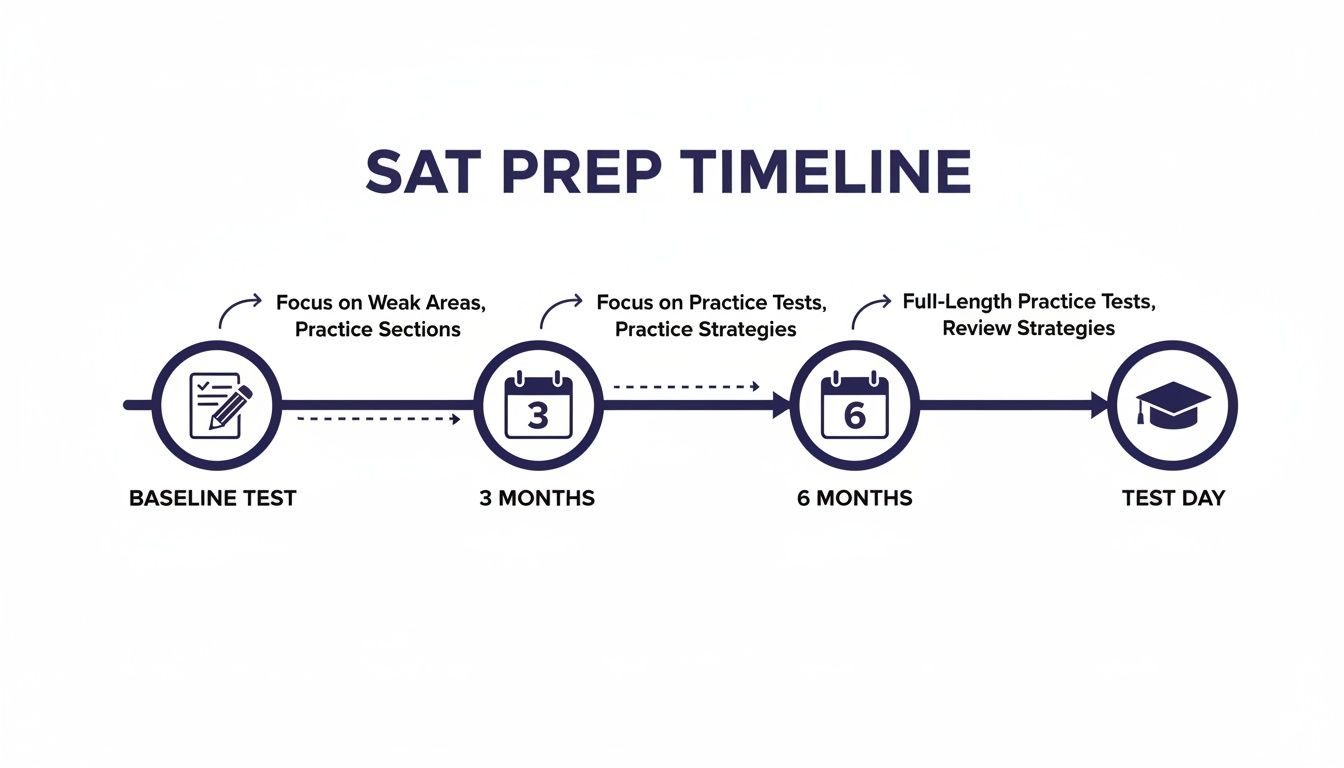
As you can see, a solid prep plan always starts with a baseline test. From there, understanding the content and structure we've just covered is the next critical step in building a focused, effective study schedule. By tailoring your practice to match what you'll actually face on test day, you make every single study session count.
Effective Test Taking Strategies and Practice
Knowing the SAT content is just the foundation. The real game-changer is your test-day strategy—that’s what turns knowledge into points.
How you manage the clock, tackle tricky questions, and actually learn from your mistakes can completely reshape your final score. This is where we shift from just reviewing material to mastering the art of the test itself.
A good strategy starts with understanding the rhythm of the digital format. With shorter passages and an adaptive structure, every single minute counts. The goal is to move through the test with precision and confidence, never letting one tough question throw off an entire section.
Smart Strategies for Test Day
Effective test-taking isn't just a natural talent; it’s a skill you build through practice. It’s about developing sharp instincts that help you make the best call when you’re under pressure. On the Digital SAT, this means having a solid plan for every type of question you'll face.
One of the most powerful tools you have is the process of elimination. Instead of hunting for the one correct answer, flip your thinking: focus on finding and getting rid of the three incorrect ones. More often than not, wrong answers have obvious flaws—they might be too extreme, totally irrelevant to the passage, or just logically inconsistent.
Another key is to make smart, educated guesses. There's no penalty for guessing on the SAT, so leaving a question blank is like throwing away a free opportunity. Even if you can only eliminate one or two choices, you've dramatically increased your odds of getting it right.
Turning Practice Tests into Score Gains
Practice tests aren't just for checking your progress; they're your single most valuable learning tool. But here's the thing: just taking a test and looking at the score is a waste of time. The real growth happens in what you do after the clock stops.
To make those practice sessions count and truly boost your score, you have to learn how to actively improve focus while studying. Deep, focused review is where the magic happens. This means simulating the real test conditions as closely as you possibly can.
Timed Conditions: Always, always time yourself using the official section limits. This is non-negotiable for building pacing and stamina.
Quiet Environment: Find a space where you won’t be disturbed. You need to get used to the silence of a real test center.
Official Materials: Stick to the College Board's Bluebook™ app for practice. This ensures the format and question style are 100% authentic.
The Power of a Mistake Journal
Here's a technique that truly separates the top-scorers from everyone else: the mistake journal. It’s a dedicated notebook or document where you break down every single question you got wrong or felt unsure about on a practice test.
It sounds simple, but the impact is massive. A mistake journal forces you to stop making the same errors on repeat. For each question you miss, you should log:
Question Details: Note the test, section, and question number.
The Mistake: Why did you get it wrong? Was it a simple careless error? Did you not know the concept? Did you misread the question?
The Correct Answer: Explain—in your own words—why the right answer is correct.
Future Strategy: What will you do differently the next time you see a question like this?
Your mistake journal is your personal roadmap to a higher score. It turns every error into a learning opportunity, ensuring you practice smarter, not just harder.
By keeping this log, you'll start seeing patterns you never would have noticed otherwise. Maybe you consistently rush geometry problems, or perhaps you always misinterpret questions with double negatives. Once you spot those patterns, you can target them with focused practice, turning your biggest weaknesses into strengths long before test day.
Managing Test Anxiety and Staying Motivated
Let’s be honest. You can have the perfect study plan, memorize every formula, and know all the grammar rules, but if anxiety takes the wheel on test day, none of it matters. How to prepare for the SAT test is as much about mental endurance as it is about academic knowledge.
Think of it this way: you’re training your brain not just to solve problems, but to stay calm, focused, and resilient when the pressure is on. Anxiety is a totally normal response to a high-stakes test. The goal isn't to eliminate it, but to build a toolkit that keeps it from running the show.

Practical Techniques to Calm Your Nerves
When your heart starts pounding and your thoughts start to spiral, you need simple, go-to tools to ground yourself. These aren't just for test day; practicing them during study sessions makes them second nature.
One of the most effective techniques is box breathing. It’s a game-changer for regulating your nervous system, and you can do it anywhere, anytime.
Inhale slowly through your nose for a count of four.
Hold your breath for a count of four.
Exhale slowly through your mouth for a count of four.
Hold the exhale for a count of four.
Just a few rounds of this can slow your heart rate and pull your focus back to the present moment, quieting those anxious thoughts. Even taking 60 seconds to do a quick mindfulness check—what do you see, hear, feel?—can have a similar calming effect.
Building this mental toolkit is like creating a first-aid kit for stress. You practice these skills when you're calm so they're ready to go the moment you feel overwhelmed.
Fueling Your Brain and Body for Success
Your mental stamina is directly connected to your physical health. Getting enough sleep, eating well, and moving your body aren't optional extras; they are non-negotiable parts of a smart SAT prep plan.
Sleep: Seriously. Aim for 7-9 hours a night. A tired brain can't consolidate memory or solve complex problems effectively.
Nutrition: Keep your energy stable with balanced meals. Loading up on sugar and caffeine will only lead to a crash. Think protein, healthy fats, and complex carbs for sustained fuel.
Exercise: You don't need to run a marathon. A simple 20-minute walk can boost blood flow to the brain, improve your mood, and work wonders for stress.
Treat these habits as part of your study routine. They build a strong foundation that makes you far less vulnerable to the draining effects of anxiety. For a deeper dive, check out our guide on how to reduce test anxiety.
Staying Motivated for the Long Haul
Let's face it: motivation is going to come and go over a multi-month prep schedule. That's totally normal. The key is to build systems that carry you through the days when you just don't feel like studying.
First, break down huge goals. "Study for the SAT" is overwhelming. "Complete 10 practice problems for quadratic equations" is manageable. These small, daily wins build momentum and make the process feel less like a mountain to climb. For more strategies on this, resources on managing academic anxiety can be incredibly helpful.
Finally, reward yourself! Did you stick to your study goals for the week? Take a guilt-free night off to see a movie or just relax. Building in planned breaks prevents burnout and gives you something to look forward to, making the whole journey feel a lot more sustainable.
What If It’s Not About Knowing More Math?
Self-study can get you pretty far. But for some students, there comes a point where the score just won't budge, no matter how many practice tests they take. That's usually a sign that the real obstacle isn't a content gap—it's something deeper.
This is where a different kind of support changes everything. It’s about moving beyond just drilling formulas and vocabulary to address the root causes of academic stress and performance plateaus.
At Bright Heart Learning, our entire philosophy is built on one core idea: Connection Before Content. We’ve seen time and again that real, lasting academic growth only happens when a student feels safe, understood, and supported. For many, the true barriers to a top SAT score aren't about knowledge; they’re about test anxiety, focus, and executive function.
Going Beyond Standard Tutoring
A generic tutoring approach often misses the mark because it only treats the symptom. A student might be bombing the math section not because they can't learn it, but because a history of bad experiences in math class has built a wall of anxiety around the subject. Another might run out of time on the reading section because their executive functions make it hard to pace themselves, not because they’re a slow reader.
This is exactly why we combine deep subject-matter expertise with a genuine understanding of the whole learning process. Our support includes:
One-on-One SAT Tutoring: Laser-focused instruction that targets your specific content weaknesses and strategy needs.
Executive Function Coaching: Practical, real-world support to build essential skills in time management, organization, and sustained focus.
Our goal is to quickly move from asking "why" a student is stuck to figuring out "now what" we can do about it. This action-oriented approach tackles the real problem, building skills that serve them long after the SAT is over.
Here’s What This Looks Like in Real Life
We worked with a student who knew all the math concepts cold but consistently scored low on his timed practice sections. As soon as the clock started, he'd freeze up and make careless mistakes. A standard tutor would have just assigned more math drills, likely making the problem worse.
Our approach was different. We paired him with a coach who started with nervous-system-aware calming techniques to get his test anxiety under control. From there, they built a step-by-step strategy for timed sections, beginning with untimed practice to build confidence and slowly dialing up the pressure.
The result? His confidence soared, the anxiety faded, and his score jumped 120 points. We didn't just teach him more math; we removed the barrier that was preventing him from showing what he already knew.
This integrated method is at the heart of everything we do. If you feel like you've hit a wall and need a more supportive, effective way to prepare, our team is here.
Explore our specialized one-on-one SAT tutoring services to see how we can build a plan that works for you. We offer virtual coaching to families everywhere and in-person support at our office located at 20270 Front St NE, Poulsbo, WA 98370.
Questions We Hear All the Time About SAT Prep
When you're staring down the SAT, it's natural to have a ton of questions. We get it. Here are some of the most common ones we hear from families, along with our straightforward, experience-based answers.
How Many Hours a Week Should I Study for the SAT?
We typically recommend starting with 5–10 hours per week for a solid 3–6 month plan. But let's be real—the number of hours isn't the whole story.
Consistency beats cramming, every single time. It's far better to have focused, high-quality study sessions where you're actively digging into your mistakes and targeting weak spots than it is to just put in mindless hours. If you're chasing a major score jump, you'll likely need to lean into the higher end of that range.
Should I Retake the SAT if I’m Unhappy with My Score?
Absolutely. Most students take the SAT two or even three times, and there's a good reason for it. Retaking the test is almost always a good idea, especially if you have a clear game plan for tackling the sections that gave you trouble the first time around.
Since most colleges will "superscore" (meaning they take your best section scores from all attempts), there’s very little risk. The key is to be intentional. Don't just sign up and hope for the best—use that first score to build a smarter, more targeted prep plan for round two.
Think of your first score as pure data. It's not a judgment—it's a roadmap. Use it to find exactly where you need to focus, turning that initial result into a powerful launchpad for improvement.
What’s the Best Way to Use Official SAT Practice Tests?
Those official practice tests in the College Board's Bluebook™ app are pure gold. They are, without a doubt, your single best resource.
Use your very first one as a diagnostic. It’ll give you a baseline score and a crystal-clear picture of your strengths and weaknesses right out of the gate.
After that, plan to take a full, timed practice test every 4–6 weeks. This helps you build stamina and track your progress under real test-day conditions. But the most important part happens after the test is over: you must review every single question. Yes, even the ones you got right. Your goal is to deeply understand the logic behind the correct answers so you can replicate that success when it counts.
How Do I Apply for Accommodations on the SAT?
If you have a documented disability and already get accommodations at school (like extended time), you can and should apply for them on the SAT.
The process kicks off through the College Board’s Services for Students with Disabilities (SSD) portal. Your school counselor will be a key player in helping you get this submitted. Heads up: this isn't a last-minute thing. You need to apply months in advance, as the approval process can take a while. Don't wait!
If you’ve hit a wall with self-study or feel like test anxiety is calling the shots, a more personalized approach can make all the difference. At Bright Heart Learning, we focus on building confidence right alongside the skills. It's about more than just the score; it's about helping you feel capable and in control.
Visit us at brightheartlearning.com to see how our one-on-one SAT tutoring and executive function coaching can help.