

Topic Vs Main Idea A Guide for Confident Reading
It’s one of the most fundamental skills in reading, yet it trips up students all the time: what’s the real difference between a topic and a main idea?
Getting this right is a game-changer. Without it, kids skim the surface of a text, missing the author’s actual point. Let’s clear this up once and for all.
Topic Vs Main Idea The Core Difference
The simplest way I explain it to students is this: the topic is the ‘what’ of a text, while the main idea is the ‘so what’. Think of the topic as a movie’s title and the main idea as its one-sentence plot summary.
A topic is broad and general. It’s the signpost telling you what you’re about to read. It’s usually just a word or a short phrase, like “solar system” or “courage.”
But the main idea is a complete thought. It’s the specific point the author is trying to make about that topic, and it’s always a full sentence.
For example, if the topic is “solar system,” a possible main idea could be, “Technological advancements have allowed scientists to discover new planets and moons within our solar system.” This is the cornerstone of true comprehension and a key part of the importance of reading for academic success.
This quick visual breaks it down perfectly.
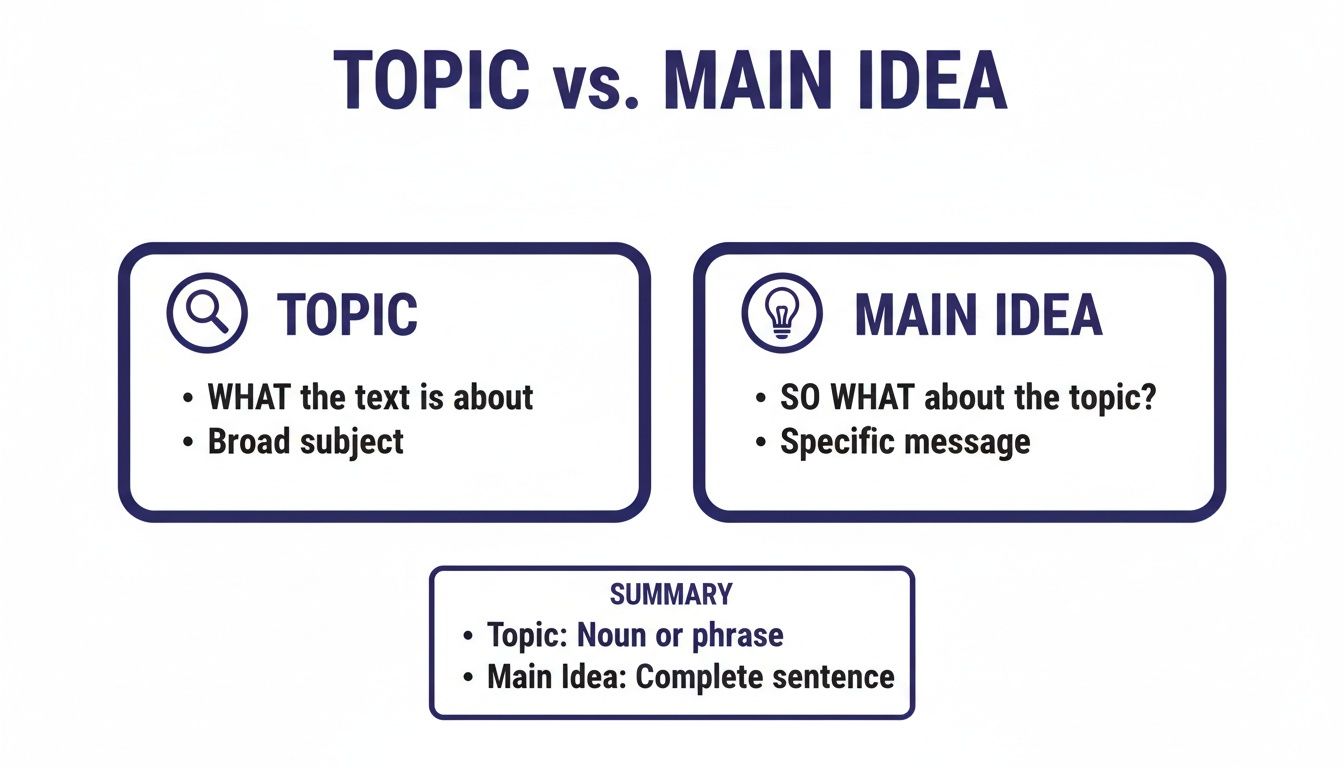
The image reinforces that finding the topic is about spotting the subject, while finding the main idea is about understanding the author’s core message.
Topic Vs Main Idea At a Glance
To make this crystal clear, let’s put them side-by-side. This table is a handy reference for quickly telling the two apart.
| Attribute | Topic | Main Idea |
|---|---|---|
| Definition | The general subject of a text. | The most important point the author is making about the topic. |
| Format | A word or short phrase. | A complete sentence. |
| Function | Answers: “What is this about?” | Answers: “What is the author’s main point about the topic?” |
| Scope | Broad and general. | Specific to the text’s argument or narrative. |
| How to Find It | Look for repeated words, headings, and titles. | Look for a thesis statement or summarize the key details. |
Seeing the attributes lined up like this really highlights the key differences. The topic is the starting point, but the main idea is the destination.
How to Pinpoint the Topic in Any Text
Figuring out the topic is the very first step to making sense of anything you read. I like to tell my students to think of it as finding the “label” on a file folder. Before you can understand the documents inside, you need to know what they’re all about.
The topic is just that: the one- or two-word subject that the entire piece of writing centers on. Nailing this skill lays the groundwork for everything else, especially for the trickier task of finding the main idea.
The goal is to make finding the topic feel automatic, almost like a reflex. When kids have a clear, repeatable method, it cuts down on the frustration and guesswork that can make reading feel like a chore. We want to free up their mental energy for the deeper thinking that comes next.
A Simple Three-Step Process
I use a straightforward, three-step approach to take the mystery out of topic identification. It helps students stop guessing and start using actual evidence from the text.
- Do a Quick Scan: Before diving in, just glance over the text. Look at the title, any headings, and words in bold. These are clues the author left to signal the subject.
- Hunt for Repeats: As you start reading, keep an eye out for words or short phrases that pop up again and again. More often than not, the noun you see the most is your topic.
- Ask the Big Question: After a quick read-through, ask yourself one simple question: “Who or what is this whole thing about?” The answer is almost always the topic.
Let’s try it. Imagine a science paragraph that keeps mentioning “photosynthesis,” “sunlight,” and “plants.” The topic is clearly photosynthesis. It’s the big subject that all the other details are there to explain.
A common mistake I see is when a student picks a small detail instead of the main subject. In a passage about the American Revolution, for instance, a student might say the topic is “the Boston Tea Party.” While that’s part of the story, the much bigger subject—the real topic—is the American Revolution.
Making the Method Stick
This process isn’t just for English class; it works for everything from science textbooks to history articles. If a student is reading about ancient Egypt and the text is full of words like “pyramids,” “pharaohs,” and “the Nile River,” they can confidently name Ancient Egypt as the topic.
This kind of foundational skill is more critical now than ever. With the growing demand for personalized learning, parents are increasingly looking for ways to support their kids at home. In fact, the private tutoring market is expected to jump from USD 70.4 billion in 2025 to a massive USD 171.3 billion by 2035, growing at a 9.3% rate each year.
This trend highlights a major shift: a global understanding that kids, especially those with focus or executive function challenges, need targeted support. You can discover more insights about the private tutoring market’s growth and what it signals for education. By focusing on fundamental skills like identifying the topic, we give our students the tools they need to build lasting confidence and success.
Uncovering the Main Idea for Deeper Meaning
Once you’ve got a handle on the topic, you’re ready to go one level deeper. This is where you find the author’s real message. If the topic is the “what,” then the main idea is the “so what?”—it’s the single most important point the author is trying to make about that topic.
A topic is just a word or phrase, but a main idea is always a complete sentence. It sums up the central argument or the key piece of information the author wants you to walk away with. Think of it as the headline for that paragraph or passage.
Finding Stated vs. Inferred Main Ideas
Main ideas show up in one of two ways: they’re either stated or inferred. A stated main idea is right there on the page. You can literally point to it. You’ll often find this key sentence at the very beginning of a paragraph, setting the stage, or at the very end, wrapping everything up.
But sometimes, authors are a little more subtle. They don’t spell it out for you. This is an inferred main idea. In these cases, all the sentences in the paragraph are like puzzle pieces. It’s your job to look at all the details and ask, “What’s the one big message that ties all of this together?”
Let’s jump back to our examples to see how this plays out.
Example 1: The American Revolution
- Topic: The American Revolution
- Main Idea: Colonial frustration over British taxation and a lack of political representation were the primary drivers of the American Revolution.
See the difference? The topic is just a label. The main idea is a full, specific sentence that makes an actual point about that label.
Example 2: Ancient Egypt
- Topic: Ancient Egypt
- Main Idea: The Nile River was the lifeblood of Ancient Egyptian civilization, shaping its farming, transportation, and culture.
Key Takeaway: The main idea gives the topic its purpose. It’s the reason the author is writing in the first place—it’s the specific angle or argument they want you to think about.
Getting good at this isn’t just about acing a test; it’s about becoming a sharper, more active reader. When you can pull the main point out from all the supporting details, you unlock a much deeper level of understanding. Honestly, learning how to improve reading comprehension really hinges on this skill. The ability to synthesize information is a critical executive function skill that builds a student’s power to analyze, summarize, and actually learn from what they read.
Actionable Strategies to Find the Main Idea
Figuring out the main idea can feel like a detective game. But with the right tools, any student can become a master sleuth. These strategies create a clear, repeatable process for uncovering the central point in any text, from a short story to a science chapter.
They’re designed to be simple, effective, and easy to practice during those homework sessions.
One of the most powerful techniques is the ‘Summarize in a Sentence’ method. After reading a paragraph, just cover the text and try to state its most important point in a single sentence—using your own words. If you can do it confidently, you’ve almost certainly found the main idea. This simple action tests true comprehension, not just recognizing words on a page.
Another great strategy is to look for clues the author leaves behind. Think of them as signposts pointing you right where you need to go.
Hunt for Author Clues and Signal Words
Authors often use specific text features and phrases to guide readers. Teaching students to spot these clues can make finding the main idea much faster and more accurate.
Here are some of the most common places to look:
- Titles and Subheadings: These are often the most direct summary of the content that follows. They act like a label for the main point.
- First and Last Sentences: Many authors state their main idea directly in the topic sentence (often the first) or the concluding sentence of a paragraph. Always check these spots first.
- Signal Words and Phrases: Keep an eye out for phrases like “the key point is,” “most importantly,” or “in conclusion.” These are explicit signals that the main idea is coming.
By turning reading into an active search for these clues, students engage more deeply with the material. It transforms them from passive readers into active thinkers.
Expert Tip: Encourage students to ask questions as they read. By continually asking “What is the author trying to prove here?” or “What is the biggest takeaway?” they stay focused on the central message. Learning how to ask better questions is a skill that strengthens every part of learning.
Put It All Together with Practice
Mastery comes from consistent practice. These strategies aren’t just abstract concepts; they are practical tools for everyday learning. The more students use them, the more automatic the process becomes.
To further hone this ability, explore additional strategies that can improve your reading comprehension skills.
The demand for effective learning support isn’t just a hunch; it reflects a much broader trend. The private tutoring market in the US is projected to grow by USD 28.85 billion between 2025 and 2029, a surge driven by a strong focus on core academic skills.
This growth highlights just how much parents value targeted instruction that builds foundational abilities like identifying the main idea—especially for kids who face challenges with attention or executive function. Developing these strong reading skills gives students a huge advantage throughout their entire academic journey.
Adapting Strategies for Students with ADHD and Anxiety
For a student with ADHD or anxiety, telling the difference between a topic and a main idea isn’t just a simple reading task—it’s a massive executive function challenge. Their working memory might struggle to hold onto all the details in a paragraph while simultaneously trying to connect them into one cohesive point. The whole process can feel completely overwhelming before they even start.
For kids with anxiety, the pressure to find the one “right” answer can be paralyzing. The fear of being wrong often leads them to either avoid the text altogether or just take a wild guess. This keeps them from engaging deeply enough to actually understand what the author is trying to say, and the line between the broad topic and the specific main idea gets incredibly blurry.
Create Visual and Tangible Supports
When a student’s nervous system is on high alert, the best way forward is with strategies that reduce the cognitive load and build confidence. Instead of just telling them to find the main idea, we need to give them concrete, multi-sensory tools that make an abstract concept feel manageable.
One of the simplest and most powerful tools is using two different colored highlighters. Just assign one color for the topic (words or phrases you see over and over) and another for the main idea (the one sentence that seems to hold the most weight). This creates a visual map right on the page, helping students see the connection without having to rely entirely on their working memory.
Key Insight: The goal here is to make their thinking visible. When a student can physically interact with the text—through color-coding, sorting sticky notes, or drawing a web—it offloads some of the mental heavy lifting. This frees up their brain to focus on real comprehension instead of just trying to remember the instructions.
Other practical supports include:
- Chunking Texts: Break down longer articles into single paragraphs or even a few sentences at a time. Tackling one small piece feels so much more doable than facing a wall of text.
- Graphic Organizers: Use a simple main idea web. A circle in the middle for the main idea with lines branching out to supporting details gives their brain a clear structure to follow.
- High-Interest Topics: Start with articles about their favorite video games, a cool animal, or a hobby they love. When a student is genuinely interested, they’re far more likely to push through the tricky parts.
Foster a Growth Mindset and Celebrate Process
It’s absolutely critical to shift the focus from getting the perfect answer to celebrating the process. Praise the effort they put into highlighting, asking questions, and organizing their thoughts, no matter what the initial outcome is. This simple shift lowers the stakes and makes it safe to take risks, which is where real learning happens. Our guide on what executive function support looks like offers more ways to build these foundational skills with patience and connection.
This need for individualized, nervous-system-aware strategies is being recognized more and more. The online tutoring industry, valued at USD 25.04 billion in 2025, is expected to explode to USD 114.62 billion by 2032. This growth isn’t just about convenience; it’s driven by the demand for tailored approaches that reduce overwhelm for learners with ADHD and anxiety. As you can learn more about the online tutoring forecast, it’s clear that using interactive tools to support memory and boost engagement is the future of helping every student succeed.
Common Questions About Topic and Main Idea
Even after the “aha!” moment, some tricky questions tend to pop up. These are the real-world, “what-if” scenarios that come up during homework or test prep. Working through them is how you really cement the skill.
Think of this section as your quick-reference guide for those common points of confusion. I’ve broken down the answers to be clear, practical takeaways that reinforce everything we’ve covered.
Can a Book’s Title Be the Main Idea?
Almost never. A book’s title is pretty much always the topic. Think of a book called The American Revolution. That’s the subject, plain and simple. The title is like a big, bold label on a file folder.
The main idea, on the other hand, is the author’s complete argument or message about that topic. You’ll find it inside the book, usually in the introduction or conclusion, stated as a full thought: “The American Revolution was primarily caused by economic pressures and a growing desire for self-governance.” The title gets you to the right folder; the main idea summarizes the critical documents inside.
How Can I Help My Child Find the Supporting Details?
This is a huge one. Kids often mix up supporting details with the main idea itself. A supporting detail is just one piece of the puzzle—a single fact or example. The main idea is the big picture that all those puzzle pieces create.
The best tool for this? A simple graphic organizer. Seriously.
- Grab a piece of paper and draw one big box at the top. Label it “Main Idea.”
- Underneath, draw a few smaller boxes and label them “Supporting Details.”
- After reading a paragraph, help your child pull out individual facts and place them in the detail boxes.
- Then, ask the magic question: “What is the one big idea that all these details are trying to prove?”
This hands-on method makes the relationship visual and concrete. It shows how smaller facts work together to build a larger argument.
For visual learners or any student who gets tangled up in abstract concepts, this is a game-changer. It turns a complex thinking task into a simple sorting activity, which immediately lowers the stress and clarifies the structure of the text.
Is the Main Idea Always the First Sentence?
Nope. While it’s often in the first sentence of a paragraph (that’s called a topic sentence), it’s not a hard-and-fast rule. Good writers like to mix things up to keep their readers engaged.
An author might build up to the main idea and place it in the middle, or save it for the very end to create a powerful, lasting impression. In more advanced texts, you’ll even find an implied main idea, where it isn’t stated in a single sentence at all. You have to infer it. That’s why it’s so important to teach students to read the entire paragraph first, then ask, “What’s the single most important message here?” instead of just hunting for the “right” sentence.
How Does This Skill Help with Test Taking?
Honestly, this is one of the most fundamental skills for standardized tests. Reading comprehension sections are built around it. Test-takers are constantly asked to find the main idea of a passage, usually under the pressure of a ticking clock.
A student who can pinpoint the main idea quickly and accurately can read with purpose. They understand why the author wrote the piece, which helps them correctly answer questions about arguments, tone, and evidence. It’s the key to grasping the core message fast—an essential skill for performing well under pressure.
At Bright Heart Learning, we know that mastering foundational skills like these unlocks a child’s confidence. Our personalized tutoring and executive function coaching are designed to help students move from feeling frustrated to feeling fluent. If you’re ready to watch your child thrive, learn more about our student-centered approach.