

Difference between theme and main idea: Guide for Students and Parents
Think of it this way: the main idea is what a specific story is about, while the theme is the universal lesson it teaches us about life. The main idea is the plot summary; the theme is the timeless message.
Getting this distinction right is a game-changer for reading comprehension.
Why This Difference Matters for Young Readers
Understanding the difference between theme and main idea is so much more than a classroom skill—it’s the key to becoming a strong, critical reader. When this concept clicks, kids can move beyond just retelling a story's plot and start connecting with its deeper meaning.
This shift is everything for building analytical skills and fostering a genuine love for reading. It gives them a clear roadmap for thinking about what they read, which can be a huge relief, especially for kids who get overwhelmed by homework.
Before we dive deeper, here's a quick side-by-side look.
Quick Look: Theme vs. Main Idea at a Glance
This little table can be a great starting point for clarifying the two concepts in your mind.
| Attribute | Main Idea (The What) | Theme (The Why) |
|---|---|---|
| Scope | Specific to one text | Universal; can apply to many texts and life |
| Type | Concrete (plot, characters, setting) | Abstract (love, courage, belonging) |
| Location | Stated or easily inferred from the text | Implied; you have to think about the bigger message |
| Format | A complete sentence summarizing the story | Usually a single word or short phrase (e.g., "friendship") |
Seeing them laid out like this makes it clear: one is about the story itself, and the other is about the world beyond the story.
The Challenge with Standardized Testing
So why do so many kids get tripped up? Part of the problem comes from how we test reading skills.
For over a century, educators have drawn a clear line between what a text is about (the main idea) and the bigger message it sends about life (the theme). Yet many standardized tests blur this distinction.
Questions about "key ideas and details"—which are really just asking for the main idea—can make up a whopping 35–40% of reading questions on state exams. Theme questions? Far less common. This means students get tons of practice summarizing a story but very little practice digging for its universal truth.
This concept map helps visualize the split between the concrete 'what' (main idea) and the abstract 'why' (theme).
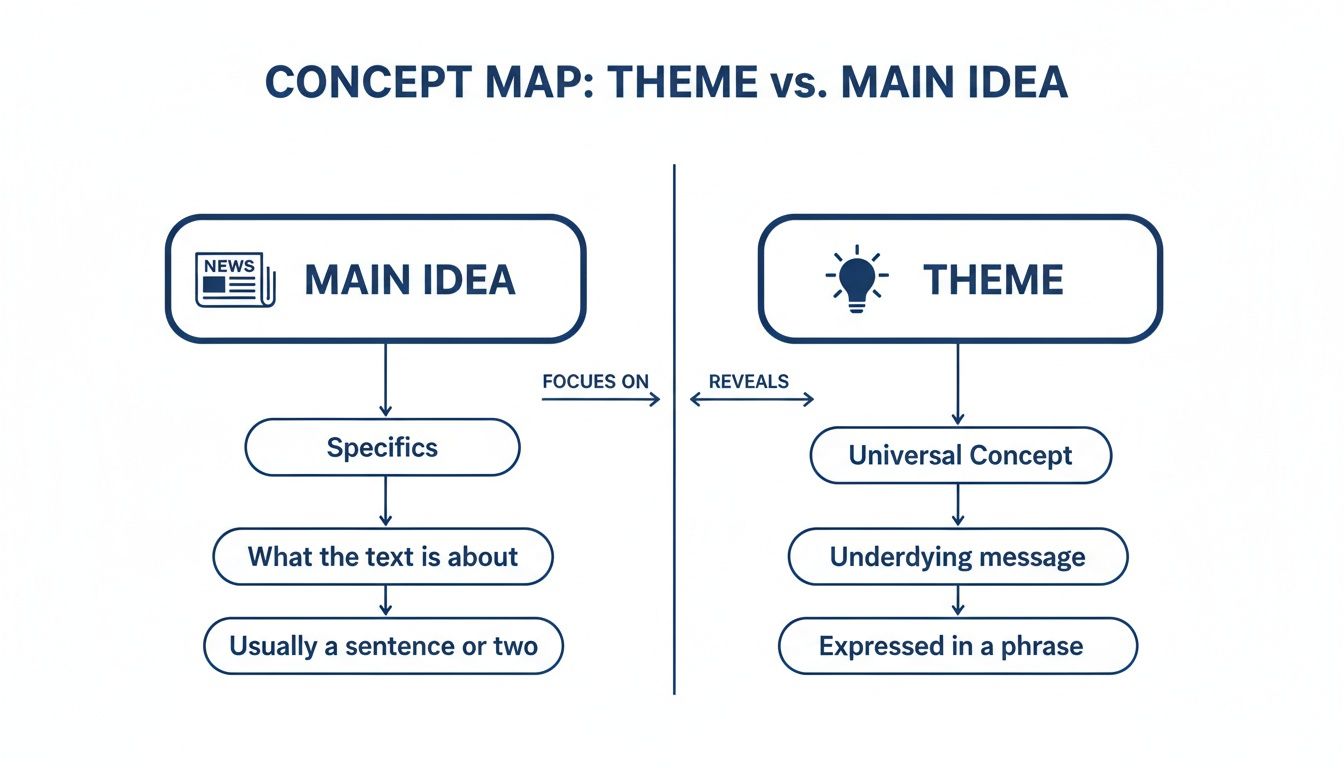
As you can see, the main idea is locked into a single story, while a theme is big enough to show up in tons of different stories—and even in our own lives.
From Frustration to Confidence
Ultimately, helping a child clearly see this difference empowers them to engage more deeply with everything they read. It builds a foundation that supports not just English class, but critical thinking across all subjects.
By mastering this skill, students learn to look for the bigger picture in the world around them. This ability is a cornerstone of the importance of reading and a true asset for life.
How To Pinpoint The Main Idea
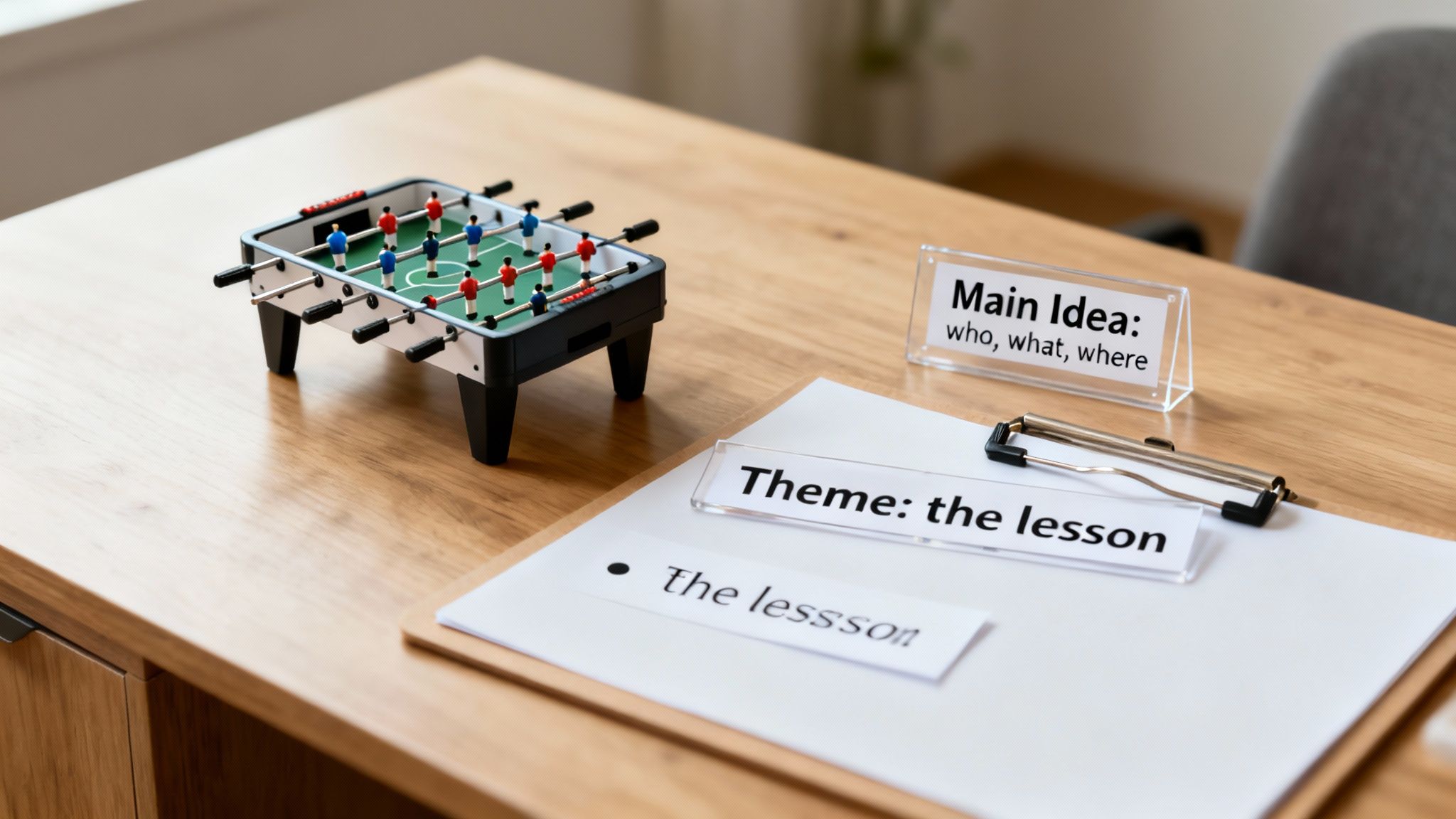
While a theme is that big, universal lesson we talked about, the main idea is much more direct. It's the factual core of the text—what it's literally about. Think of it like a news headline combined with the first sentence of the story. It gets right to the point, answering the classic questions: Who did what, where, and when?
A story's main idea is unique to that story alone. For example, hundreds of books share the theme of "courage," but the main idea of The Three Little Pigs—"Three pigs build houses of different materials to protect themselves from a wolf"—only belongs to that specific fairytale.
Because finding the main idea is such a concrete skill, it's a fantastic place to start building a child's reading confidence. It’s less about interpretation and more about investigation.
Use A Detective’s Toolkit
To find the main idea, we have to teach our kids to be detectives, looking for clues the author leaves behind. This isn't a guessing game; it’s about gathering evidence to solve the case of what the text is mostly about.
And here’s a great tip: you don't need to read every single word at first. Instead, start by scanning for obvious signposts and repeating patterns.
Here are the top clues to look for:
- Titles and Subheadings: These are the author's first attempt to tell you what's going on. They're often the most direct summary you'll find.
- First and Last Sentences: It’s a classic writing strategy for a reason. Authors frequently drop the main point right at the beginning or end of a paragraph.
- Repeated Words or Concepts: If a word, name, or idea keeps popping up, that’s a huge clue. It's almost certainly the central focus.
Key Insight: Finding the main idea is about systematically collecting evidence from the text. The answer is always right there on the page, waiting to be found.
Once you’ve scanned for these clues, you’ll have a pretty good hypothesis. The next step is to test it by reading more closely. Do the other sentences support your idea? If so, you've cracked the case! Understanding what key points are and how to find them is a huge help here, as they're the building blocks of any main idea.
Putting It Into Practice
Let's walk through this process with a quick example. Imagine your child is reading a paragraph about a school bake sale.
Example Text:
"The Lincoln Middle School annual bake sale was a huge success last Saturday. Over 50 students and parents volunteered to bake cookies, brownies, and cakes. The event, held in the school gym, raised over $1,500 for new library books. Principal Miller said she was thrilled with the community turnout and the funds raised."
Okay, let's put on our detective hats and figure out the main idea.
-
Gather the Key Details (The 5 Ws):
- Who? Lincoln Middle School students and parents.
- What? Held a super successful bake sale.
- When? Last Saturday.
- Where? In the school gym.
- Why? To raise money ($1,500) for library books.
-
Combine the Clues into One Sentence:
- Now, we just stitch the most important information together. We don't need the minor details, like what kind of treats they sold. Just the core facts.
-
State the Main Idea:
- "Lincoln Middle School held a successful bake sale last Saturday, raising over $1,500 for new library books."
Boom. That one sentence nails it. It’s specific, it’s factual, and it tells you exactly what that paragraph was about. This process is different from identifying the topic, which is usually just a single word or phrase. For a deeper dive, check out our guide on the difference between topic vs. main idea. Once a student gets this down, nonfiction articles and complex stories become so much easier to understand.
How to Uncover the Theme
If the main idea is a story’s headline, then the theme is its soul. It's the universal lesson the author wants you to carry with you long after you’ve put the book down.
Think of a theme like the quiet wisdom a grandparent might share—it doesn't just apply to the characters in the story, it applies to everyone.
Unlike the main idea, which is usually right there on the surface, the theme is almost always implied. It’s a hidden gem, and finding it means you have to become a bit of a literary detective. You have to hunt for clues in a character's journey, their struggles, and their moments of growth.
The key difference is that a main idea belongs to one story, but a theme is universal. A theme like “courage in the face of fear” can be found in countless books, movies, and even in our own lives.
From Simple Topics to Powerful Themes
This is where a lot of students get stuck. They can correctly identify a simple topic—saying a story is about "friendship" or "family." That's a fantastic start, but it isn't a theme just yet. A topic is just a word; a theme is a complete message about that topic.
Your job is to turn that one-word topic into a full sentence that reveals what the author is trying to say. This is the leap from a simple idea to a powerful, lasting statement.
-
Topic: Friendship
-
Theme: True friendship requires honesty, even when it’s difficult.
-
Topic: Courage
-
Theme: Courage isn't the absence of fear, but acting in spite of it.
Making this shift is where real comprehension happens. You move from what the story is about to why it matters.
Asking the Right Detective Questions
To dig up the theme, you need to ask questions that go beyond just what happened in the plot. These questions help you connect the characters’ experiences to bigger life lessons. A story will almost never have just one theme, especially longer books, but you can usually find one that stands out the most.
Here are the questions to keep in your detective toolkit as you read:
- What major challenges did the main character face?
- What important decisions did they make because of those challenges?
- How did the character change from the beginning of the story to the end?
- What did the character learn about themselves or the world?
Key Takeaway: The theme often reveals itself through the main character's growth or the consequences of their actions. What they learn is what the author wants you to learn.
Answering these questions helps you gather clues about the author's message. Each answer is a puzzle piece, and when you put them together, you start to see the universal truth at the story's heart.
Crafting a Strong Theme Statement
Once you've gathered your clues, it’s time to assemble them into a theme statement. A strong theme statement is a complete sentence that expresses a general truth about life or human nature. Crucially, it should be broad enough to apply to situations outside of the story.
Let's use a classic example: The Tortoise and the Hare.
- Identify the Topic: The story is about a race, so some topics could be "competition," "pride," or "persistence." We'll go with persistence.
- Ask Detective Questions: What did the tortoise learn? He learned that slow, consistent effort can beat natural talent. What did the hare learn? He learned that overconfidence and laziness lead to failure.
- Draft a Theme Statement: Now, combine these lessons into a universal truth. A great theme statement would be: "Slow and steady progress is more effective than inconsistent talent."
See how that statement doesn't mention a tortoise or a hare? It’s a piece of wisdom that applies to doing homework, learning an instrument, or training for a sport. Mastering this skill is what separates a passive reader from a truly active, critical thinker.
Seeing The Difference With Real Examples
Knowing the textbook definitions is one thing, but seeing how theme and main idea play out in actual stories is where it all starts to click. Let's break down a few classic, kid-friendly tales to make the difference between theme and main idea totally clear. When kids can see these concepts side-by-side in stories they already know, it helps build a strong mental map they can use with any new text.
This is a huge step, because so many students get tangled up trying to separate the plot of a story from its deeper message. Classroom experience and literacy research tell us the same thing: students constantly mix up theme and main idea, especially as texts get more complex in upper elementary and middle school.
In one well-known literacy study, teachers reported that while more than half their 4th-6th graders could name a topic (like “friendship”), fewer than 25% could articulate that topic as a complete theme (like “true friendship means telling hard truths”). It's a common hurdle, and you can discover more insights about student comprehension on Newsela.com.
The Tortoise and the Hare
This fable is the perfect place to start because its lesson is so direct. Most kids are already familiar with the story, which frees them up to focus on pulling out the main idea and theme without getting lost in the plot details.
First, let's pin down the main idea. Remember, this is the "who did what" summary of this specific story.
- Who? A slow, steady tortoise and a fast, overconfident hare.
- What happened? They ran a race. The hare got so far ahead that he took a nap, but the tortoise just kept plodding along.
- The result? The tortoise crossed the finish line first and won.
Put it all together, and the main idea is: A slow but steady tortoise wins a race against a fast, arrogant hare who stops to nap. That sentence is a perfect summary, but it only applies to this one story.
Now, let's dig for the theme. What’s the big life lesson here? The story isn't really about animals racing; it’s a commentary on how we approach our goals. The theme is a piece of wisdom that applies to just about anything in life.
A great theme for this story is: Consistency and determination can triumph over unfocused talent.
Key Insight: Notice the theme doesn't mention a tortoise or a hare at all. That's the ultimate test. It's a universal truth that could apply to practicing an instrument, finishing a big project for school, or training for a soccer team.
The Three Little Pigs
Let's try another one. The story of the three pigs and the big bad wolf is a childhood staple, making it fantastic for this kind of analysis.
First up, the main idea.
- Who? Three pig brothers and one very hungry wolf.
- What happened? Each pig built a house using different materials—straw, sticks, and bricks. The wolf came and tried to blow them all down.
- The result? The flimsy houses of straw and sticks were destroyed, but the sturdy brick house kept the pigs safe.
So, the main idea is pretty straightforward: Three pigs build houses of varying quality, and only the pig who built a strong brick house stays safe from the wolf.
Next, what’s the theme? What is the storyteller trying to teach us about work, planning, and safety? The story sets up a clear contrast between taking the easy way out and putting in the effort.
A powerful theme from this fable would be: Thoughtful planning and hard work create more security than taking shortcuts.
Example Breakdown Main Idea vs Theme in Action
Sometimes, just seeing the concepts side-by-side is what makes it all sink in. This table puts our examples together to highlight the difference in a really visual way.
| Text Example | Main Idea (What the text is about) | Theme (The universal life lesson) |
|---|---|---|
| The Tortoise and the Hare | A slow but persistent tortoise wins a race against a fast but lazy hare. | Slow and steady progress wins out over inconsistent talent. |
| The Three Little Pigs | Three pigs build houses of straw, sticks, and bricks, and only the brick house protects them from a wolf. | Hard work and preparation pay off in the long run. |
| Cinderella | A kind girl, mistreated by her stepfamily, gets magical help to attend a ball and marries a prince. | Kindness and perseverance are rewarded in the end. |
The table makes the core difference pop. The main idea column is filled with character names and specific plot points from each story. But the theme column? That's all about broad, universal wisdom that could apply to anyone's life. Focusing on that distinction is the key to helping kids move from just retelling a story to truly understanding it.
Support Strategies for All Kinds of Learners
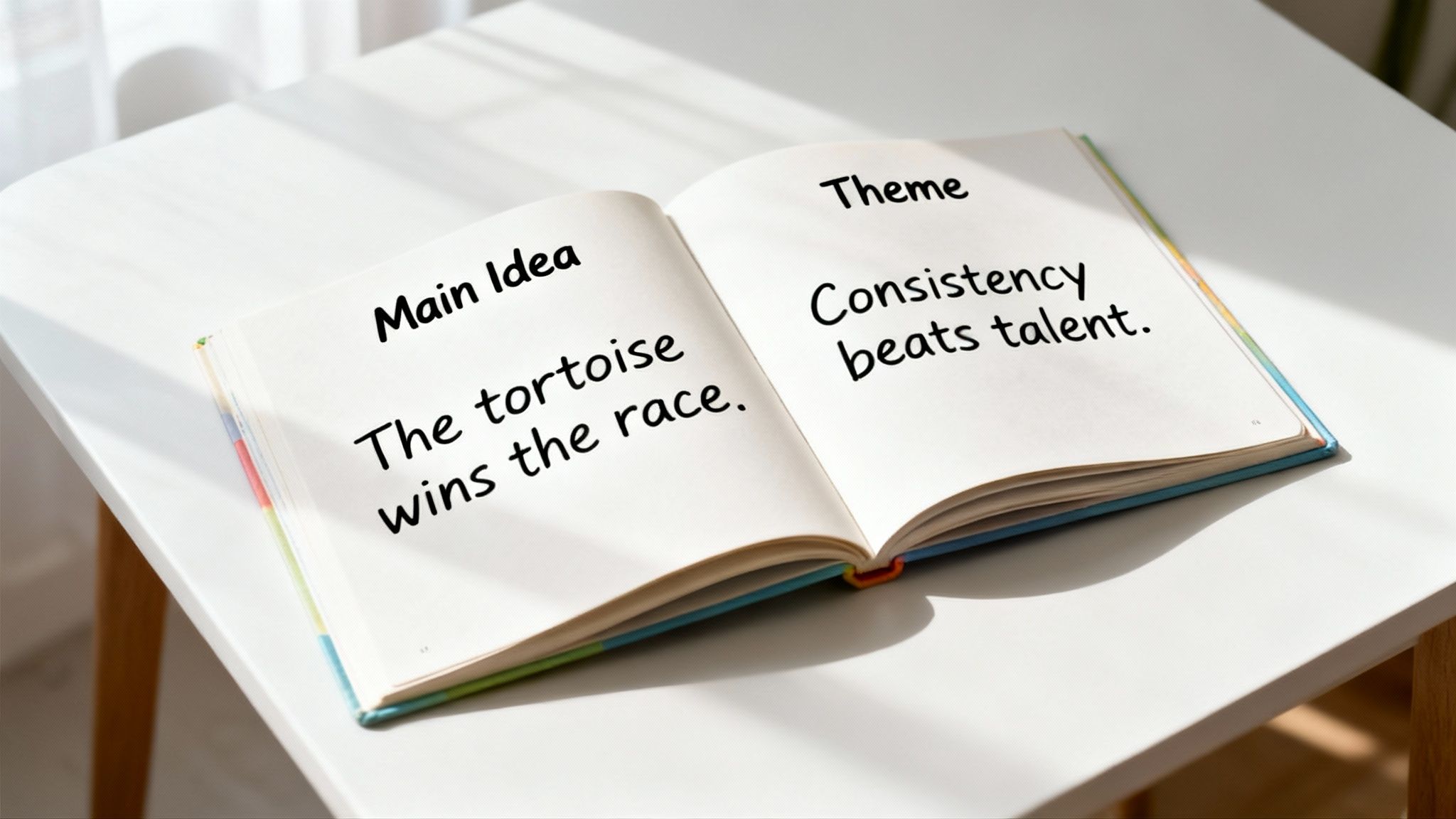
Finding the theme of a story requires a lot of abstract thinking, and that can be a heavy lift for any student. It's especially tough for kids managing anxiety, ADHD, or dyslexia.
When a student’s brain is already working overtime just to decode words and keep track of the plot, there’s very little mental energy left for that kind of deep analysis. This is where frustration kicks in and kids start to shut down.
The key isn’t to push harder, but to offer practical, brain-friendly strategies that lighten this cognitive load. Instead of just asking, "What's the theme?" we can provide scaffolds that make the process feel less like an impossible leap and more like solving a fun puzzle.
Making the Abstract Concrete
One of the biggest hurdles is jumping from a story's concrete events (the main idea) to its abstract lesson (the theme). Reading experts agree that these are two very different mental tasks. Main idea is all about what literally happened. Theme demands that we find patterns and understand the emotional core of the story.
In fact, classroom reports show that when asked to find a theme, up to 60–70% of students with executive function challenges will simply retell the plot or give a one-word topic. This isn't a failure to understand; it's a signal that they need a bridge to get from one type of thinking to the other.
We can help build that bridge with simple, visual tools.
- Graphic Organizers: A simple two-column chart works wonders. On one side, list the main events under a heading like "What Happened?" On the other side, ask, "What big lesson did the character learn?" This visually separates the plot from the message.
- Color-Coding Clues: Hand your student two different colored highlighters. Use one color for key plot points that support the main idea. Use the other color for moments where characters grow, make a tough choice, or have an "aha!" moment—those are your theme clues.
These tools take the thinking process out of their head and put it onto the page, freeing up precious mental bandwidth. For parents and educators looking for more proven methods, these effective strategies for teaching reading comprehension are a great resource.
Scaffolding Language and Thinking
Sometimes, the roadblock isn’t about understanding the concept itself, but finding the right words to talk about it. Providing structured language supports can make all the difference, building confidence and easing the anxiety that comes with staring at a blank page.
Sentence starters are an incredibly powerful tool for this. They act as a launchpad, guiding a student’s thinking toward a complete theme statement instead of just a single topic word.
Pro Tip: Offer sentence frames like, "The author believes that…" or "This story teaches us that…" These simple prompts nudge students to think about the author’s bigger message and frame it as a complete thought.
This small shift turns the task from inventing something from scratch to simply completing a thought—a much more accessible starting point. It helps them practice how to phrase a theme until it starts to feel natural.
Reducing Anxiety and Building Momentum
For kids with anxiety, the fear of getting the answer wrong can be paralyzing. It's so important to create low-stakes opportunities for practice where we celebrate the effort, not just the "right" answer.
Here are a few ways to lower the pressure:
- Start with Familiar Stories: Use their favorite movies, TV shows, or fairy tales. Since they already know the plot inside and out, their brain is free to focus completely on digging for the theme.
- Offer Choices: Instead of asking them to come up with a theme from thin air, give them three options. Ask them to pick the one that fits best and explain why. This builds analytical skills without the pressure of creation.
- Focus on the Effort: Praise the process. Say things like, "I love how you found that clue!" or "That's a really interesting thought." This reinforces that the thinking itself is what matters most.
By providing these supports, we can help all learners navigate the difference between theme and main idea with way more confidence. When a child feels truly stuck, expert guidance can be life-changing; personalized support through https://brightheartlearning.com/reading-tutoring-services-near-me-the-life-changing-the-course-of-a-childs-life/ can make all the difference. These strategies empower students to move from frustration to feeling successful.
Simple Activities to Practice at Home
The best way to really get the hang of the difference between theme and main idea is through regular, no-pressure practice. When you can turn everyday moments into little learning opportunities, the skills just seem to stick better.
These simple activities are designed to feel more like a game than a chore, so you can reinforce these concepts at home without anyone getting stressed out.
Movie Night Breakdown
Your next family movie night is the perfect, low-key setting for a bit of practice. Your child already knows the story, so their brain can focus on thinking a little deeper instead of just trying to keep up with the plot.
Once the credits are rolling, you can casually start a conversation.
- For the Main Idea: Ask, "If you had to tell a friend what that movie was about in just one sentence, what would you say?" This gets them right to the heart of summarizing the plot.
- For the Theme: Then you can follow up with, "So, what do you think the filmmakers wanted us to learn about life from that story?" This nudges them toward that bigger, universal lesson.
Key Insight: This works so well because it’s fun and familiar. Talking about the main idea and theme of Frozen or The Super Mario Bros. Movie is way more engaging than dissecting a dense chapter in a book.
Headline Challenge
This is a fantastic, quick-fire activity for sharpening main idea skills, especially for nonfiction. The whole point is to grab the core message from a small piece of information.
Just pull up a kid-friendly news site or grab a magazine. Cover the headline of a short article and read the first paragraph or two out loud.
Then, challenge your child to write their own headline for what you just read. Their headline is basically their main idea statement. Compare it to the real one and chat about what makes a summary short and powerful.
Commercial Detectives
Think about it—commercials are just tiny stories trying to get a message across in 30 seconds. This makes them an absolute goldmine for practicing theme identification in a fun, fast-paced way.
Watch a couple of commercials together and then hit the pause button. Ask two simple questions:
- Main Idea: What is actually happening in this commercial? (e.g., "A family is driving a new car on a road trip.")
- Theme/Message: What feeling or big idea are they trying to sell us? (e.g., "Family adventures bring happiness," or "This car will keep your family safe.")
This exercise does a brilliant job of separating the plot (what's literally happening) from the underlying message (the theme). Because it’s so quick and visual, it’s a great activity for kids who get bogged down by long passages of text. It makes learning feel totally natural.
Questions That Always Come Up
Even with a clear breakdown, a few questions about theme and main idea pop up time and time again. It’s totally normal to need a little extra practice telling them apart. Let’s tackle the most common sticking points I hear from students and parents.
Can a Story Have More Than One Theme?
Yes, absolutely! While a text really only has one main idea, it can have multiple themes, especially in longer works like novels.
For instance, a book could explore themes of both courage and the importance of friendship. Usually, one theme will feel more central than the others, but it’s great practice to look for all the different messages an author might be sending.
Is the Theme Just the Moral of the Story?
This is a great question. A moral is a direct, often spelled-out lesson, like, "Don't count your chickens before they hatch." It tells you exactly what to do or not to do.
A theme is much broader and more open to interpretation. It’s a statement about life or human nature, such as, "Unchecked pride can lead to downfall." While they feel similar, themes explore an idea rather than giving a direct command. Think of it this way: all morals contain a theme, but not all themes are morals.
Key Distinction: A moral often feels like a rule to follow, whereas a theme is an observation about the world that invites you to think more deeply.
What Is the Difference Between Topic and Theme?
This is probably the most frequent point of confusion. Here’s how I explain it: a topic is just a one-word subject. Think "love," "courage," or "honesty." It's the starting point.
A theme is the complete sentence that expresses a specific message about that topic.
- Topic: Love
- Theme: Love requires sacrifice.
So, if a student says the story is about "friendship," they've correctly identified the topic! The next step is to ask them, "What is the author trying to say about friendship?" That's the question that uncovers the theme.
Navigating these concepts takes practice, but you don't have to do it alone. Bright Heart Learning provides personalized tutoring and coaching to help students build confidence and master critical reading skills. Learn how our expert tutors can support your child's journey.